

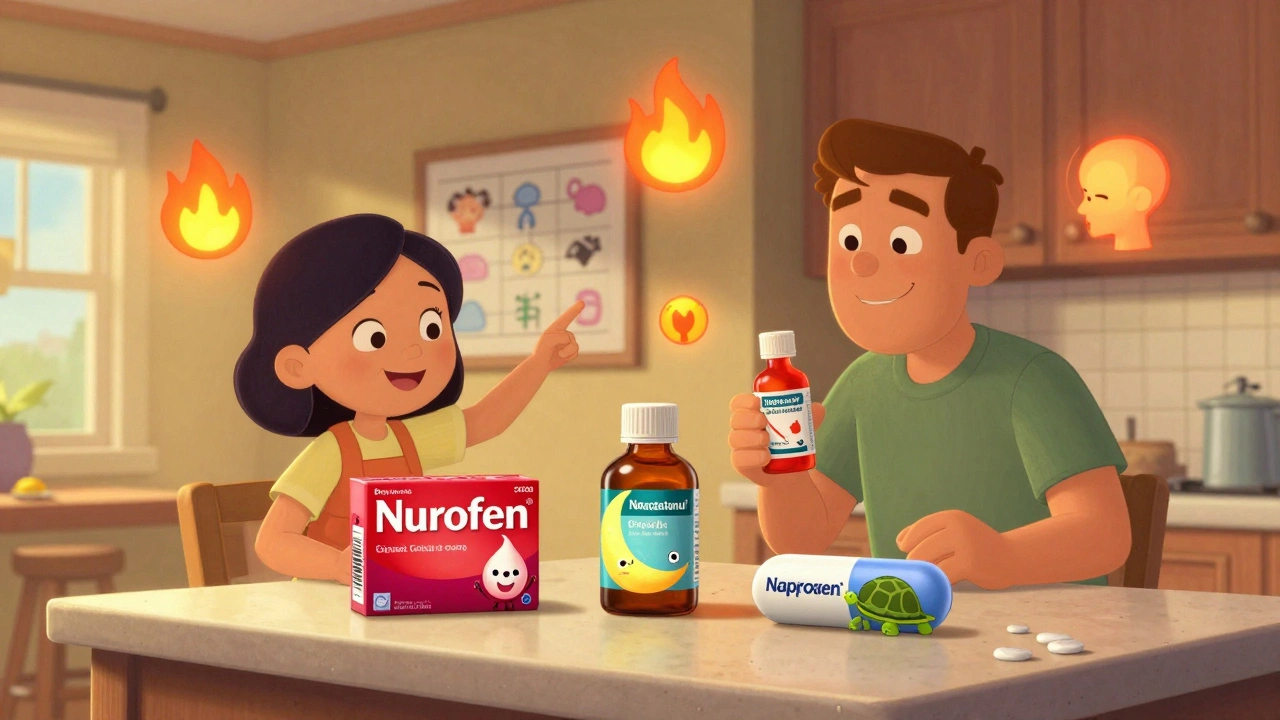
When you’ve got a headache, a sore throat, or a fever that won’t quit, Nurofen is often the first thing you reach for. It’s everywhere - in medicine cabinets, at checkout counters, in first aid kits. But is it always the best choice? And what happens if you can’t find it, or it doesn’t work, or your stomach can’t handle it? You’re not alone in asking these questions. Many people switch between pain relievers without knowing the real differences. Let’s cut through the noise and look at what actually works, what doesn’t, and what you should consider before grabbing the next pack off the shelf.
What is Nurofen, really?
Nurofen is a brand name for ibuprofen, a non-steroidal anti-inflammatory drug (NSAID). It’s not a special formula. It’s the same active ingredient found in generic ibuprofen tablets sold under dozens of other labels. In Australia, you can buy 200mg ibuprofen tablets without a prescription. Nurofen just packages it with extra marketing - different forms like fast-acting gels, caplets, or children’s suspensions - but the core drug hasn’t changed since it was first approved in the 1960s.
The science is clear: ibuprofen reduces pain, inflammation, and fever by blocking enzymes that cause swelling and discomfort. It starts working in about 20 to 30 minutes and lasts 4 to 6 hours. For most people, it’s effective. But not everyone can use it safely.
Paracetamol: The gentler option
If your stomach gets upset with ibuprofen, or you’re on blood thinners, or you have kidney issues, paracetamol (also called acetaminophen) is often the go-to alternative. Brands like Panadol, Dymadon, and Calpol all contain paracetamol. It’s not an NSAID, so it doesn’t reduce inflammation - but it’s just as good at lowering fever and easing mild to moderate pain like headaches, toothaches, or muscle aches.
Here’s the catch: paracetamol is safer for your stomach and doesn’t interfere with blood clotting. But it’s harder on your liver. Taking more than 4,000mg in 24 hours - even if it’s spread across different cold and flu meds - can cause serious liver damage. That’s why so many people end up in hospital after accidentally overdosing. Always check the labels of other medicines you’re taking. Many cold and flu remedies already contain paracetamol.
For kids, paracetamol is often the first recommendation from pediatricians. It’s also the preferred choice during pregnancy, especially in the first and second trimesters. If you’re unsure, stick with paracetamol unless you need the anti-inflammatory effect.
Naproxen: Longer-lasting but stronger
Naproxen is another NSAID, sold under brands like Naprosyn or Aleve. It works similarly to ibuprofen but lasts longer - up to 8 to 12 hours. That means you might only need to take it twice a day instead of three or four. For chronic pain like arthritis or lower back pain, that convenience matters.
But naproxen carries higher risks. Studies show it may increase the chance of heart attack or stroke more than ibuprofen, especially with long-term use. It’s also harder on the stomach. If you’ve ever had ulcers or acid reflux, naproxen could make things worse. In Australia, you can buy 220mg naproxen over the counter, but it’s not recommended for daily use without medical advice.
Think of it this way: if ibuprofen is a sprinter, naproxen is a marathon runner. It lasts longer, but it’s heavier on your system. Use it only if you need sustained relief and have no history of heart or stomach problems.
Aspirin: Not just for heart health
Aspirin is the oldest painkiller on this list. It’s an NSAID like ibuprofen and naproxen, but it has a unique trait: it thins the blood permanently for the life of the platelet. That’s why low-dose aspirin (75-100mg) is prescribed for people at risk of heart attack or stroke.
For pain and fever, aspirin works fine - but it’s not the first choice anymore. It can cause stomach bleeding, especially in older adults. It’s also linked to Reye’s syndrome in children and teenagers recovering from viral infections like flu or chickenpox. That’s why you’ll never see aspirin marketed for kids in Australia.
Use aspirin only if you’ve been advised to by a doctor, or if you’ve used it safely for years and know how your body reacts. For most people, ibuprofen or paracetamol are better, safer options.
Topical options: Creams, gels, and patches
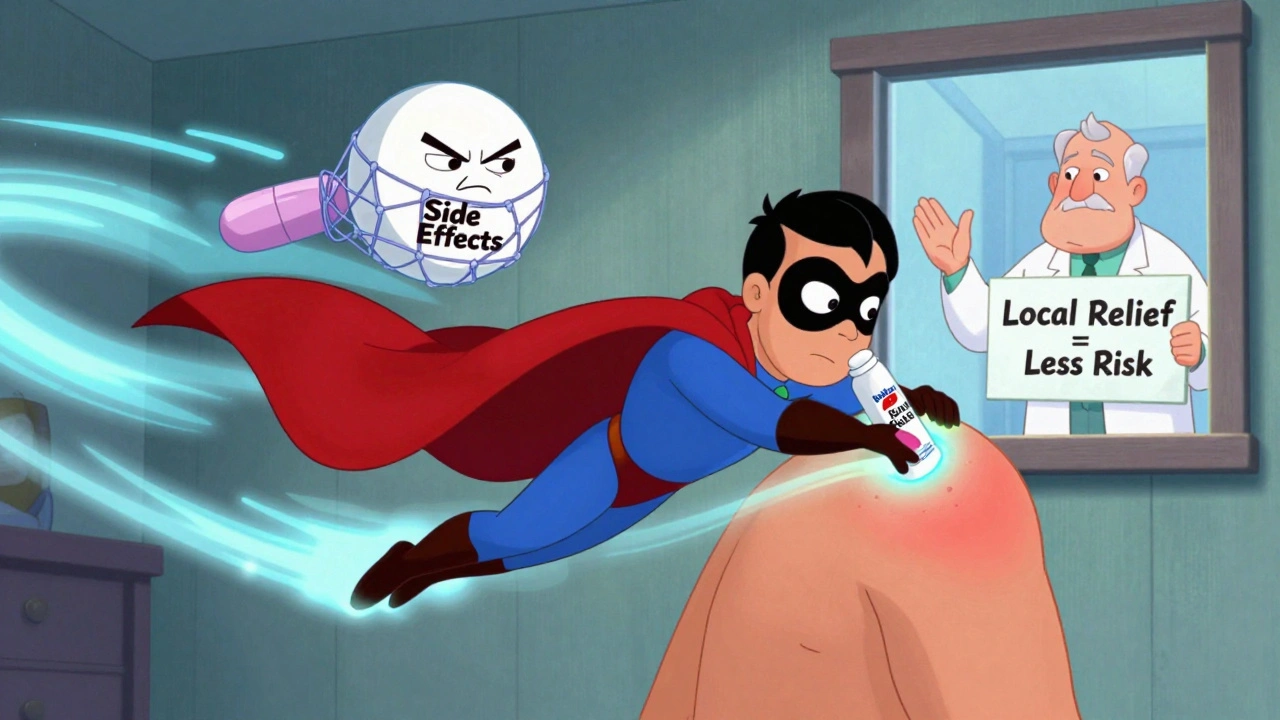
Not all pain needs to be swallowed. If you’ve got sore muscles, a sprained ankle, or joint pain, topical NSAIDs can help without hitting your stomach. Products like Deep Relief Gel or Voltaren Emulgel contain diclofenac or ibuprofen in a gel form. You apply it directly to the skin over the painful area.
Studies show topical NSAIDs work just as well as oral ones for localized pain - and with far fewer side effects. They’re especially useful for older adults who can’t tolerate pills, or people who want to avoid systemic effects. The downside? They don’t help with fever or internal inflammation like a sore throat or menstrual cramps.
Don’t use them on broken skin, and don’t combine them with oral NSAIDs unless your doctor says it’s okay. Too much NSAID in your system - even through the skin - can still cause problems.
When to avoid NSAIDs altogether
Some people should never take ibuprofen, naproxen, or aspirin. These include:
- People with active stomach ulcers or a history of GI bleeding
- Those with severe heart failure or recent heart surgery
- People with kidney disease
- Anyone allergic to NSAIDs or aspirin
- Pregnant women in the third trimester (NSAIDs can affect fetal circulation)
- People taking blood thinners like warfarin or clopidogrel
If any of these apply to you, paracetamol is usually the safest choice. But even paracetamol has limits. Don’t exceed 4,000mg a day. And if you drink alcohol regularly, your liver is already under stress - so stick to the lower end of the dose range.
What about natural alternatives?
You’ve probably seen ads for turmeric, ginger, or CBD oil as "natural pain relievers." Some studies show mild benefits, especially for arthritis. But here’s the truth: they don’t work like medicine. Turmeric contains curcumin, which has anti-inflammatory properties - but you’d need to take grams of it daily to see any effect, and most supplements contain far less. They’re not regulated like drugs, so quality and potency vary wildly.
Don’t replace proven painkillers with supplements unless you’re using them as a complement, not a substitute. If you’re in real pain, waiting for a herbal remedy to kick in could mean more discomfort - or worse, a delay in treating something serious.

Choosing the right one: A simple guide
Here’s how to pick based on your needs:
| Option | Best For | Duration | Key Risks | Safe for Kids? |
|---|---|---|---|---|
| Nurofen (ibuprofen) | Inflammation, fever, muscle pain | 4-6 hours | Stomach upset, kidney strain | Yes (from 3 months) |
| Paracetamol | Fever, headaches, mild pain | 4-6 hours | Liver damage if overdosed | Yes (from birth) |
| Naproxen | Chronic joint pain, longer relief | 8-12 hours | Heart risk, stomach ulcers | No (under 12) |
| Aspirin | Heart protection, occasional pain | 4-6 hours | Bleeding, Reye’s syndrome | No |
| Topical NSAIDs | Sore muscles, localized pain | 6-8 hours | Skin irritation | Yes (check label) |
For most common aches and fevers, start with paracetamol. If it doesn’t help after a few doses, switch to ibuprofen. If you need longer relief and have no health risks, naproxen might be worth trying. Avoid aspirin unless prescribed. And if you’re unsure - ask your pharmacist. They see this every day.
What to do if nothing works
If you’ve tried paracetamol, ibuprofen, and even topical options - and you’re still in pain or running a high fever - don’t keep doubling up. That’s when you need to see a doctor. Persistent pain could signal something deeper: an infection, a joint problem, or even something more serious.
Also, never mix NSAIDs. Taking ibuprofen and naproxen together doesn’t make you feel better - it just doubles your risk of stomach bleeding or kidney damage. And never combine them with alcohol. That’s a recipe for trouble.
Keep a simple pain relief log: what you took, when, and how you felt after. It helps you and your doctor spot patterns. If you’re using painkillers more than 10 days a month, it’s time to talk to a professional.
Is Nurofen better than generic ibuprofen?
No. Nurofen contains the same active ingredient - ibuprofen - as any generic version. The only differences are the brand name, packaging, and sometimes the form (like fast-release gel). You’ll get the same effect for less money with a generic tablet. Save your money unless you need a specific delivery method, like a child’s syrup or a topical gel.
Can I take Nurofen and paracetamol together?
Yes, you can take them together if needed. Many people do this for stubborn fevers or severe pain. Space them out by at least 2-3 hours to avoid overwhelming your liver or stomach. For example, take paracetamol at 8am, ibuprofen at 11am, paracetamol at 2pm, and so on. Always stay within the daily maximum doses for each.
Why does Nurofen sometimes stop working?
If you’ve been using ibuprofen regularly for weeks or months, your body may become less responsive - a phenomenon called tolerance. It’s not addiction, but your pain receptors may need higher doses to respond. The better fix is to rotate pain relief methods or address the root cause. If you’re relying on it daily, talk to a doctor. Chronic pain shouldn’t be managed with pills alone.
Is it safe to give Nurofen to a child with a fever?
Yes, if used correctly. Nurofen for Children is formulated with the right dose of ibuprofen for kids. Always use the measuring syringe that comes with it - never guess with a kitchen spoon. Dose by weight, not age. If your child is under 3 months or weighs less than 5kg, talk to a doctor first. Never give aspirin to children under 16.
What’s the safest painkiller for older adults?
For most older adults, paracetamol is the safest first choice. NSAIDs like ibuprofen increase the risk of stomach bleeding and kidney problems in people over 65. If paracetamol isn’t enough, try a topical NSAID gel first. If that doesn’t help, talk to a doctor before switching to oral NSAIDs. Many seniors take multiple medications - mixing them with NSAIDs can be dangerous.
Final thoughts: Know your body, know your options
Nurofen isn’t magic. It’s just one tool in a bigger box. The best pain relief isn’t about the brand - it’s about matching the right medicine to your body, your symptoms, and your health history. Sometimes, the safest choice isn’t the strongest one. And sometimes, the cheapest option is the smartest.
If you’re unsure, ask your pharmacist. They’re trained to help you choose safely - and they won’t push a brand. They’ll help you find what works, without the hype.




I used to buy Nurofen until I realized generic ibuprofen costs half as much and works the same. Duh.
Now I just grab the store brand and save my cash.
Oh, so now we're just... accepting pharmaceutical marketing?!!
Who decided ibuprofen was 'good enough'? Who authorized the commodification of pain relief?!
And you call this 'science'? Ha!
This is capitalism masquerading as healthcare-selling you the same molecule under a prettier label while your liver screams in the background.
Wake up, sheeple.
They don't want you healthy-they want you compliant.
And now you're thanking them for the price cut?
Pathetic.
Great breakdown! One thing I’d add: many people don’t realize that paracetamol and ibuprofen can be safely alternated-especially for kids or elderly folks who need consistent relief.
Just space them 3 hours apart, track your doses, and you’re golden.
Also, if you’re using topical NSAIDs, make sure you’re not applying them over large areas or for more than a week without checking in with your provider.
It’s easy to think ‘topical = safe,’ but systemic absorption still happens, especially with broken skin or prolonged use.
And yes-pharmacists are your secret weapon. Don’t be shy to ask them! They’re not salespeople; they’re your medication safety net.
Have you ever thought about how many people are being drugged by Big Pharma without even knowing it? 😔
Nurofen isn’t just a brand-it’s a trap.
They put it in every pharmacy, every gas station, every Walmart checkout.
They want you addicted to pills because they know you won’t question it.
And don’t even get me started on how they hide paracetamol in every cold medicine so you overdose without realizing it.
They’re poisoning us slowly, and no one talks about it.
Wake up. 🚨
I’ve been giving my 8-year-old paracetamol for fevers since she was a baby, and it’s worked every time.
I never touch ibuprofen unless she’s got swollen joints or a really bad sprain.
My mom always said: ‘If it doesn’t hurt to move, don’t reach for the NSAIDs.’
Simple, but it’s saved us from a lot of stomach issues.
And yeah-pharmacists are the real MVPs. I always ask them before I buy anything new.
This whole post is just a glorified Walmart ad for generic ibuprofen.
Who even cares? You’re just telling people to buy the cheapest shit on the shelf.
Meanwhile, real pain-chronic pain, autoimmune pain, neuropathic pain-needs more than a 200mg tablet.
You’re reducing human suffering to a grocery list.
Pathetic.
Also, ‘ask your pharmacist’? LOL. They’re paid by the store to upsell.
Don’t be gullible.
Interesting how the article frames paracetamol as ‘safe’-until you realize it’s the #1 cause of acute liver failure in the U.S.
And yet, no one screams about it.
Meanwhile, NSAIDs get demonized for stomach issues, but liver damage? Silent.
There’s a pattern here.
Who benefits from this narrative? Who funds the studies?
And why is there zero mention of the fact that many OTC painkillers are manufactured in China under lax regulations?
Just asking.
Not accusing.
But you should be worried.
generic ibuprofen is cheaper yea but i always get nurofen because it works faster lol
maybe its placebo idk but i feel it better
Have you considered that the entire pharmaceutical industry is a construct designed to maintain control over the population’s perception of bodily autonomy?
The FDA, the WHO, the pharmacists-they are all nodes in a centralized system of medical hegemony.
Nurofen isn’t a drug-it’s a symbol of your submission to institutional authority.
Paracetamol? A quiet poison, engineered to normalize dependency.
And the ‘topical’ options? A distraction-designed to make you believe you have agency while the system quietly reprograms your biology.
They don’t want you healed.
They want you dosed.
And you’re still buying it.
Wake up.
Okay but let’s be real-Nurofen’s gel is *chef’s kiss*.
It smells like a spa and my knee feels like it’s been hugged by an angel.
Meanwhile, generic ibuprofen? Tastes like regret and cardboard.
And don’t even get me started on naproxen-I tried it once, felt like I swallowed a brick wrapped in barbed wire.
So yeah, I’ll take the branded gel, thank you very much.
It’s not about the science.
It’s about the vibes.
And my vibes are… very relieved.
As someone who grew up in Singapore, where paracetamol is the default for fever, I appreciate this guide.
Here, we rarely use ibuprofen unless there’s visible swelling.
And we’re taught from childhood to check labels-every cold medicine, every flu tablet.
It’s a cultural habit, really.
Also, the pharmacist here doesn’t just hand you pills-they ask about your sleep, your stress, your diet.
Maybe that’s the real missing piece: care, not just chemistry.
Why are we even talking about this like it matters
Everyone knows the government controls all meds anyway
So just take whatever they give you
And stop overthinking it
It's not like you have a choice
While the pharmacokinetic profiles of ibuprofen and paracetamol are well-documented, the article fails to contextualize the pharmacodynamic heterogeneity across CYP450 metabolizer phenotypes.
Moreover, the assumption that ‘generic = equivalent’ ignores bioequivalence thresholds and excipient variability.
Additionally, the absence of discussion regarding COX-1/COX-2 isoform selectivity undermines the clinical rationale for NSAID selection.
And yet, we are encouraged to ‘ask the pharmacist’-a profession increasingly commodified under managed care.
Irony.
I work in a community pharmacy, and this is exactly what we tell people every day.
Most folks don’t know that the same pill costs $0.10 generic vs $3.50 branded.
Or that mixing paracetamol with cold meds is a silent killer.
And yes-topical gels are underused.
I’ve had older patients tell me they stopped taking pills because they kept getting stomach pain-then we switched them to Voltaren gel and their pain improved *and* their GI symptoms vanished.
It’s not magic.
It’s just knowledge.
And we’re here to help.
No sales pitch. Just facts.
You’re all overthinking this
Just take what works
If Nurofen helps you feel better-use it
If paracetamol does the job-use that
Don’t let anyone make you feel bad for taking pain relief
You deserve to feel better
And if you’re scared? Talk to your doctor
But don’t let fear stop you from living
You got this 💪
Same. I use the gel for my knees and generic for headaches.
It’s not about the brand-it’s about matching the tool to the job.
Also, I keep a little notebook of what I take and when.
Helps me spot patterns.
And yes, my pharmacist remembers my name now.
That’s the good stuff.