


Imagine trying to follow a conversation in a busy restaurant, but every time someone speaks from your left side, their voice disappears. You turn your head, lean in, squint - still nothing. This isn’t just bad acoustics. It’s single-sided deafness (SSD), a condition where one ear has little to no hearing, while the other works fine. Around 4 to 5 people out of every 100,000 develop it each year, often after an infection, head injury, or sudden hearing loss. The problem isn’t just missing sound - it’s the head shadow effect. High-frequency sounds like consonants (s, t, k) get blocked by your skull before they reach your good ear. Background noise becomes overwhelming. You start avoiding social situations. You feel isolated. That’s where CROS and bone-anchored devices come in.
What Is CROS Hearing Technology?
CROS stands for Contralateral Routing of Signals. It’s a non-surgical solution that uses two hearing aids: one on your deaf ear, one on your good ear. The device on the deaf side picks up sound and sends it wirelessly - via Bluetooth or magnetic signals - to the hearing aid on your better ear. It doesn’t amplify the sound on the bad side. It just moves it. Think of it like a radio transmitter: your deaf ear becomes a microphone, and your good ear becomes the speaker. Modern CROS systems like the Phonak CROS Marvel, Oticon CROS Free, and Signia CROS Pure 312 are sleek, rechargeable, and Bluetooth-enabled. They can connect to your phone, TV, or smart home devices. Many include noise reduction and directional microphones that focus on speech in front of you. They’re easy to put on, take off, and clean. No surgery. No scars. No recovery time. But here’s the catch: CROS doesn’t restore binaural hearing. You still only hear with one ear. The brain gets sound from the deaf side, but it doesn’t get the natural timing and volume differences between ears that help us locate where a sound is coming from. That’s why many users report voices from their deaf side sound “inside their head” or “echoey.” In noisy places like cafés or meetings, CROS can sometimes make things worse. A 2022 study found that when noise came from the deaf side, CROS users had 1.2 dB worse speech understanding than when they wore nothing at all. Battery life is another pain point. Most CROS devices use size 13 or 312 batteries that last only 2-3 days. If you’re active, forgetful, or hate changing batteries, this gets old fast. About 73% of users in a 2022 survey said battery life was their biggest complaint.How Bone-Anchored Devices Work
Bone-anchored hearing systems (BAHS) work differently. Instead of sending sound through the air, they send it through your skull bone. The sound bypasses your outer and middle ear entirely and vibrates directly into the inner ear on your good side. There are two types: percutaneous and transcutaneous. Percutaneous systems - like the Cochlear Baha 6 Max - use a titanium implant surgically placed into the skull behind the deaf ear. After 3-6 months of healing, the implant fuses with the bone (osseointegration). A small abutment sticks out through the skin, and the sound processor snaps onto it. This gives the strongest, most direct signal - up to 45 dB of hearing gain. Transcutaneous systems - like the Oticon Medical Ponto 5 SuperPower - use a magnet under the skin. The sound processor clips onto a magnetic disc that holds it in place without breaking the skin. It’s less invasive, but the signal loses about 10-15 dB due to skin and tissue resistance. The MED-EL Bonebridge is another option. It’s fully implantable. The transmitter sits under the skin, and a tiny vibratory device is attached to the skull bone. No external abutment. No skin irritation. But it requires more complex surgery. Bone-anchored devices fix the head shadow effect better than CROS. Studies show they improve speech understanding in noise by 3.5 dB SNR when speech comes from the deaf side. They’re also more stable during exercise. You can sweat, swim, or run without worrying about the device falling off. In surveys, 92% of BAHS users say they never have issues with retention during physical activity, compared to just 68% of CROS users.Which One Is Better for You?
There’s no one-size-fits-all answer. Your choice depends on your lifestyle, hearing health, and tolerance for surgery. Choose CROS if:- Your good ear has normal hearing (pure-tone average ≤ 25 dB HL)
- You want to avoid surgery and recovery time
- You’re okay with changing batteries every few days
- You mostly need help with conversations in quiet rooms
- You’re not in a job with loud environments or heavy physical activity
- Your good ear has mild to moderate hearing loss (up to 45-55 dB HL)
- You’re active - runner, swimmer, gym-goer
- You work in noisy places (construction, hospitality, events)
- You’ve tried CROS and found it ineffective or annoying
- You’re willing to manage a small surgical site and skin care routine
| Feature | CROS Hearing Aid | Bone-Anchored System (BAHS) |
|---|---|---|
| How it works | Wirelessly transmits sound to good ear | Vibrates sound through skull bone |
| Surgery required? | No | Yes (3-6 months healing) |
| Cost (USD) | $2,500-$4,000 | $7,000-$15,000 (including surgery) |
| Battery life | 2-3 days | 5-7 days |
| Sound quality | Can sound unnatural or echoey | More natural, less feedback |
| Wind noise | Can be problematic | Minimal |
| Skin issues | None | Up to 63% report irritation (percutaneous) |
| Long-term use | 46% abandonment rate after 12 months | 93% continue use after 12 months |
| Best for | Quiet environments, low-risk lifestyles | Noisy environments, active users, long-term needs |
The Hidden Cost: Patient Experience
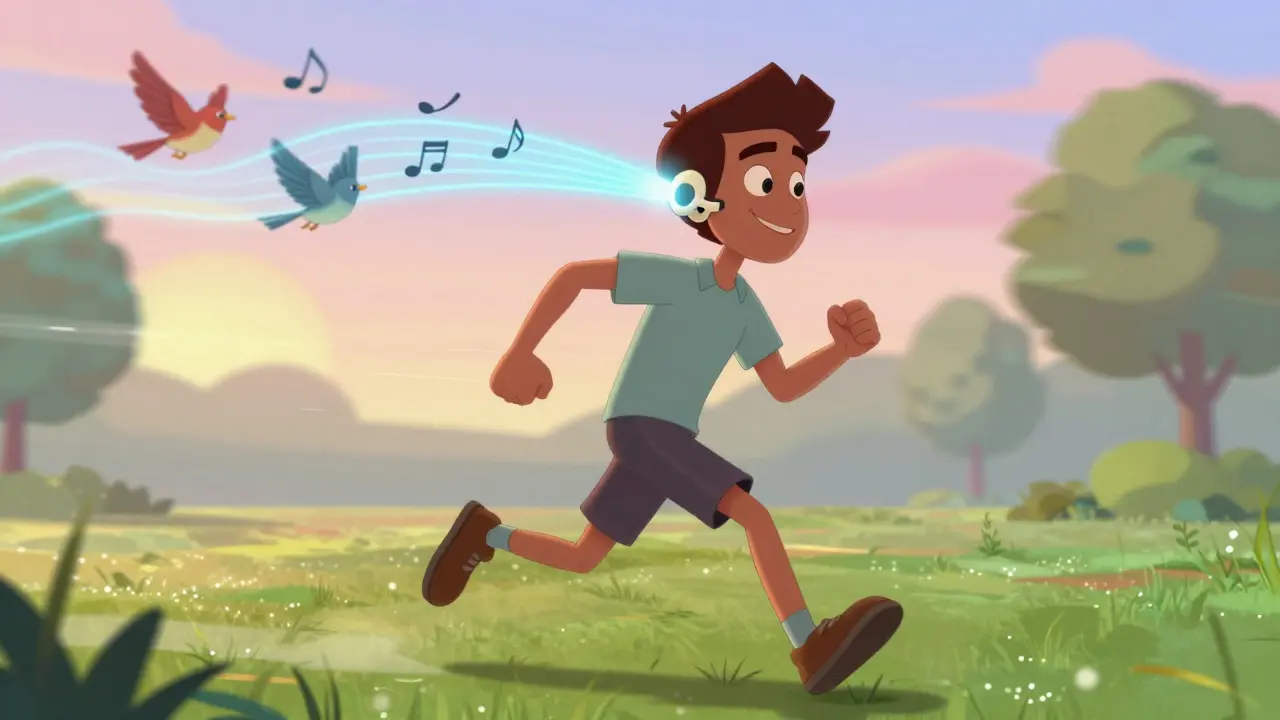
Numbers don’t tell the whole story. Real people have real experiences. One Reddit user wrote: “I loved the idea of CROS - no surgery, no scars. But after six months, I hated how my own voice sounded inside my head. And I was changing batteries every other day. I switched to Baha. The first time I heard a bird chirp from my deaf side, I cried.” Another user, who had the Cochlear Baha for three years, said: “The skin around the abutment flares up about twice a month. I use antibiotic cream and keep it clean. It’s a hassle. But when I’m at work and someone calls my name from behind me? I hear it. No turning my head. No guessing. Worth it.” A 2023 survey found that while 87% of CROS users were happy with the fitting process, only 68% said they’d recommend it to others. For BAHS, 72% were happy with fitting, but 93% said they’d recommend it. Why? Because once you get used to the sound and the routine, the benefits stick.What About Cochlear Implants?
Cochlear implants (CIs) were once only for people with hearing loss in both ears. But in January 2024, the FDA expanded approval for SSD. Studies show CIs outperform both CROS and BAHS in sound localization. In the CINGLE trial, CI users could pinpoint where a sound came from within 18.3 degrees on average. CROS users? 35.2 degrees. That’s like guessing between three chairs in a row instead of knowing exactly which one someone is sitting in. But CIs require full surgery, a longer recovery, and are more expensive. They’re usually recommended only after CROS and BAHS have been tried and failed - especially if you’re still struggling with spatial hearing after six months.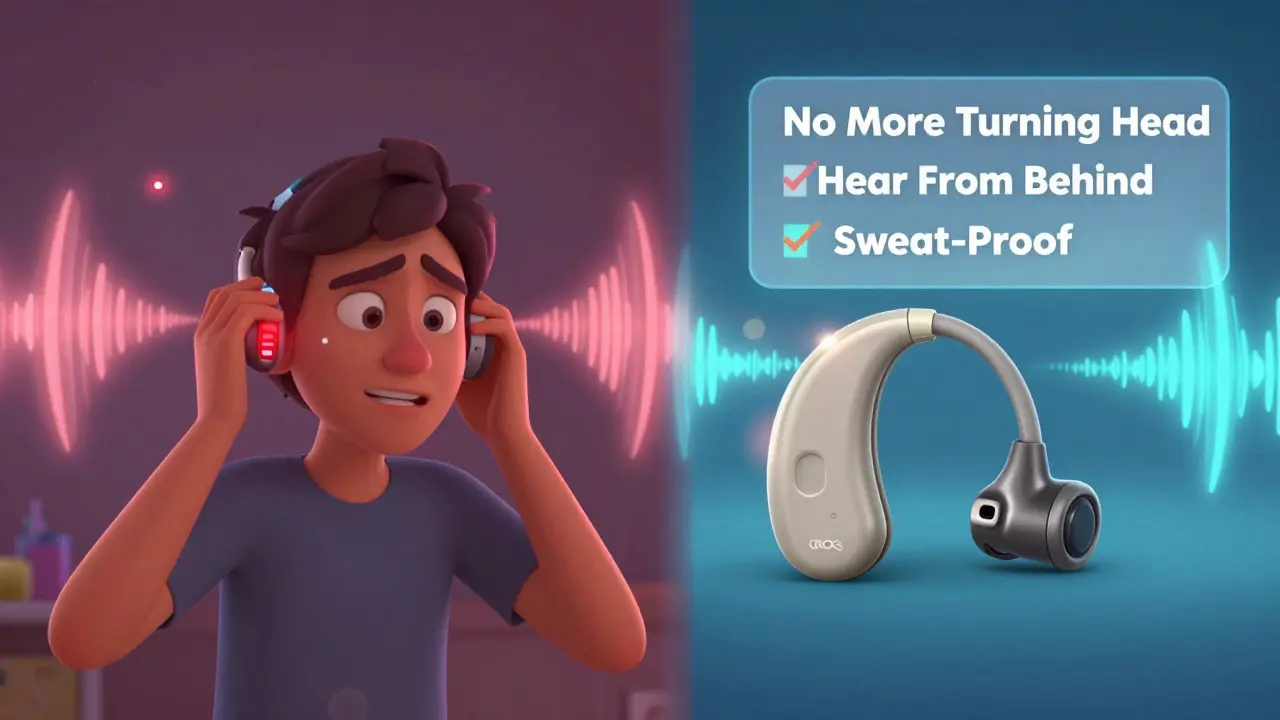
Getting Started: What to Do Next
If you have single-sided deafness, here’s what to do:- See an audiologist who specializes in SSD. Not all hearing clinics know how to test or treat it properly.
- Get a full hearing test. Your good ear must be assessed for mild or moderate loss - this affects your options.
- Request a CROS trial. Most clinics offer a 2-week trial with no obligation. Wear it in real situations: at work, in traffic, at dinner.
- If CROS doesn’t help enough, ask about a BAHS evaluation. You’ll need a CT scan to check your skull bone thickness (minimum 3.5 mm needed).
- Ask about insurance. Medicare and some private plans cover BAHS if you meet criteria. CROS is rarely covered.
- Don’t rush. This isn’t a phone upgrade. It’s a long-term solution.
The Future of SSD Treatment
Technology is evolving fast. Signia’s 2023 CROS Pure 312 now includes built-in tinnitus therapy - important since 78% of SSD patients also have ringing in the ears. Cochlear’s 2024 Baha 7 Smart uses AI to reduce background noise in real time. Transcutaneous BAHS are getting smaller, more powerful, and easier to maintain. But the biggest shift? The medical community is moving away from “CROS or BAHS” and toward “CROS first, then BAHS, then CI if needed.” It’s a stepped approach. You don’t have to pick one forever. You can start simple and upgrade later. Still, if you’re in your 40s or 50s and work in a loud job, or if you’ve already tried CROS and it didn’t work - don’t waste more time. Bone-anchored systems are reliable, durable, and life-changing for the right person. The surgery is routine. The recovery is manageable. And the improvement in daily life? It’s not subtle. It’s obvious.Can CROS hearing aids restore normal hearing in one ear?
No. CROS systems don’t restore hearing. They move sound from the deaf side to the good ear. You still hear with only one ear. The brain adapts to this, but you won’t regain natural 3D hearing or the ability to locate sounds accurately like someone with two working ears.
Is bone-anchored surgery risky?
It’s low-risk but not risk-free. The most common issue is skin irritation around the abutment - affecting up to 63% of users. Infection, bone loss, or implant failure happens in less than 5% of cases. Most procedures are outpatient and take under an hour. Recovery takes 3-6 months for the implant to fuse with bone. Transcutaneous systems reduce skin issues but may offer slightly less sound quality.
How long do CROS and bone-anchored devices last?
CROS sound processors typically last 4-5 years before needing replacement. Bone-anchored processors last 5-7 years. The implant itself (titanium) is meant to last a lifetime. Only the external processor needs replacing. Some manufacturers offer upgrade programs when new models come out.
Can children use CROS or bone-anchored devices?
Yes. CROS devices are used in children as young as 5. Bone-anchored systems are approved for children 5 and older, though some clinics use softband versions (non-surgical headbands) for younger kids. Early intervention helps with speech and language development.
Will insurance cover CROS or bone-anchored devices?
Medicare and some private insurers cover bone-anchored systems if you meet specific criteria (like documented SSD and failed CROS trial). CROS devices are rarely covered - they’re often seen as “convenience” devices. Check with your provider. Some clinics offer payment plans or financing for BAHS.
What happens if I stop using my device?
Your hearing doesn’t get worse. But your brain may re-adapt to the lack of input from the deaf side. You might find it harder to notice sounds from that side again. If you’ve had a bone-anchored implant, removing the processor doesn’t affect the implant. You can always reactivate it later.
Do CROS devices help with tinnitus?
Not directly. But some newer CROS models include built-in sound therapy - like white noise or nature sounds - that can distract from tinnitus. For many, the act of hearing environmental sounds again reduces the brain’s focus on the ringing. It’s not a cure, but it helps.




Just got my CROS device last month. Honestly? The battery life is brutal. Changed two sets in one week. But hearing my kid call me from the left side? Worth it.
Of course the government wants you to buy these $15k implants. They’re in bed with Cochlear and Oticon. Meanwhile, the real solution? A $20 hearing aid from Alibaba + a tin foil hat. You think they don’t know about bone conduction tech? They’ve had it since the 70s. They just don’t want you free.
Did you know the FDA approved these devices after a secret meeting with Big Hearing at the Bohemian Grove? The skull vibration tech? It’s been used in MKUltra experiments since ’72. They’re not fixing hearing-they’re syncing your neural patterns to satellite frequencies. That’s why the CROS devices feel ‘echoey’-it’s the signal bleed from the NSA’s listening posts. And the battery life? That’s not a bug, it’s a feature. Keeps you dependent.
It is with considerable respect for the medical and technological advancements detailed herein that I offer this observation: the distinction between contralateral signal routing and osseointegrated bone conduction represents not merely a clinical choice, but a profound existential negotiation between convenience and permanence. One must weigh the transient discomfort of battery replacement against the lifelong integration of titanium into the cranial architecture. The human condition, in this context, becomes a calculus of adaptation.
I switched to Baha after 6 months of CROS and I am LIVING now like I’ve been reborn 🙌 I heard a dog bark behind me at the park and I didn’t even turn around I just knew 😭 I cry every time I hear my coffee machine from my deaf side I’m not even joking
I tried CROS first. It didn’t work for me. I went with BAHS. Skin irritation? Yeah, I get it. But I clean it daily with saline. It’s a habit now. If you’re active, go BAHS. Don’t waste your time with CROS if you’re in a loud job or gym every day. The numbers don’t lie.
For anyone considering BAHS: make sure your bone density is >3.5mm on CT. I had a 3.1mm skull-got rejected. Went with CROS instead. Also, if your good ear has >30dB HL loss, BAHS is the only option. CROS won’t help if your ‘good’ ear is already compromised. Don’t skip the audiologist. Not all of them know SSD protocols.
I’m from India and my cousin got a Baha implant last year. He’s a mechanic. Used to miss people calling him from behind the engine. Now he hears everything. The only thing he complains about? People staring at the magnet on his head. But he says it’s worth it. No more anxiety in traffic. Just peace.