

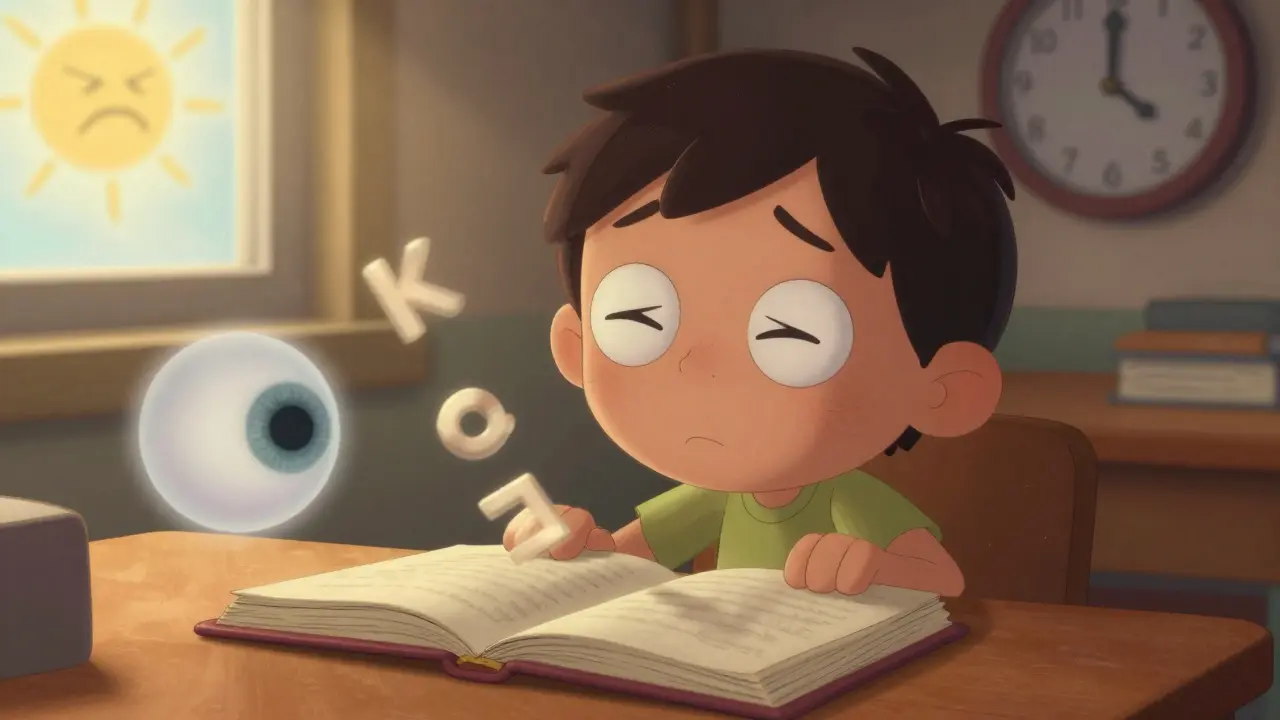
If you or your child struggles to read for more than a few minutes without headaches, blurred vision, or double letters on the page, it might not be a vision problem you can fix with stronger glasses. It could be convergence insufficiency - a hidden binocular vision disorder that tricks the eyes into working against each other when focusing on close tasks. Unlike nearsightedness or astigmatism, this isn’t about lens power. It’s about coordination. The eyes simply can’t turn inward properly to lock onto a book, phone, or computer screen. And left untreated, it can make learning, reading, and even working on screens exhausting.
What Exactly Is Convergence Insufficiency?
Convergence insufficiency (CI) happens when your eyes don’t work together as a team at close range. Think of it like trying to aim two flashlights at the same spot on the wall - if one drifts outward, the light splits. That’s what happens in CI. Instead of both eyes pointing at the same word on a page, one eye tends to drift away. Your brain gets confused. It either suppresses the image from one eye (causing eye strain) or tries to merge two slightly different images (causing double vision). The result? Headaches, tired eyes, words that seem to move, and an urge to stop reading altogether.
It’s not rare. Around 5% of the population has it, but it’s especially common in kids and young adults who spend hours reading, doing homework, or staring at screens. Many are misdiagnosed as having ADHD or learning disabilities because their symptoms mimic inattention. But the root cause isn’t focus - it’s eye alignment.
How Is It Diagnosed?
A standard eye exam won’t catch it. Most optometrists check for clarity of vision and eye health - not how well the eyes work together. To diagnose CI, you need a specialized binocular vision assessment. This includes three key tests:
- Near Point of Convergence (NPC): How close your eyes can focus on a small target before they lose alignment. A normal result is under 7 cm. With CI, it’s often over 10 cm - sometimes even 15 cm.
- Positive Fusional Vergence (PFV): Measures how much your eyes can strain to stay aligned under stress. Normal is above 15 prism diopters. In CI, it’s often below 10.
- Convergence Insufficiency Symptom Survey (CISS): A 15-question score that rates how often you experience symptoms like headaches, blurred vision, or trouble concentrating while reading. A score above 16 strongly suggests CI.
If you score high on the CISS and fail the NPC or PFV tests, you likely have convergence insufficiency. Many people go years without knowing - assuming their symptoms are just "bad eyesight" or "not enough sleep."
The Gold Standard: Office-Based Vision Therapy
Not all treatments are created equal. In 2008, the National Eye Institute funded a landmark study called the Convergence Insufficiency Treatment Trial (CITT). It compared three approaches: home-based pencil push-ups, computer-based therapy, and supervised office-based vision therapy. The results were clear.
After 12 weeks, 75% of patients in the office-based group saw full or major improvement. Only 43% improved with pencil push-ups at home. And just 33% improved with computer-only therapy.
Why? Because office-based therapy isn’t just doing exercises. It’s guided, personalized, and monitored. Each session lasts 45 to 60 minutes, once a week, with a trained vision therapist. You’ll do exercises like:
- Gradual convergence (pencil push-ups): Focus on a small letter on a pencil as you slowly move it toward your nose, keeping it single. If it doubles, you’ve gone too far.
- Jump convergence: Rapidly shift focus between a distant target and a near one - training your eyes to switch speed and accuracy.
- Stereograms and convergence cards: Images with hidden 3D patterns that force both eyes to fuse correctly.
At home, you do 15 minutes a day, five days a week, using printed cards or apps. But without professional feedback, most people do the exercises wrong - and get little benefit.
Other Treatments - What Works and What Doesn’t
There are other options, but they come with big caveats.
Base-out prism glasses force your eyes to work harder to converge. They’re sometimes used short-term to reduce symptoms during reading. But they’re tiring and don’t fix the underlying problem. The American Association for Pediatric Ophthalmology says they’re not a long-term solution.
Base-in prism glasses help you see clearly by aligning your eyes passively. But they reduce the need for your eyes to strengthen themselves. Think of them like a crutch - helpful temporarily, but they don’t build muscle.
Computer-based therapy like AmblyoPlay or HTS Instinctive is convenient. You do exercises on a tablet or computer, often with real-time feedback. It’s better than doing nothing - and better than unsupervised pencil push-ups. But studies show it’s still less effective than in-office therapy. One 2023 update showed remote supervision improved adherence, but outcomes still lagged behind in-person care.
Patching is a hard no. Covering one eye stops binocular vision entirely. CI is about using both eyes together - patching makes that impossible. Experts like AAPOS explicitly warn against it.
How Long Does It Take to See Results?
Most people start feeling better within 4 to 6 weeks. But full results usually take 8 to 12 weeks. The CITT study found 75% of kids achieved normal convergence by week 12. Adults often take a little longer - sometimes up to 16 weeks - because neural plasticity slows with age.
Success isn’t just about test scores. Parents report:
- 85% of kids can now read for over an hour without complaints
- 78% have fewer headaches
- 65% show improved grades or focus in school
One parent on Reddit wrote: "After 10 weeks of therapy, my 10-year-old went from skipping reading time to choosing books on his own. He didn’t even realize he’d been struggling before."
Why Do Some People Fail to Improve?
Failure usually isn’t because the treatment doesn’t work. It’s because of adherence.
Patients who complete 80% or more of their home exercises have an 82% success rate. Those who do less than half? Only 45%. The biggest hurdles:
- Consistency: Skipping days breaks the rhythm. Vision therapy is like physical therapy - you need repetition.
- Technique: Many do pencil push-ups too fast or don’t notice when the image doubles. A therapist catches this.
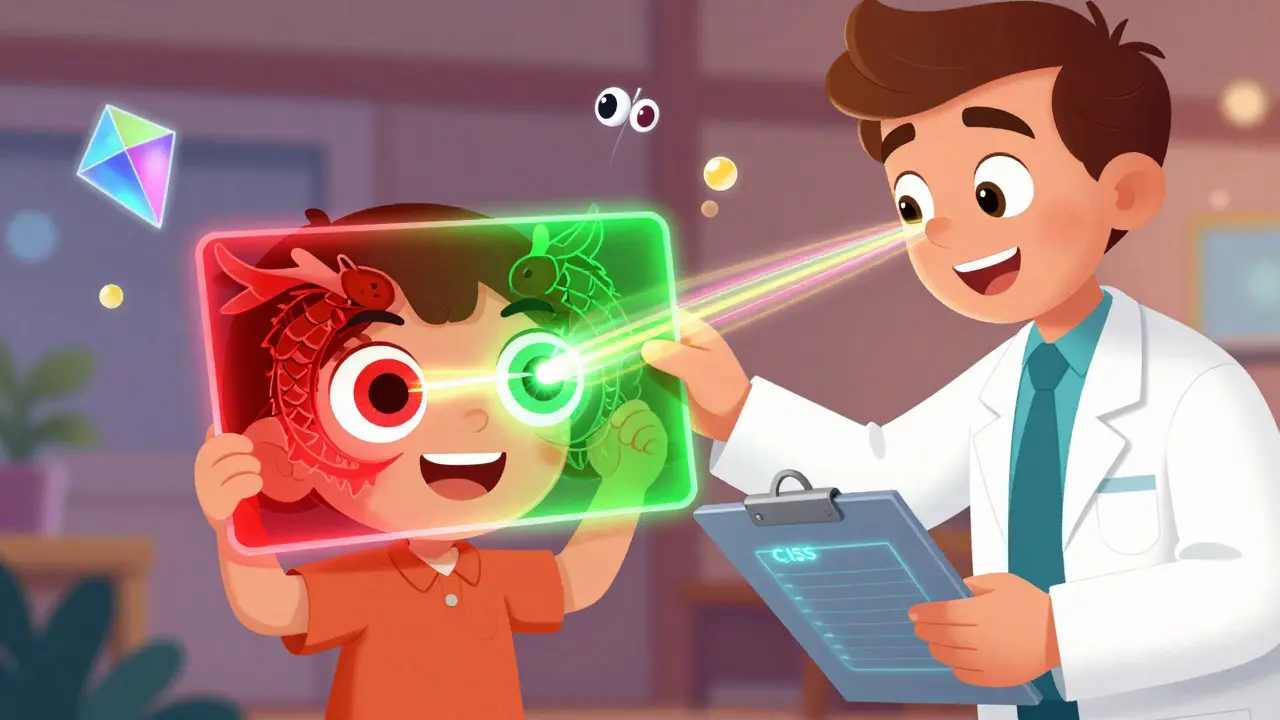
- Suppression: Some brains ignore one eye to avoid double vision. Therapists use red-green filters to retrain the brain to use both eyes.
- Cost: A full course can cost $2,500 to $4,000. Only 32% of private insurance plans cover vision therapy in the U.S. Many families delay or drop out because of this.
Some clinics offer payment plans. Others use telehealth tools to reduce visit frequency. And newer digital systems like AmblyoPlay now include remote check-ins - helping bridge the gap between office visits.
What’s New in CI Therapy?
The field is evolving. A 2023 pilot study at SUNY College of Optometry used virtual reality to simulate convergence tasks in immersive 3D environments. Patients saw symptom relief 23% faster than with traditional methods.
AI is also entering the picture. Companies like Vivid Vision are building adaptive therapy programs that adjust difficulty based on real-time eye tracking. If you’re struggling with a task, the system lowers the challenge. If you’re excelling, it ramps up.
The CITT-2 study, published in early 2022, tracked patients for a year after treatment. 82% maintained their gains - meaning the improvements stick. This isn’t temporary relief. It’s lasting change.
What Should You Do Next?
If you suspect convergence insufficiency:
- Find a developmental optometrist or vision therapist certified by COVD (College of Optometrists in Vision Development). Standard optometrists may not have the right training.
- Ask for the CISS questionnaire and a near point of convergence test. If they don’t offer these, keep looking.
- If diagnosed, commit to the full 12-week protocol. Don’t give up after two weeks.
- Track your symptoms. Keep a simple journal: "Today I read for 20 minutes without a headache. Yesterday, I stopped after 5."
- Ask about insurance coverage. Some plans cover it under "vision rehabilitation." Others require a letter of medical necessity.
Convergence insufficiency is treatable. It’s not a learning disability. It’s not laziness. It’s a physical eye coordination issue - and science has proven how to fix it. The hardest part isn’t the therapy. It’s knowing it exists.
Can convergence insufficiency go away on its own?
No, convergence insufficiency rarely resolves without treatment. While some children may show slight improvement as they grow, most continue to struggle with reading and eye strain into adulthood if untreated. The condition doesn’t fix itself - the eye muscles and brain pathways need targeted training to relearn how to work together.
Is vision therapy just for kids?
No. While CI is often diagnosed in children, adults benefit just as much. Studies show adults aged 18 to 40 respond well to office-based vision therapy. The brain’s ability to adapt (neuroplasticity) doesn’t disappear with age - it just takes a bit longer. Many adults report relief from digital eye strain and improved focus at work after treatment.
Do glasses help with convergence insufficiency?
Standard prescription glasses won’t fix CI. If you have a refractive error (like nearsightedness), you still need those glasses - but they won’t solve the eye alignment issue. Special prism lenses can help temporarily, but they’re not a cure. They reduce symptoms by forcing alignment, not by training the eyes to align on their own.
How do I know if my child has convergence insufficiency and not ADHD?
ADHD affects attention broadly - in class, during play, and in social settings. CI only affects near-vision tasks. If your child can sit still during TV or video games but struggles to read for more than 10 minutes, has frequent headaches after homework, or complains of words "moving" on the page, CI is more likely. A binocular vision exam can confirm it. Many kids with CI are misdiagnosed with ADHD because they appear distracted - but they’re actually exhausted from trying to keep their eyes aligned.
Can I do vision therapy at home without seeing a therapist?
You can try home-based exercises, but they’re far less effective. The CITT study showed only 43% success with home pencil push-ups versus 75% with supervised therapy. Without professional feedback, you’re likely doing the exercises incorrectly - missing key cues like when your vision doubles or when one eye drifts. Home therapy can be a supplement, but not a replacement for in-office care.
Is vision therapy covered by insurance?
Only about 32% of private insurance plans in the U.S. cover vision therapy for convergence insufficiency. Many classify it as "experimental" or "not medically necessary," even though it’s backed by NIH-funded research. Some families get coverage by submitting a letter of medical necessity from their doctor. Others use HSA or FSA accounts. Always ask your provider for a detailed explanation of benefits before starting treatment.






OMG I DIDN’T KNOW THIS WAS A THING 😭 My 9-year-old used to cry every night during reading time and I thought he was just being dramatic. We finally got him tested after he failed his school vision screening (the regular one) and guess what? CI. 12 weeks of therapy and now he reads chapter books for fun. I cried again - this time happy tears. Vision therapists are unsung heroes. If you’re reading this and your kid hates reading? Get them checked. It’s not laziness. It’s not ADHD. It’s eyes that need coaching, not glasses. 🥹❤️
Thank you for writing this. As a special ed teacher, I’ve seen so many kids labeled "inattentive" when they’re just exhausted from fighting their own eyes. One student I worked with thought he was "bad at reading" - turns out he couldn’t keep both eyes on the same word. After vision therapy? He went from reading 3 sentences to 3 pages without a break. No meds. No behavior plan. Just eye training. We need more awareness. Maybe schools should screen for CI during routine vision checks. It’s not expensive. It’s not complicated. It’s just overlooked.
So let me get this straight - we have a condition where your eyes literally can’t look at the same word, and the cure is… moving a pencil closer to your nose? 🤔 I mean, cool, I guess. But also… why does this cost $4K? My dog does pencil push-ups when he’s bored. Should I start billing him as a vision therapist? Just saying - if the gold standard is a 12-week pencil game, maybe we’re overcomplicating it. Or maybe insurance is just being extra greedy. Either way, I’m glad it works. But also… really? A pencil?
Pencil pushups don’t work. Office therapy does. End of story.
Okay but what if it’s just your brain being lazy? Like… maybe your eyes are fine but your attention span is trash? I’ve seen people with CI who still can’t focus even after therapy - turns out they were just scrolling TikTok all day and forgot how to concentrate. Also, why is this only a US problem? I’m from Canada and no one here even talks about this. Maybe it’s not a medical issue - maybe it’s a culture of overdiagnosis. Like, we’ve turned every little thing into a disorder so we can sell solutions. I’m not saying it’s fake. I’m saying maybe it’s not as common as they claim. Also - how many of these kids had too much screen time? Just saying.
Let’s be honest - this is just a fancy way of saying "your eyes are weak." If you need a $4,000 program to train your extraocular muscles, you’re not a patient - you’re a marketing target. The NIH study? Cute. But real science is in the biomechanics of ocular motility, not some therapist waving a pencil around like a wizard. Also, "neuroplasticity" is the new buzzword for anything we don’t fully understand. You don’t need therapy. You need to stop reading so much.
My 14-year-old had CI. We did the full 12-week office therapy - 12 sessions, weekly. Home exercises every day. We spent $3,200. Insurance covered $0. But here’s the thing - after week 4, she stopped saying "my eyes hurt" after homework. By week 8, she was reading for pleasure. By week 12, she got her first A in English in two years. I don’t care how much it costs. I don’t care if it’s "just a pencil." If your kid’s eyes are fighting each other and they’re losing, you fix it. Vision therapy isn’t a luxury. It’s a necessity. And if your insurance doesn’t cover it? Fight them. Write letters. Use your HSA. Call your state’s health advocate. This isn’t cosmetic. It’s functional. And it works. Don’t let money or doubt stop you.
I’m a parent of a child with CI and I’ve read every study, every forum, every article. I’ve seen the before and after. I’ve watched my kid go from avoiding books to reading aloud to the dog. I won’t pretend it’s easy. It’s expensive. It’s time-consuming. But it’s real. The science is solid. The outcomes are measurable. I’m not here to argue. I’m here to say: if you suspect this, get tested. Don’t wait. Don’t assume it’s ADHD. Don’t assume it’s laziness. Don’t assume it’ll go away. It won’t. But it can be fixed. And you don’t need to be rich to make it happen - you just need to be persistent.
lol so the "gold standard" is basically physical therapy for your eyeballs? I mean, I get it - muscles need training. But why does this feel like a cult? Like, you gotta go to a COVD-certified wizard who charges $200/hr to make you stare at a 3D card? Meanwhile, my 12-year-old nephew just uses an app for 10 mins a day and says he feels better. And no, he didn’t pay $4K. Also - why is everyone acting like this is some groundbreaking discovery? My dad had this in the 90s. They gave him prism glasses and told him to look at a candle. Now we’re selling VR goggles and AI tracking? I’m not saying it doesn’t work. I’m saying we’ve turned a simple neuromuscular issue into a $4K industry. And honestly? Kinda sketchy.
Y’all are so gullible. This is a scam. The CITT study was funded by the same people who sell vision therapy equipment. The "75% improvement"? They measured it by asking parents if their kid "seems better." Not by objective eye tracking. Not by fMRI. Just "he reads more now." Oh wow, what a miracle. Meanwhile, real ophthalmologists don’t even recognize this as a legitimate diagnosis. It’s a diagnosis invented by optometrists to sell services. And now you’re all crying over a pencil? Wake up. Your kid isn’t broken. Your wallet is.
Convergence insufficiency? Cute. But let’s be real - this is just the American healthcare system inventing problems so it can sell solutions. In Europe, they just tell kids to take breaks. In Japan, they use traditional eye exercises that have worked for centuries. Here? We need a $4,000 VR headset and a therapist with a clipboard. We’ve turned basic biology into a profit-driven industry. And now you’re all thanking the system for "saving" your kid from a condition that probably doesn’t even exist outside of a billing code. I’m not against therapy. I’m against capitalism turning eye strain into a luxury service. You don’t need a COVD-certified wizard. You need a screen timeout. And a nap.