

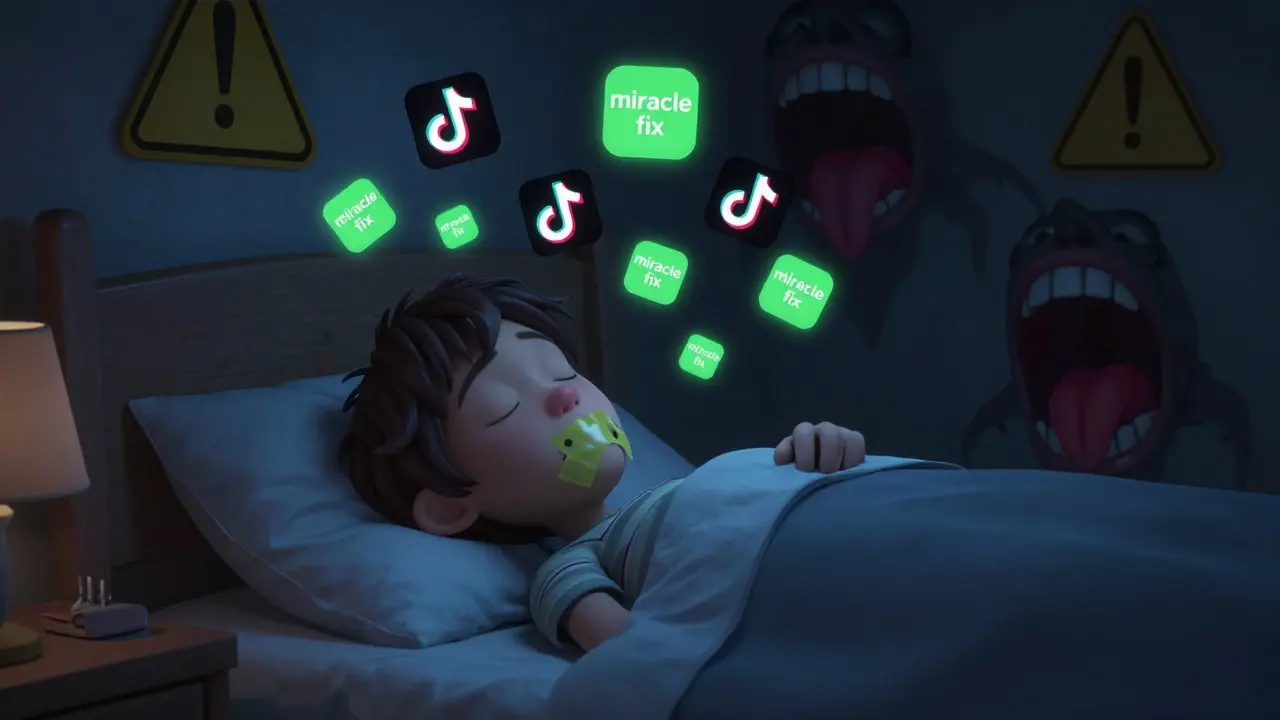
People are taping their mouths shut at night because they’ve seen it on TikTok. They’re told it will stop snoring, improve sleep, even make their skin look younger. But here’s the truth: mouth taping isn’t a proven sleep solution-it’s a risky experiment with little science behind it and serious dangers for some.
What Mouth Taping Actually Does
Mouth taping means sticking a small strip of adhesive tape across your lips before bed. The idea is simple: if you can’t open your mouth, you’ll be forced to breathe through your nose. Proponents claim this reduces snoring, fights sleep apnea, and even improves oral health by keeping your mouth from drying out. But none of these benefits are backed by solid medical evidence.The practice started as a niche idea among some breathing coaches and alternative health advocates. It exploded in 2020 when influencers began posting videos of themselves sleeping with tape on their lips, calling it a "miracle fix." Soon, people were buying "sleep tape" online-products like Somnifix Lips Strips, marketed with claims that sound like miracle cures. But these aren’t medical devices. They’re just adhesive strips, often repurposed medical tape like 3M Micropore.
The Science (or Lack Thereof)
A 2020 systematic review in PLOS One looked at 10 studies involving 213 people who tried mouth taping. The results? Weak. Only two showed any real improvement in sleep apnea measurements. Most studies were small, poorly designed, or didn’t measure oxygen levels. And here’s the kicker: many participants couldn’t even tolerate the tape. One study found 25% of people couldn’t sleep with it on at all.The NIH did find that in a small group of 20 people with mild sleep apnea, mouth taping reduced snoring and apnea events by about half-but only if they could already breathe through their nose. That’s a big "if." About 20% of adults have some form of nasal obstruction due to allergies, deviated septum, or chronic congestion. For them, taping their mouth shut doesn’t help-it traps them.
And then there’s "mouth puffing." Researchers have documented this phenomenon: people keep trying to breathe through their mouth even with tape on. Air leaks around the edges, causing loud, irregular breathing sounds. It doesn’t fix sleep apnea-it just makes it harder to detect.
Why This Is Dangerous
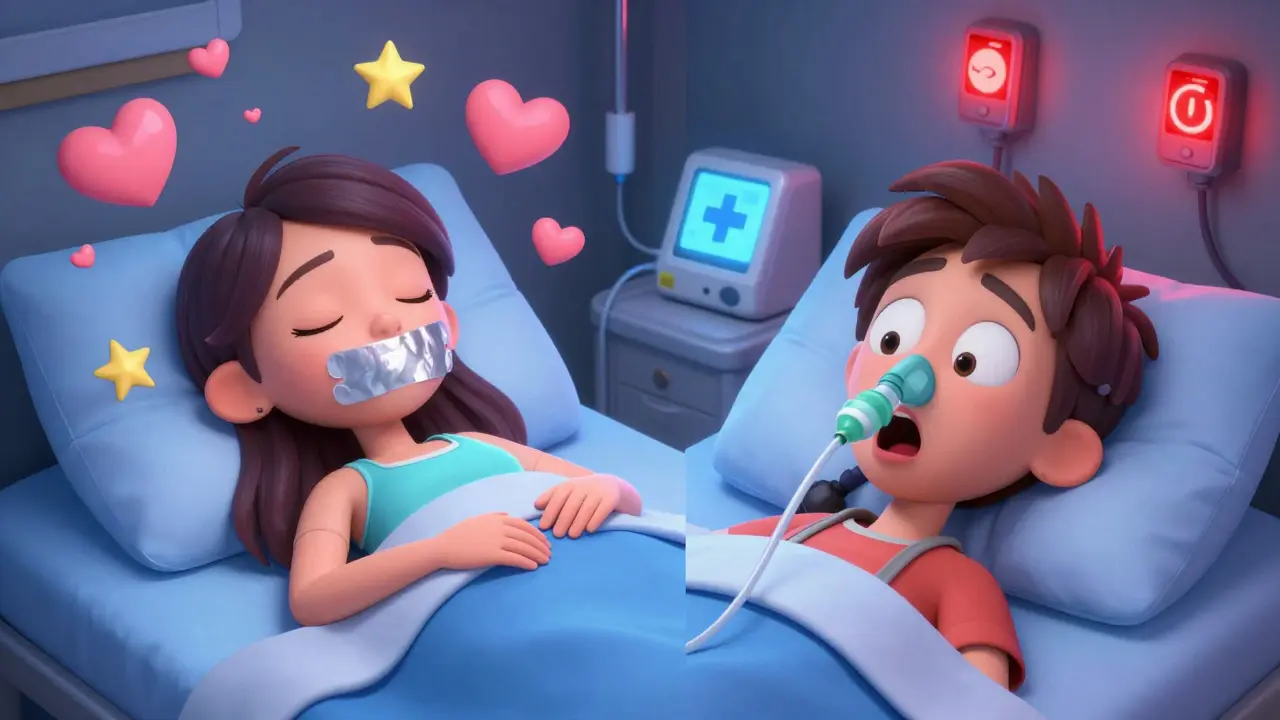
The biggest danger? You might have undiagnosed sleep apnea.Over 80% of people with sleep apnea don’t know they have it. If you’re one of them, taping your mouth shut could be life-threatening. When your airway collapses during sleep, your body needs to wake up to breathe. If you’ve taped your mouth, you might not be able to gasp for air fast enough. Oxygen levels can drop dangerously low.
A June 2023 study in the Journal of Clinical Sleep Medicine followed 127 people with mild sleep apnea. When they taped their mouths, 22% had oxygen levels fall below 88%-a level that doctors consider clinically dangerous. That’s four times higher than when they slept normally.
Doctors at the Cleveland Clinic, Harvard, and London Health Sciences Centre all warn against it. Dr. Brian Rotenberg, who led the PLOS One review, says: "Taping the mouth shut during sleep is dangerous, especially among those who may not be aware they have sleep apnea. These individuals are unknowingly making their symptoms worse."
And it’s not just about oxygen. People report waking up gasping, panicked, or with skin irritation from the adhesive. Some develop anxiety because they feel trapped. One Reddit thread with over 140 comments showed 36 people said they woke up gasping for air. Only 22% reported any real benefit.
What Works Better
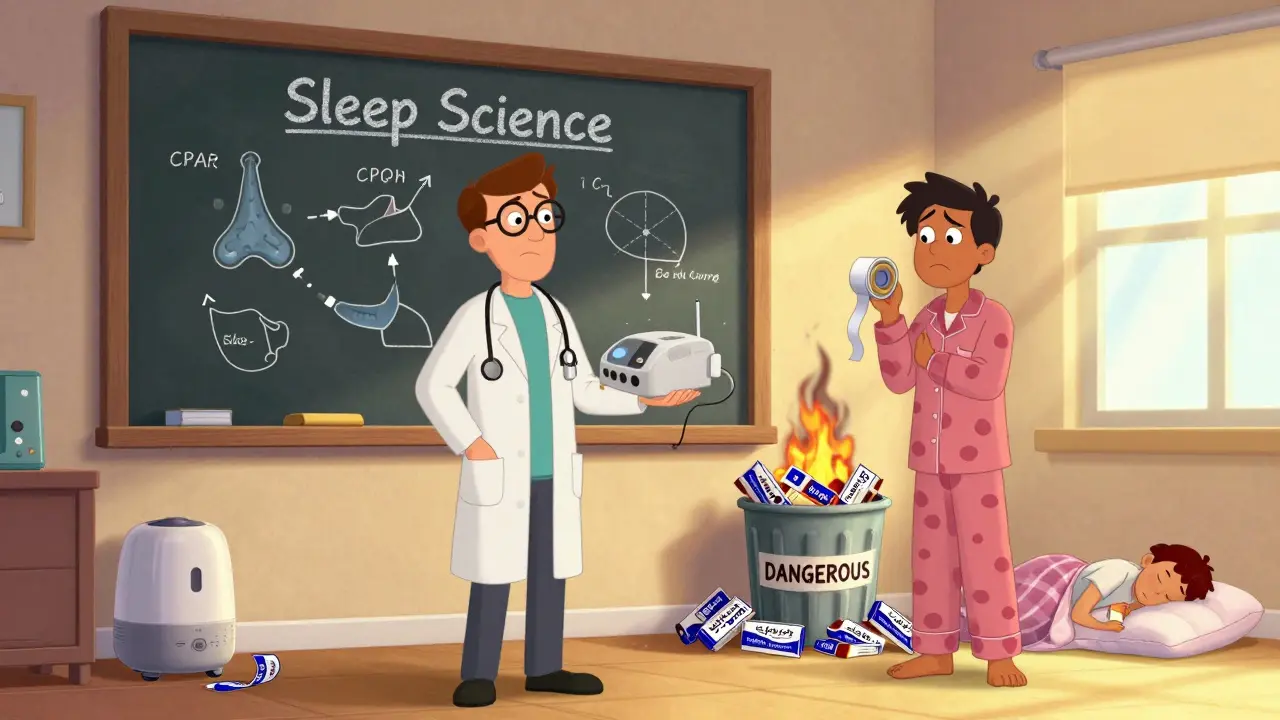
If you snore or suspect sleep apnea, there are proven, safe solutions.- CPAP machines are the gold standard. They work 85-90% of the time for moderate to severe sleep apnea. They don’t just reduce snoring-they prevent oxygen drops, heart strain, and stroke risk.
- Mandibular advancement devices (mouthguards worn at night) help 40-60% of people with mild to moderate sleep apnea. They’re FDA-cleared and prescribed by sleep specialists.
- Nasal dilators like Provent Sleep Therapy (FDA-cleared in September 2023) open nasal passages without restricting mouth breathing. They’re non-invasive and designed by sleep experts.
- Weight loss, sleeping on your side, and treating allergies can dramatically improve breathing without any devices.
Compare that to mouth taping: no FDA approval, no standard product, no medical oversight. It costs $5-$15 for a roll of tape. CPAP machines cost $500-$3,000. But one works. The other might kill you.
Who Should Never Try It
If any of these apply to you, don’t tape your mouth:- You snore regularly
- You wake up gasping or choking
- You feel tired all day, even after 8 hours of sleep
- You have nasal congestion, allergies, or a deviated septum
- You’ve been told you stop breathing at night
- You have asthma, COPD, or heart disease
The American Academy of Sleep Medicine and the American Academy of Dental Sleep Medicine both say: do not use mouth taping without a sleep study and medical supervision. And even then, they don’t recommend it.
The Social Media Trap
You’ve probably seen dozens of TikTok videos showing happy people with tape on their lips, claiming "I sleep better than ever." But here’s what those videos don’t show:- They don’t mention the 75% of users who quit within two weeks because it felt scary or uncomfortable.
- They don’t warn about the 12% who woke up unable to breathe.
- They don’t say that 87% of top YouTube tutorials lack medical disclaimers-even when they claim to "cure" sleep apnea.
Only 7% of the top Google results for "mouth taping" come from medical sources. The rest? Influencers, e-commerce sites selling tape, and blogs with no medical credentials.
The FDA has issued warning letters to three companies for making false claims. The FTC is watching. And yet, the market for "sleep tape" is worth $2.3 million-and growing.
What You Should Do Instead
If you’re struggling with sleep, snoring, or daytime fatigue:- Get evaluated. Talk to your doctor about a sleep study. It’s simple, non-invasive, and often covered by insurance.
- Try nasal strips or saline rinses. They’re safe, cheap, and help with congestion.
- Use a humidifier. Dry air worsens mouth breathing.
- Sleep on your side. Back sleeping makes snoring worse.
- Don’t rely on social media hacks. Real sleep health comes from science-not viral trends.
Mouth taping might seem harmless. But when it comes to your breathing while you sleep, there’s no room for guesswork. What looks like a simple fix could be hiding a serious health risk.
Is mouth taping safe for everyone?
No. Mouth taping is not safe for people with nasal obstruction, sleep apnea, asthma, or any respiratory condition. Even healthy individuals can experience anxiety, panic, or oxygen drops. The American Academy of Sleep Medicine warns that it can worsen undiagnosed sleep disorders and should never be used without medical evaluation.
Does mouth taping cure sleep apnea?
No. There is no strong evidence that mouth taping cures or effectively treats sleep apnea. A few small studies showed minor improvements in snoring or apnea events-but only in people who could already breathe through their nose. For most people with sleep apnea, it’s ineffective and potentially dangerous. CPAP and oral appliances are the only proven treatments.
Can mouth taping cause low oxygen levels?
Yes. A 2023 study found that 22% of people with mild sleep apnea experienced oxygen saturation levels below 88% while mouth-taped-levels considered clinically dangerous. This happens because the tape prevents mouth breathing, which is often the body’s backup when the airway collapses. Without that escape route, oxygen levels can crash.
What’s the difference between mouth taping and CPAP?
CPAP delivers continuous air pressure to keep the airway open, preventing apnea events entirely. It’s medically proven, FDA-cleared, and used by millions. Mouth taping physically blocks the mouth, forcing nasal breathing-but doesn’t address the root cause of airway collapse. CPAP has an 85-90% success rate. Mouth taping has no consistent success rate and is not approved for medical use.
Why do influencers promote mouth taping if it’s dangerous?
Many influencers profit from selling "sleep tape" or affiliate products. They often lack medical training and rely on anecdotal stories. A University of Pennsylvania analysis found 73% of TikTok videos promoting mouth taping didn’t mention any risks. The FDA and FTC have warned companies for making false claims. What looks like wellness advice is often marketing.
Are there safer alternatives to mouth taping?
Yes. Nasal dilators (like Provent), saline rinses, side-sleeping, weight management, and CPAP machines are all proven, safe options. The FDA-cleared Provent device helps open nasal passages without blocking the mouth. These solutions work with your body-not against it. Always consult a sleep specialist before trying any new sleep intervention.
so i tried mouth taping for three nights. first night: woke up like i’d been suffocating in a pillowcase. second night: panic attack at 3am because my nose felt like a clogged drain. third night: i just ripped the tape off and cried into my pillow. also my lips are still weirdly chapped. thanks, tiktok.
no one warned me about the feeling of being trapped. like, i get it, you want to breathe through your nose. but what if your nose is just not having it tonight? what if your body’s screaming for air and you’ve taped it shut like a science experiment gone wrong?
oh sweet mercy. someone finally said it. i’ve been watching these tiktoks where girls wake up glowing and say ‘mouth tape changed my life’ and i’m just screaming into the void: WHERE’S THE OXYGEN MONITOR?!
you’re not ‘fixing’ sleep apnea, you’re just making it harder for your body to scream for help. if you wake up gasping, that’s not a sign it’s working - that’s your brain begging you to stop before you die. also, i’ve seen people with red raw lips like they got into a fight with duct tape. this isn’t wellness. it’s a horror movie with influencer sponsorship.
the fact that people think this is a solution says everything about modern society. you’ve got a 2000-year-old human body, a 100-year-old medical system, and a 10-year-old algorithm telling you to tape your mouth shut because a girl in Austin got 200k likes. no one checks the science. no one reads the studies. you just see ‘miracle sleep hack’ and go buy it. we’re not evolving. we’re regressing into a cult of viral nonsense.
CPAP is expensive. So is a sleep study. But it’s not $12 for a roll of tape that might kill you. The real tragedy isn’t the tape. It’s that we’ve stopped trusting medicine and started trusting influencers.
agree. i’ve had sleep apnea for 10 years. i use a cpap. it works. mouth taping? no. never. don’t risk it.
i just want to hug everyone who’s tried this and woke up terrified. you’re not alone. i did it too. thought it’d help my dry mouth. instead i had a full-blown anxiety attack because i couldn’t breathe through my nose and the tape felt like a prison. i cried. i called my mom. i threw the tape away.
but here’s the good part: i went to a sleep specialist. got tested. found out i had mild nasal congestion. used saline rinses for two weeks. now i sleep like a baby. no tape. no panic. just peace.
your body knows what it needs. sometimes it just needs you to listen - not tape it shut.
you people are pathetic. this isn’t rocket science. if you’re snoring, you have a problem. if you’re using tape because you’re too lazy to get a sleep study, you deserve what happens. i’ve seen people in the ER from this. not because they’re ‘sensitive’ - because they ignored the red flags. your body doesn’t lie. your tiktok feed does.
cpap isn’t sexy. it’s not viral. but it’s the only thing that saves lives. stop pretending you’re a wellness guru. you’re just a walking health risk.
in india, we have a word for this: ‘jugaad.’ cheap fix. duct tape solution. you think you’re being clever? you’re being reckless. we’ve been dealing with air pollution, congestion, and sleep issues for generations. we didn’t tape our mouths. we used steam, turmeric, sleep positions, and discipline.
now you’re buying tape because you’d rather spend $15 than 10 minutes googling ‘nasal irrigation.’
this isn’t innovation. it’s ignorance with a marketing budget.
let me break this down for you because clearly you didn’t read the studies. the plos one review had 213 people. two studies showed improvement. that’s less than 10%. and yet, you’re telling people to ignore the 87% who saw no benefit? the 25% who couldn’t even tolerate it? the 22% whose oxygen dropped below 88%? that’s not anecdotal - that’s statistically alarming.
and don’t even get me started on the fact that the ‘sleep tape’ market is worth $2.3 million. that’s not wellness. that’s predatory capitalism disguised as self-care. you’re not healing. you’re being monetized.
the american academy of sleep medicine says don’t do it. the fda has issued warning letters. the ftcs watching. and you’re still buying it because a girl with 500k followers said ‘it’s life-changing.’
you’re not a pioneer. you’re a pawn.
we live in a world where the body is no longer a temple, but a problem to be hacked. we seek shortcuts to the sacred act of rest. we tape our mouths shut not because we are wise - but because we are afraid. afraid of the silence. afraid of the breath. afraid of the truth that sleep is not a product to be optimized, but a mystery to be surrendered to.
the nose breathes. the mouth sighs. the soul sleeps. when we force the body into unnatural shapes, we do not heal - we fracture.
perhaps the real apnea is not in the airway - but in the soul’s inability to rest without a product, a trend, a hashtag.
as a healthcare professional, I have seen firsthand the consequences of unregulated sleep interventions. Mouth taping is not a benign practice. It is a high-risk behavior masquerading as a lifestyle upgrade. The documented cases of nocturnal hypoxia, panic episodes, and delayed diagnosis of obstructive sleep apnea are not outliers - they are predictable outcomes of a culture that prioritizes aesthetics over physiology.
There is no substitute for clinical evaluation. No app, no tape, no influencer testimonial replaces the precision of polysomnography. To suggest otherwise is not just irresponsible - it is dangerous.
i just want to say: if you’re reading this and you’ve been scared to talk about this - you’re not crazy.
i tried it. i panicked. i cried. i thought i was broken. but i went to my doctor. got a sleep study. found out i had mild nasal polyps. got treated. now i sleep 8 hours without fear.
you don’t need tape. you need care. and care doesn’t come from a viral video. it comes from a conversation. with yourself. with a professional. with your body.
you’re worth more than a hack. you’re worth a real solution.
i’m so glad someone wrote this. i tried mouth taping because i thought it would help my dry mouth and snoring. i woke up with a panic attack and a rash. i didn’t know what to do. i felt stupid. but i went to the doctor. they helped me. it’s okay to ask for help. it’s okay to say no to trends. your health matters more than a viral video.
cpap is for losers. i don’t need machines. i need discipline. i need to retrain my body. i’ve been breathing through my nose for 3 months now. no tape. no machine. just willpower. you’re all weak. this isn’t a medical issue. it’s a mental one. stop outsourcing your health to corporations and start taking responsibility.
i’ve been sleeping with my mouth open for 15 years. never had a problem. never felt tired. never snored. i don’t need to fix what isn’t broken. the real issue isn’t mouth taping. it’s the medicalization of normal human variation. why must every bodily function be optimized? why must every breath be controlled? maybe the body knows better than the algorithm.