

Anaphylaxis Symptom Checker
This tool helps you quickly assess if symptoms indicate medication-induced anaphylaxis. Based on CDC and AAAAI guidelines, anaphylaxis requires immediate action. Call 911 immediately if you suspect anaphylaxis.
Symptom Assessment
Select all symptoms you're experiencing or observing. The CDC recommends acting immediately if symptoms occur in two or more body systems.
Epinephrine is the only treatment that saves lives
If you suspect anaphylaxis, administer epinephrine immediately and call 911. Do not wait for symptoms to worsen. Do not use antihistamines or steroids as a substitute.
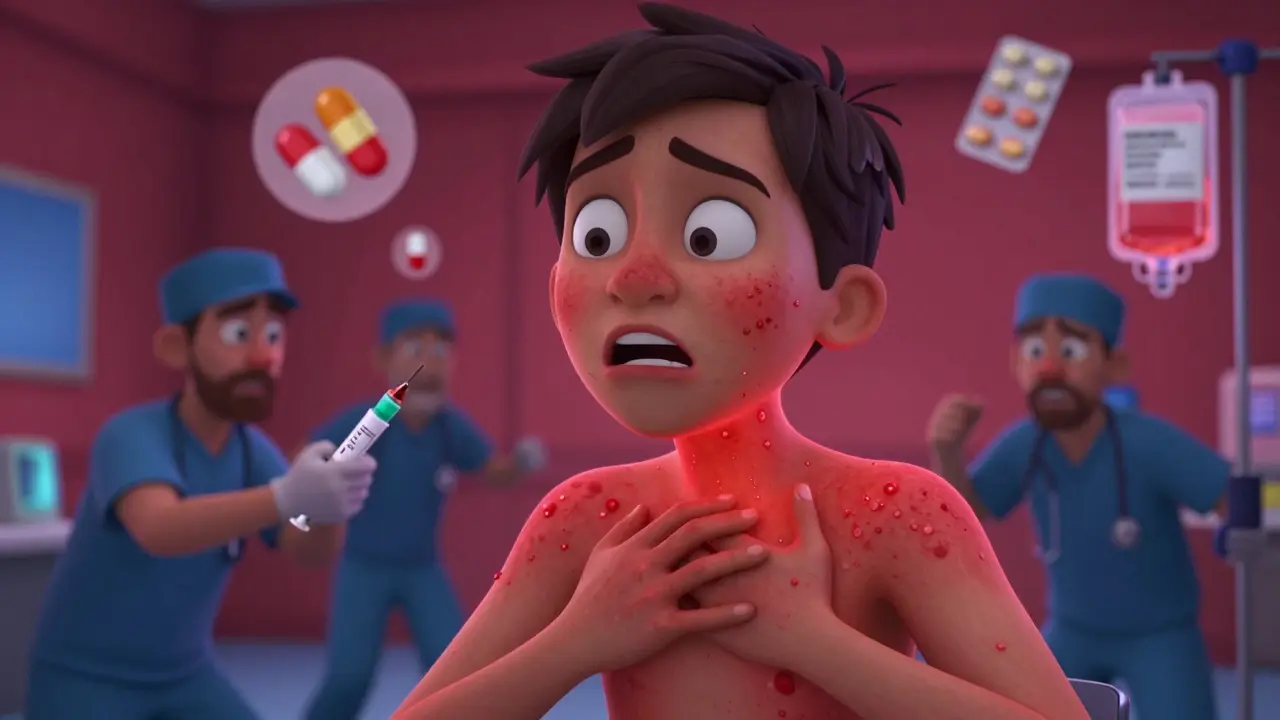
When a medication triggers a life-threatening allergic reaction, it doesn’t wait for permission. It hits fast - within minutes, sometimes seconds. Your skin breaks out in hives. Your throat closes. Your blood pressure plummets. If you don’t act, it can kill you. This is anaphylaxis - and it’s one of the most dangerous side effects of modern medicine.
What Exactly Is Medication-Induced Anaphylaxis?
Anaphylaxis isn’t just a bad rash or upset stomach. It’s a full-body emergency caused by your immune system overreacting to a drug. The body sees the medication as a threat and floods your bloodstream with chemicals like histamine and tryptase. These cause blood vessels to leak, airways to tighten, and your heart to struggle. The result? Trouble breathing, dizziness, swelling, and shock.
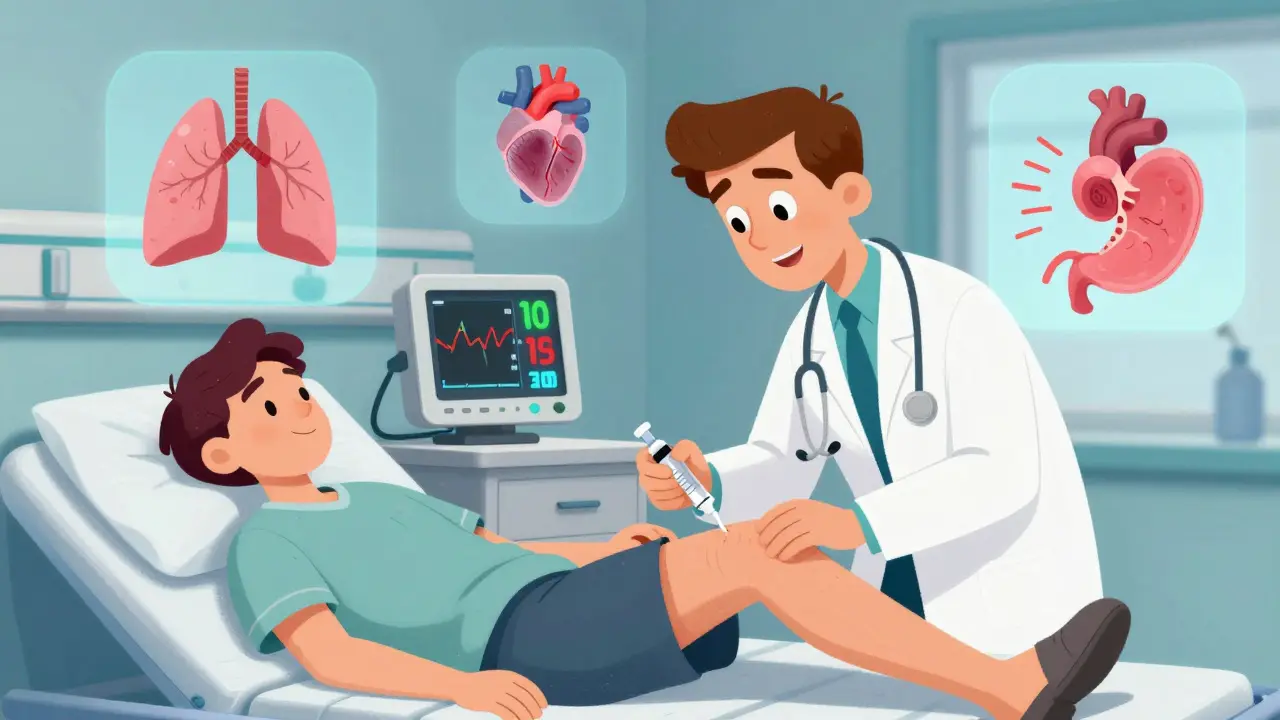
Unlike mild allergies, anaphylaxis doesn’t just affect one part of the body. It hits multiple systems at once - skin, lungs, heart, gut. According to the American Academy of Allergy, Asthma & Immunology (AAAAI), you’re likely having anaphylaxis if you develop symptoms in two or more body systems after taking a drug. Or if your blood pressure drops sharply, even without other symptoms.
Medications are the third most common cause of anaphylaxis, after foods and insect stings. About 1 in 6 anaphylaxis cases in hospitals come from drugs. Antibiotics - especially penicillin - make up nearly 70% of those cases. NSAIDs like ibuprofen, monoclonal antibodies used in cancer and autoimmune disease, and chemotherapy drugs are also major triggers.
How Fast Does It Happen?
Time matters. Every second counts.
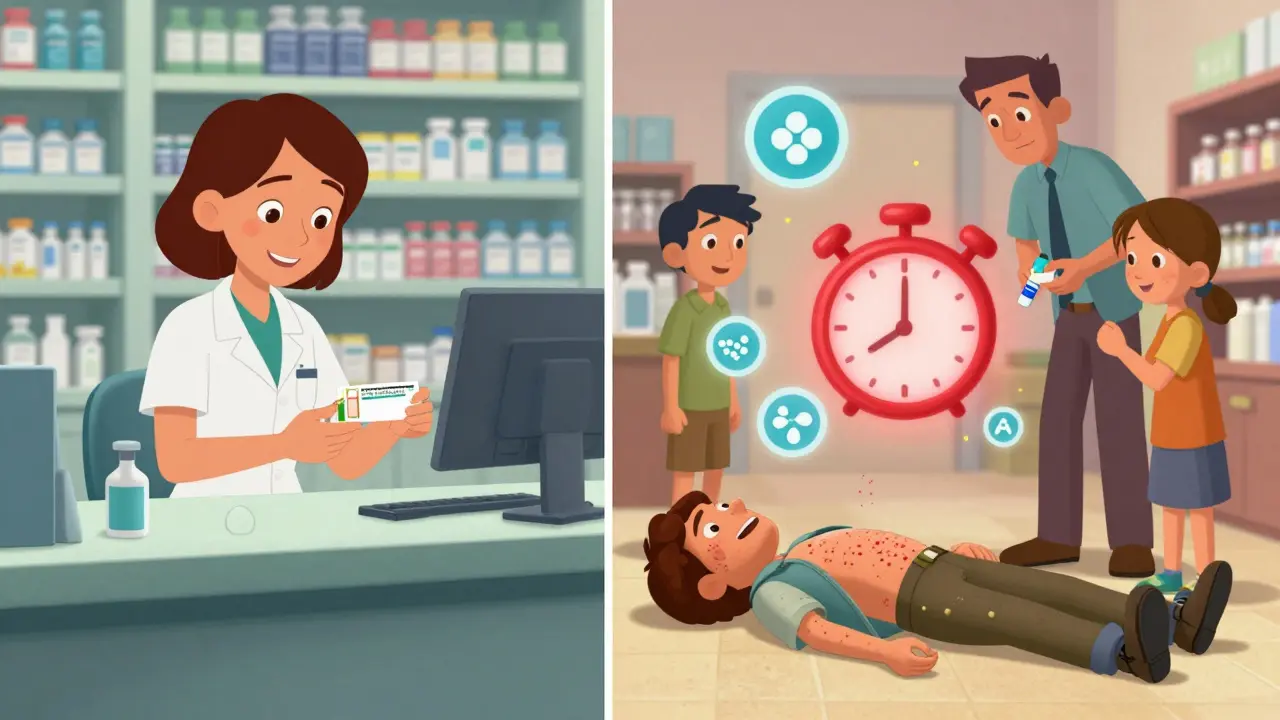
With IV medications, symptoms can start in under five minutes. Oral drugs might take 15 to 30 minutes. But in rare cases, reactions can be delayed - up to six hours after taking the pill. That’s why you shouldn’t walk away from the pharmacy or leave the hospital right after getting a new drug, even if you feel fine at first.
The most dangerous delay? Waiting to give epinephrine. Studies show that if epinephrine isn’t given within 30 minutes of symptom onset, the risk of death triples. In nearly 80% of fatal cases, epinephrine was either given too late or not at all.
What Are the Key Warning Signs?
You don’t need all the symptoms to recognize anaphylaxis. But here’s what to watch for - grouped by body system:
- Skin: Hives, flushing, swelling of lips, tongue, or face. Itching without a rash is also common.
- Respiratory: Wheezing, shortness of breath, tight throat, hoarse voice, coughing. This is often the most life-threatening part.
- Cardiovascular: Dizziness, fainting, rapid or weak pulse, low blood pressure. This is more common with drug reactions than food allergies.
- Gastrointestinal: Nausea, vomiting, cramps, diarrhea. These can be misleading - people often think it’s just a stomach bug.
One key difference between drug-induced and food-induced anaphylaxis? Medication reactions are more likely to cause low blood pressure and breathing trouble early on. Food reactions tend to start with hives and stomach upset. But either way, if you see two or more systems reacting - act immediately.
Epinephrine Is the Only Treatment That Saves Lives
Antihistamines like Benadryl? They help with itching. Steroids? They prevent delayed reactions. But neither stops anaphylaxis in its tracks.
Only epinephrine does.
It works by tightening blood vessels, opening airways, and supporting heart function. It’s not optional. It’s not a backup. It’s the first and only treatment that reverses the reaction.
For adults, the dose is 0.3 to 0.5 mg injected into the outer thigh. You don’t need to remove clothing. You don’t need to be precise. Just jab it in, hold for 3 seconds, then call 911. Even if symptoms improve, you still need to go to the hospital - a second wave of symptoms can come hours later.
Studies show that when epinephrine is given correctly within minutes, survival rates jump to over 95%. But in emergency rooms across the U.S., only about half of patients get it on time. Why? Misdiagnosis. Many doctors mistake it for a panic attack, sepsis, or vasovagal faint. One ER nurse in Boston described a patient with low blood pressure and swelling who was initially treated for a “vagal response.” Only when the patient started gasping for air did they realize it was anaphylaxis. Epinephrine reversed it in four minutes.
What Drugs Are Most Likely to Cause It?
Not all medications carry the same risk. Here’s the breakdown based on recent data:
| Drug Class | Percentage of Cases | Examples |
|---|---|---|
| Antibiotics | 69.3% | Penicillin, amoxicillin, cephalosporins |
| NSAIDs | 15.2% | Ibuprofen, naproxen, aspirin |
| Monoclonal Antibodies | 5.8% | Rituximab, cetuximab, trastuzumab |
| Chemotherapy | 4.1% | Platinum drugs like cisplatin |
| IV Contrast Dyes | 3.5% | Iodinated contrast for CT scans |
Penicillin is the #1 offender. But here’s the catch - many people think they’re allergic to penicillin when they’re not. About 90% of people who report a penicillin allergy aren’t truly allergic. That’s why testing matters. If you’ve been told you’re allergic, ask for an allergist referral. Getting tested could open up safer, more effective treatment options.
Why Do People Miss the Signs?
It’s not just patients. Even trained medical staff misdiagnose anaphylaxis.
A 2022 survey of over 1,200 doctors found that nearly 7 out of 10 had misdiagnosed a drug reaction at least once. The top mistakes:
- Calling it a panic attack (15.2%)
- Thinking it’s sepsis (28.4%)
- Blaming it on a pulmonary embolism (19.7%)
- Assuming it’s “red man syndrome” from vancomycin (a non-allergic flush)
“Red man syndrome” is a common trap. It causes flushing and itching during IV vancomycin, but it doesn’t cause low blood pressure or breathing trouble. That’s the key difference. If the patient’s blood pressure is stable and their airway is clear, it’s not anaphylaxis.
Another problem? Poor allergy documentation. Nearly two-thirds of medication errors that lead to anaphylaxis happen because the patient’s allergy history is missing or wrong in their electronic health record. A patient might say they’re allergic to “something in antibiotics,” but the nurse writes “penicillin allergy” without confirming. That’s how someone ends up getting a drug they’re actually allergic to.
Can You Prevent It?
Yes - but it takes a team.
At Johns Hopkins Hospital, they created an Allergy Alert System that flags high-risk patients in their digital records. Within a year, medication-induced anaphylaxis dropped by 47%. How? They made sure:
- Allergy information was verified before every medication order
- Staff got training on recognizing early signs
- Epinephrine auto-injectors were stocked in every treatment room
For patients with known drug allergies, premedication with antihistamines and steroids before certain drugs (like monoclonal antibodies) can reduce risk. But this isn’t a cure - it’s a safety net.
And if you’ve had anaphylaxis before, you should carry an epinephrine auto-injector - even if the trigger was a one-time event. About 20% of people who’ve had one reaction will have another. The FDA approved a new rapid test for penicillin allergy in June 2023. If you’ve been told you’re allergic, ask your doctor about getting tested.
What Happens After an Episode?
Surviving anaphylaxis isn’t the end. It’s the beginning of a new safety plan.
After an episode, you should:
- See an allergist within 4 to 6 weeks
- Get skin or blood tests to confirm the trigger
- Receive a prescription for two epinephrine auto-injectors
- Learn how to use them - and teach someone else
- Get a medical alert bracelet
Here’s the hard truth: Over half of patients who survive medication-induced anaphylaxis never get an epinephrine prescription. That’s not an oversight. It’s a system failure. You need to ask for it. If your doctor doesn’t offer it, push back.
The Bigger Picture
Anaphylaxis from drugs isn’t rare. It’s rising. With more biologic drugs, cancer treatments, and complex medications being used, the number of cases is expected to grow 22% by 2030. The WHO is pushing for global protocols to cut deaths by half by 2030. But that won’t happen without better training, better records, and better access to epinephrine - especially in low-income areas.
Here’s what you can do today:
- If you’ve had a reaction, don’t ignore it. Get tested.
- If you’re prescribed a new drug, ask: “Could this cause anaphylaxis?”
- If you’re a caregiver or family member, learn how to use an epinephrine pen.
- If you’re a healthcare worker, know the ABCD rule: Airway, Breathing, Circulation, Dermatologic - check all four.
Anaphylaxis is scary. But it’s preventable. It’s treatable. And with the right knowledge, it doesn’t have to be deadly.
Can you survive anaphylaxis without epinephrine?
It’s possible, but extremely risky. Without epinephrine, the body’s reaction can spiral into shock, cardiac arrest, or suffocation. Studies show that delays in epinephrine increase death risk by 300%. Antihistamines and steroids don’t stop the reaction - they only manage minor symptoms. Epinephrine is the only treatment that reverses the life-threatening effects. If you suspect anaphylaxis, give epinephrine immediately - even if you’re unsure.
Can you be allergic to a medication you’ve taken before without problems?
Yes. Allergic reactions can develop after repeated exposure. Your immune system may not react the first time you take penicillin, but after a second or third dose, it can start recognizing it as a threat. That’s why even if you’ve taken a drug before without issue, you’re still at risk. Always watch for symptoms - especially with antibiotics, NSAIDs, and IV drugs.
Is anaphylaxis the same as a side effect?
No. Side effects are common, predictable reactions - like nausea from antibiotics or dizziness from blood pressure meds. Anaphylaxis is an immune system overreaction. It’s rare, unpredictable, and life-threatening. Side effects don’t cause throat swelling or sudden low blood pressure. If you’re unsure, assume it’s anaphylaxis if symptoms involve two or more body systems and appear suddenly after taking a drug.
Do all people with drug allergies need an epinephrine auto-injector?
Not everyone, but if you’ve had anaphylaxis before - yes. Even one episode puts you at higher risk for another. Doctors recommend two auto-injectors for anyone with a history of severe reaction. If you have a known allergy to penicillin, NSAIDs, or monoclonal antibodies and have had symptoms like swelling, breathing trouble, or dizziness, you should carry one. If you’ve only had a mild rash, you may not need it - but talk to an allergist to be sure.
Can you outgrow a medication allergy?
Some people can - especially with penicillin. Studies show that up to 90% of people who think they’re allergic to penicillin aren’t. Their allergy fades over time, often within 10 years. But you shouldn’t assume it’s gone. You need testing. A simple skin test or blood test can confirm whether you’re still allergic. If you’re cleared, you can safely use penicillin again - which is often the best, safest antibiotic for certain infections.
What should you do if someone near you has an anaphylactic reaction?
Call 911 immediately. Then, if they have an epinephrine auto-injector, help them use it - or use it yourself if they’re unable. Inject into the outer thigh, even through clothing. Don’t wait for symptoms to get worse. Lie the person flat, raise their legs if possible, and don’t let them stand or walk. If they’re having trouble breathing, help them sit up slightly. Don’t give them anything to drink. Stay with them until help arrives. Even if they seem better, they still need emergency care.

Just wanted to add: if you’ve ever been told you’re allergic to penicillin, please, PLEASE get tested. I was one of those people who avoided it for years-until an allergist did a skin test and said, ‘You’re not allergic.’ Turned out my ‘reaction’ was just a rash from a virus I had at the time. Now I take amoxicillin like it’s candy, and my doctor says I saved myself years of suboptimal antibiotics. Don’t assume. Test.
Good breakdown. I work in ER and see this all the time. The biggest issue isn’t patients-it’s the chart. Someone writes ‘penicillin allergy’ without context, and the whole team assumes it’s real. We had a guy come in with pneumonia, couldn’t give him first-line treatment because of a note from 2012. Turned out he never had a true reaction. Just a stomach ache. We need better documentation.
LMAO they say epinephrine saves lives? Nah, it’s just Big Pharma’s way to sell auto-injectors for $600 a pop. You know what really fixes anaphylaxis? Ginger tea, ice packs, and a good prayer. I’ve seen it work. The FDA’s just scared people will stop buying their overpriced junk if they realize it’s not magic. Also, ‘monoclonal antibodies’? That’s just GMO stuff disguised as medicine. Wake up, sheeple.
It’s not just about epinephrine-it’s about the systemic failure of medical education. Medical schools don’t teach anaphylaxis as a clinical emergency; they teach it as a footnote in pharmacology. And don’t get me started on the fact that most nurses can’t tell the difference between vasovagal syncope and true anaphylaxis. The ABCD rule? That’s not even in the textbooks anymore. It’s a miracle anyone survives. And yes, I’ve written three peer-reviewed papers on this exact topic. You’re welcome.
So now we’re supposed to carry epinephrine pens because some drug company wants us to be afraid? I mean, I’m American. We don’t need to be coddled like toddlers with peanut allergies. If you can’t handle a little swelling, maybe you shouldn’t be taking medicine in the first place. Also, why are we letting foreigners dictate our healthcare? This whole ‘global protocols’ thing? Just give us penicillin and shut up.
okay but like… i had a reaction to ibuprofen once and i just took a benadryl and went to bed?? it was fine?? why are we all acting like this is the end of the world?? also epinephrine is so expensive like wtf??
This is so important!! 🙏 I’m so glad someone finally said it about penicillin testing-I got tested last year and turned out I’m NOT allergic!! 🥳 Now I can take the good antibiotics without worrying. If you’ve ever been told you’re allergic to anything, please, please, please get checked. Your future self will thank you. 💙
Okay but have you ever seen someone go into anaphylaxis and NOT get epinephrine? Like, I swear, I’ve seen ERs treat it like a panic attack for 20 minutes while the patient turns blue. I had a cousin who almost died because the nurse said ‘it’s probably just anxiety.’ And then, guess what? They didn’t even give her two epinephrine pens afterward. Just one. And she had to beg for it. And now she’s terrified to go to any hospital. And don’t even get me started on how hospitals don’t stock them in the waiting rooms. Like, what are we even doing? This isn’t just negligence-it’s a crime. And no one’s being held accountable. Not one single person. And we wonder why people don’t trust the system? 😭