

TCA Side Effect Risk Calculator
How This Tool Works
Based on research from the article, this tool estimates your risk of common side effects when taking tricyclic antidepressants (TCAs) like amitriptyline or nortriptyline. It uses medical guidelines and statistics to provide personalized risk assessments.
Note: This is not medical advice. Always consult your doctor before making treatment decisions.
Tricyclic antidepressants (TCAs) like amitriptyline and nortriptyline aren’t the first choice for depression anymore-but they’re still used. Why? Because for some people, nothing else works. Whether it’s chronic nerve pain, severe migraines, or treatment-resistant depression, these older medications can deliver results where newer drugs fail. But they come with a heavy price tag: a long list of side effects that can seriously affect daily life.
What Are Tricyclic Antidepressants?
Tricyclic antidepressants got their name from their three-ring chemical structure. First introduced in the 1950s, they were the go-to treatment for depression before SSRIs like Prozac and Zoloft came along in the 1980s. Today, they’re mostly used as a backup option-when other antidepressants don’t help, or when the problem isn’t depression at all.
Common TCAs include amitriptyline (Elavil), nortriptyline (Pamelor), imipramine (Tofranil), desipramine (Norpramin), and doxepin (Sinequan). Among these, amitriptyline is the most widely prescribed, not because it’s the safest, but because it’s effective for a wide range of conditions: depression, neuropathic pain, fibromyalgia, chronic headaches, and even bedwetting in children.
How do they work? Unlike SSRIs that mainly boost serotonin, TCAs block the reuptake of both serotonin and norepinephrine. But they don’t stop there. They also mess with other receptors in your body-cholinergic, histamine, and alpha-adrenergic receptors. That’s why their side effects go far beyond mood changes.
Common Side Effects of TCAs
Most people on TCAs experience at least one of these common side effects. Some are mild and fade after a few weeks. Others stick around-and can be hard to ignore.
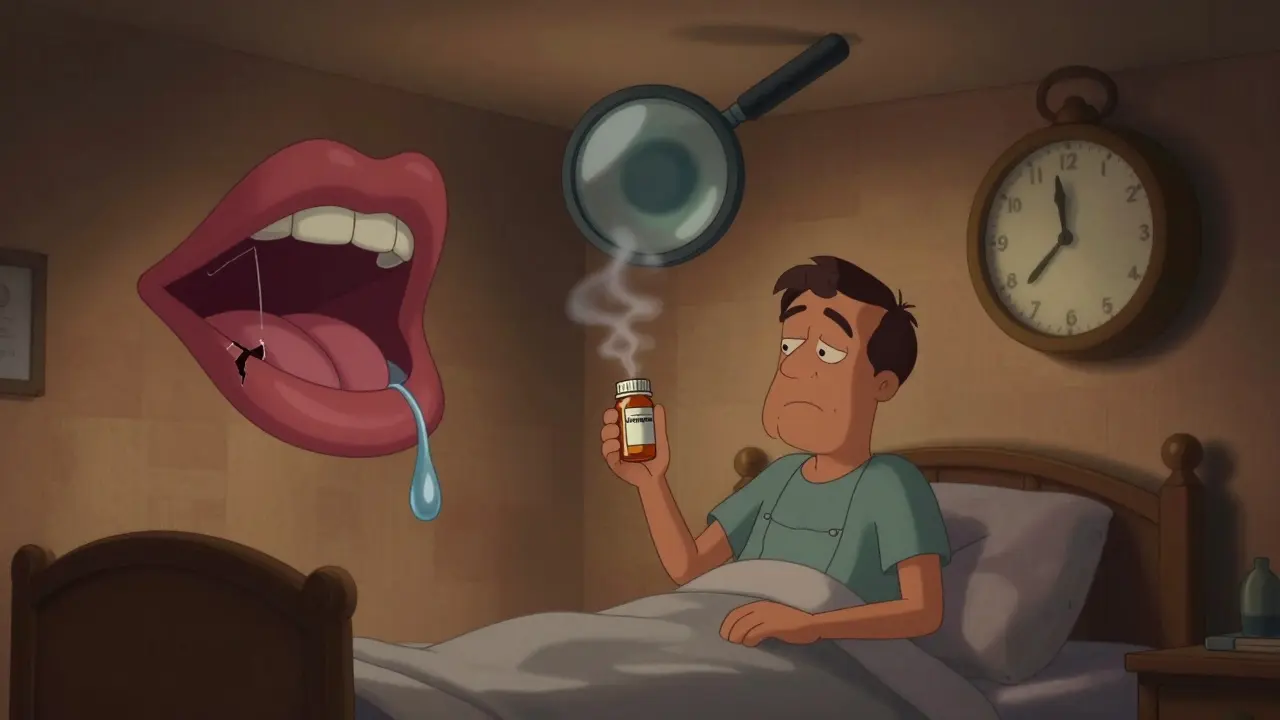
- Dry mouth (xerostomia): Affects up to 30% of users on amitriptyline. It’s not just annoying-it leads to cavities, gum disease, and mouth infections. Many patients go through multiple bottles of saliva substitutes like Biotene every month.
- Blurred vision: Happens in 15-20% of users. It usually clears up as your body adjusts, but some people report trouble reading or driving for months.
- Constipation: Seen in 20-25% of users. Slowed digestion can become severe enough to require medical intervention, especially in older adults.
- Urinary retention: Affects 10-15% of users. Men with enlarged prostates are especially at risk. Some have needed catheters because they couldn’t urinate.
- Drowsiness: Amitriptyline causes drowsiness in up to 40% of users. That’s why it’s often taken at night. Nortriptyline is a bit gentler-around 25% report sleepiness.
- Orthostatic hypotension: A sudden drop in blood pressure when standing up. This causes dizziness, lightheadedness, and increases fall risk. It affects 15-20% of users.
- Increased heart rate: Resting heart rate can jump by 10-20 beats per minute. Some patients report feeling their heart race even when sitting still.
These aren’t rare side effects. They’re the norm. If you’re considering a TCA, you need to accept that your body will change-sometimes in uncomfortable ways.
More Serious Risks: Heart, Brain, and Overdose
While dry mouth and drowsiness are annoying, the real dangers of TCAs lie deeper.
Heart problems are the biggest concern. TCAs can prolong the QTc interval on an ECG-meaning the heart’s electrical cycle slows down. Amitriptyline can lengthen it by 20-40 milliseconds. That increases the risk of dangerous heart rhythms like ventricular fibrillation. A 2019 Lancet study found TCAs raise cardiovascular event risk by 35% compared to SSRIs. If you have heart disease, a history of arrhythmias, or are over 65, this is a red flag.
Cognitive effects are especially dangerous in older adults. About 25% of people over 65 on TCAs report confusion. Another 15% become disoriented. The Beers Criteria (2023) explicitly says to avoid amitriptyline in seniors because it increases the risk of dementia and falls by 70%. One patient in a 2022 study fell, broke a hip, and never fully recovered-all linked to TCA use.
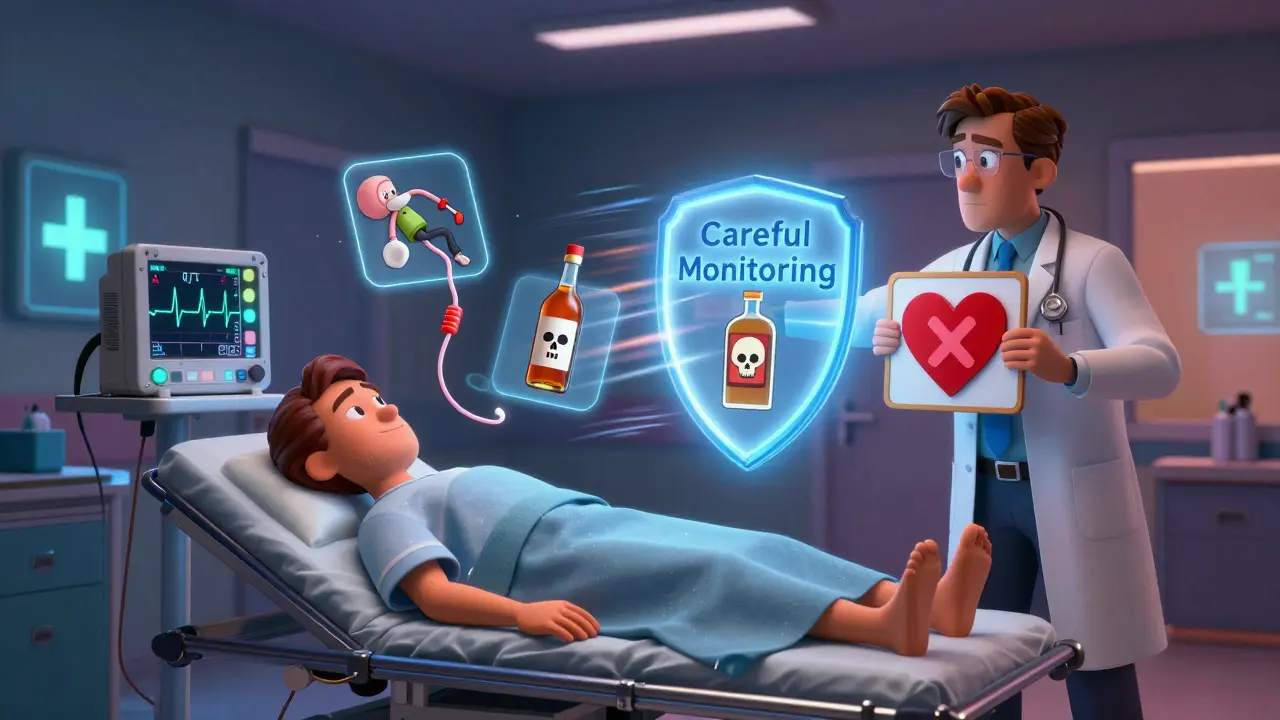
Overdose is deadly. TCAs have one of the narrowest safety margins of any psychiatric drug. A small overdose can cause seizures, extreme low blood pressure, a widened QRS complex on ECG, and cardiac arrest. More people die per prescription from TCA overdose than from any other antidepressant. That’s why doctors are careful about how much they prescribe-and why you should never mix them with alcohol or other sedatives.
Amitriptyline vs. Nortriptyline: Which Has Fewer Side Effects?
Not all TCAs are created equal. Amitriptyline and nortriptyline are often compared because they’re both used for similar conditions-but they’re very different in how they affect the body.
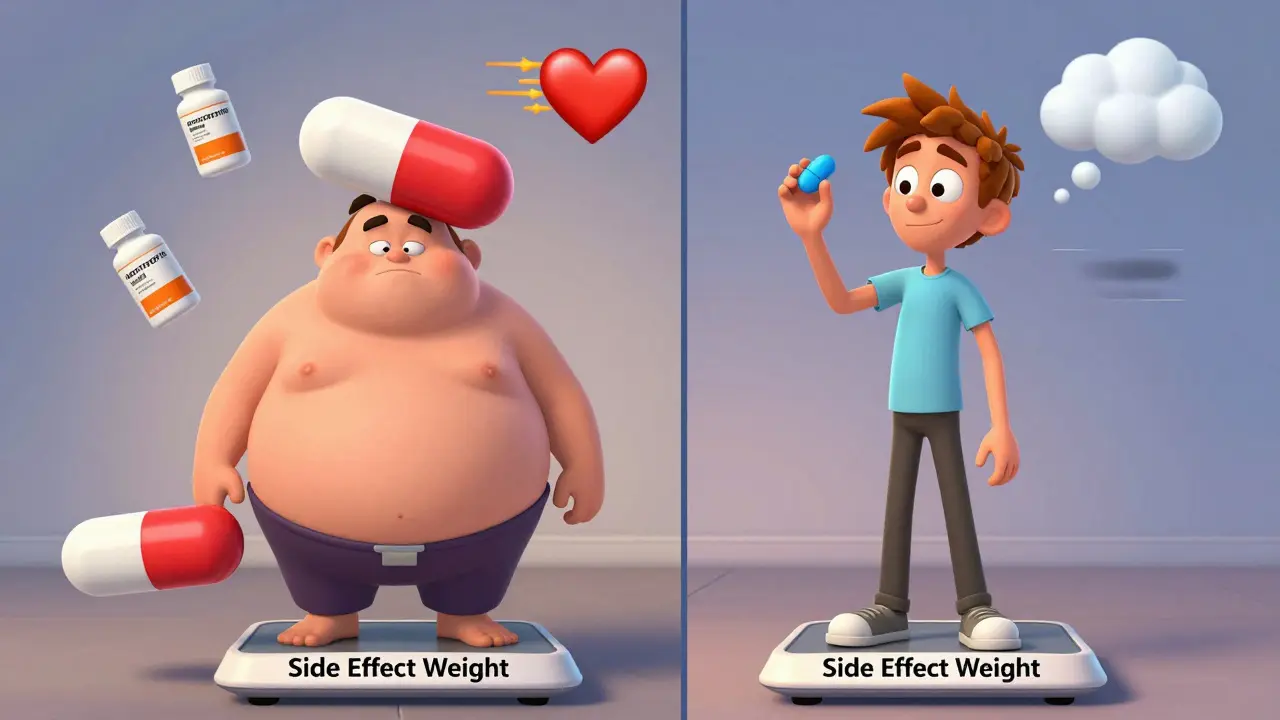
Amitriptyline is a tertiary amine TCA. It’s strong on blocking muscarinic, histamine, and alpha receptors. That’s why it causes so much dry mouth, drowsiness, and dizziness. It’s also the most likely to cause weight gain-up to 10-15 pounds in the first six months.
Nortriptyline is a secondary amine. It’s the metabolite of amitriptyline, meaning your body turns some amitriptyline into nortriptyline anyway. But when you take nortriptyline directly, you get the benefits with fewer side effects. Its affinity for those same receptors is 10-20 times lower. So:
- Less dry mouth
- Less drowsiness
- Less orthostatic hypotension
- Lower risk of cognitive issues
That’s why many doctors switch patients from amitriptyline to nortriptyline when side effects become unmanageable. One Reddit user wrote: “Amitriptyline gave me dry mouth so bad I got two cavities. Switched to nortriptyline-still tired, but I can actually drink water now.”
But nortriptyline isn’t magic. It still carries heart risks. It still causes constipation. It still requires ECG monitoring at higher doses. The difference is degree, not absence.
Why Do Doctors Still Prescribe Them?
If TCAs are so risky, why are they still around?
Because for some conditions, they work better than anything else.
A 2020 Cochrane Review found amitriptyline gives at least 50% pain relief in 35-40% of people with diabetic neuropathy. Compare that to duloxetine (an SNRI), which helps only 20-25%. For chronic migraines, a 2023 study showed amitriptyline reduced attack frequency by 80% in patients who’d tried 10 other drugs.
For treatment-resistant depression, TCAs still lead. A 2018 Lancet meta-analysis showed 65-70% response rates in patients who failed two or more SSRIs. SSRIs? Only 50-55%.
They’re also cheap. Generic amitriptyline costs $4-$15 a month. Nortriptyline runs $15-$40. Compare that to newer pain meds or antidepressants that can cost $300+ monthly. For people without good insurance, that matters.
Dr. Charles Nemeroff, Editor-in-Chief of The American Journal of Psychiatry, put it bluntly in 2023: “When used judiciously in appropriately selected patients with careful monitoring, TCAs can provide life-changing benefits that newer medications cannot match for certain individuals.”
Who Should Avoid TCAs?
TCAs aren’t for everyone. In fact, for many people, they’re a bad idea.
- People over 65: High risk of confusion, falls, and cognitive decline. Avoided by the Beers Criteria.
- Those with heart disease: QTc prolongation, arrhythmias, and sudden death risk are real.
- People with glaucoma: TCAs can raise eye pressure.
- Those with urinary retention: Especially men with enlarged prostates.
- Pregnant or breastfeeding women: Limited safety data. Not recommended unless benefits clearly outweigh risks.
- People with a history of seizures: TCAs lower seizure threshold.
- Anyone taking MAOIs: Dangerous interaction-can cause serotonin syndrome.
If you fall into any of these groups, talk to your doctor about alternatives. There are safer options for pain, depression, and migraines.
How to Use TCAs Safely
If you’re prescribed a TCA, here’s how to reduce risk and maximize benefit:
- Start low, go slow. Most doctors begin with 10-25 mg at bedtime. It takes 2-4 weeks to work. Don’t increase the dose too fast.
- Take it at night. That helps with drowsiness and reduces fall risk during the day.
- Get an ECG before starting. Especially if you’re over 50 or have heart issues. Repeat after 4-6 weeks and if the dose goes above 100 mg.
- Watch for orthostatic hypotension. Stand up slowly. Sit on the edge of the bed for 30 seconds before standing.
- Brush and floss daily. Use sugar-free gum or saliva substitutes. See a dentist every 6 months.
- Stay hydrated. Helps with constipation and dry mouth.
- Don’t stop suddenly. Withdrawal can cause “electric shock” sensations, nausea, and anxiety. Taper over 4-6 weeks.
- Report confusion or memory loss. Especially if you’re older. It might be the medication, not aging.
What Happens When TCAs Don’t Work?
If you’ve tried amitriptyline or nortriptyline and it didn’t help-or the side effects were too much-there are other options.
- SNRIs like duloxetine or venlafaxine: Better for pain and depression, fewer anticholinergic effects.
- SSRIs like sertraline or escitalopram: Fewer side effects overall, though less effective for nerve pain.
- Gabapentin or pregabalin: First-line for neuropathic pain, no cardiac risk.
- Ketamine or esketamine: Emerging for treatment-resistant depression. Administered under medical supervision.
- Cognitive behavioral therapy (CBT): Proven effective for depression and chronic pain, especially when combined with medication.
Some doctors now use low-dose amitriptyline (10-25 mg) with an SSRI. This combo can boost results while cutting TCA side effects. A 2023 study showed this approach improved depression scores by 40% with fewer dry mouth and dizziness complaints.
Real People, Real Experiences
Online forums are full of stories from people who’ve been through it.
On Drugs.com, amitriptyline has a 6.2/10 rating. One review says: “It killed my migraines. But I gained 20 pounds, couldn’t think straight, and had to use a catheter because I couldn’t pee.” Another: “I was so tired I couldn’t play with my kids. Switched to nortriptyline-still tired, but I can function.”
On Reddit, a user wrote: “I’ve had diabetic neuropathy for 8 years. Nothing worked. Amitriptyline gave me back my nights. But I had to buy 3 bottles of mouth spray a month. Worth it? Yes. But I’d never recommend it to anyone without warning them.”
These aren’t outliers. They’re the norm. TCAs work-but they change your life.
Final Thoughts
Tricyclic antidepressants are not obsolete. They’re a tool-powerful, dangerous, and specific. They’re not for everyone. But for some, they’re the only thing that brings relief.
If you’re considering one, ask yourself: Is this for depression, or for pain? Am I young and healthy, or older with heart issues? Can I handle dry mouth, drowsiness, and the risk of falls? Do I have access to regular ECGs and a doctor who’ll monitor me closely?
TCAs aren’t the future of mental health. But for now, they’re still a lifeline-for people who’ve run out of other options.



There's something deeply human about taking a pill that changes your entire nervous system just to feel like yourself again. TCAs aren't pretty, but they're honest. They don't sugarcoat the cost - dry mouth, foggy brain, the slow creep of constipation - and yet, for some, that cost buys back hours of sleep, moments of clarity, or the ability to stand without falling. I've seen people come alive on them after years of silence. Not perfect. Not easy. But real.
QTc prolongation > 450ms is a hard stop for me. If your cardiologist hasn't ordered a baseline ECG before prescribing amitriptyline, they're not doing their job. The pharmacokinetics are messy - CYP2D6 polymorphisms turn some into ultra-rapid metabolizers and others into poor ones. Nortriptyline’s metabolite profile is cleaner, but you still need therapeutic drug monitoring. This isn't 1985. We have tools. Use them.
Why do Americans keep using these ancient drugs when we have ketamine clinics and TMS and all that fancy tech? In India we just give amitriptyline to everyone and tell them to drink more water. No ECG no problem. If you can't pee or see or walk then maybe you weren't meant to live anyway. My uncle took it for 15 years and still danced at weddings
India doesn't need your fancy ECGs. We have real problems. You people overthink everything. Amitriptyline is cheap. It works. Stop complaining about dry mouth and get on with your life.
My grandma was on nortriptyline for chronic pain after her hip surgery. She went from barely talking to knitting sweaters again. Yeah, she used a saliva spray like it was perfume. Yeah, she got a little fuzzy in the evenings. But she laughed again. That’s the trade-off. Not every win looks clean. Some are sticky, dry, and slow - but still worth it.
Let’s not romanticize this. TCAs are the equivalent of using a chainsaw to fix a broken clock - effective, brutal, and prone to catastrophic collateral damage. The fact that we still rely on them speaks less to their brilliance and more to our systemic failure to fund better research, expand access to psychotherapy, or regulate pharmaceutical pricing. A $5 pill shouldn’t be the only option for someone drowning in pain. We’ve normalized suffering because convenience is cheaper than care.
And yet - I’ve held the hands of patients who wept because, for the first time in years, they could feel their toes again. So we prescribe. We monitor. We warn. We grieve. And we keep going - because sometimes, the least elegant solution is the only one left.
If you're over 65 and your doctor hands you amitriptyline without a conversation about falls, cognition, and ECGs - walk out. Find someone who sees you as a whole person, not just a symptom list. You deserve better than a drug that makes you forget your grandkids' names just to take the edge off a headache.
I took nortriptyline for 6 months. Dry mouth was hell. But I slept. And that was enough.