

When someone takes a blood thinner, they’re doing it to stay alive - to prevent a stroke, a heart attack, or a deadly clot. But what happens when things go wrong? What if they fall, bleed internally, or need emergency surgery? That’s where reversal agents come in. These aren’t just backup plans. They’re life-saving tools that can turn a potentially fatal situation into a manageable one. And understanding how they work isn’t just for doctors - it’s critical for anyone on these medications, or caring for someone who is.
Why Reversal Matters More Than You Think
Blood thinners, or anticoagulants, are among the most commonly prescribed drugs in the world. Millions of people with atrial fibrillation, deep vein thrombosis, or artificial heart valves rely on them daily. But here’s the catch: they don’t come with an off switch. Until recently, if a patient on a blood thinner suffered a major bleed - say, a brain hemorrhage - doctors had very limited options. They could wait for the drug to wear off, which might take days. Or they could give something like fresh frozen plasma or vitamin K, which worked slowly and inconsistently. That changed with the arrival of specific reversal agents. For the first time, we could neutralize these drugs quickly, predictably, and safely. But not all blood thinners are the same, and not all reversal agents work the same way. Choosing the right one depends on which drug the patient took, how severe the bleeding is, and what’s available at the hospital.The Three Main Reversal Agents You Need to Know
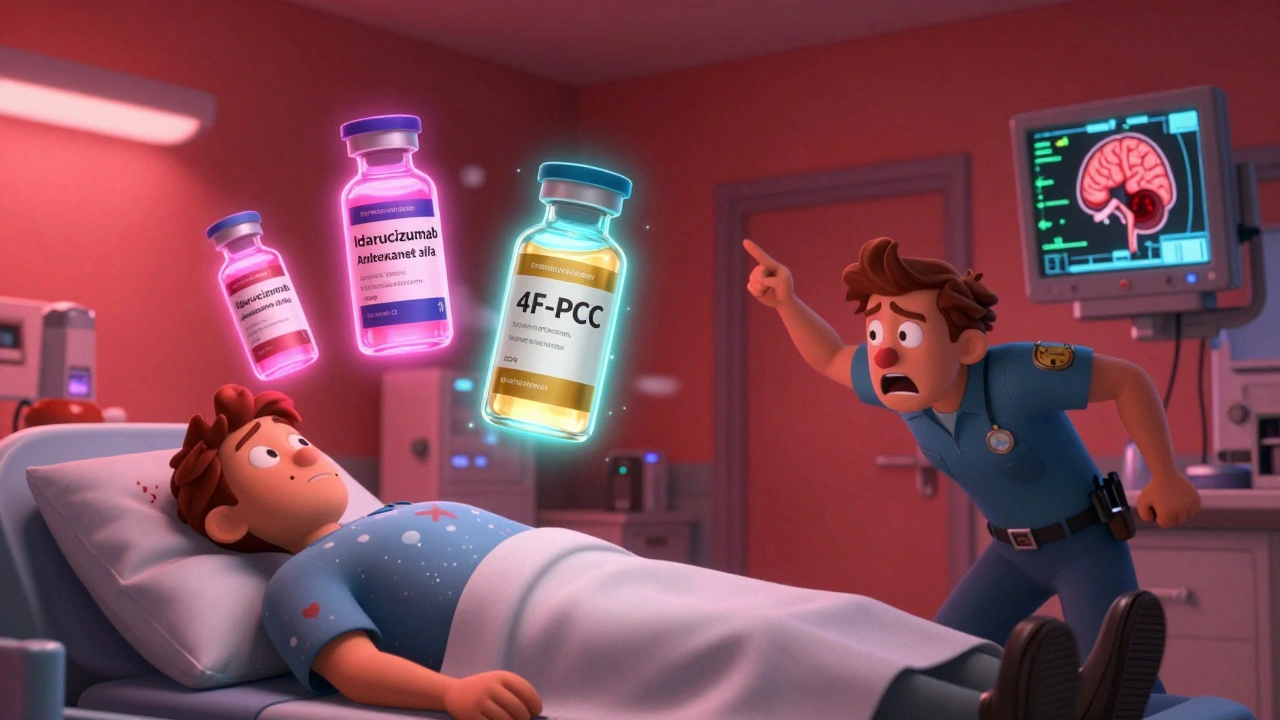
There are three primary tools used today to reverse blood thinners in emergencies. Each has a specific target, mechanism, and set of limitations.- Idarucizumab (Praxbind) - This is the only reversal agent approved specifically for dabigatran (Pradaxa). It’s a monoclonal antibody fragment that binds to dabigatran like a lock and key, instantly neutralizing it. In clinical trials, it achieved 100% reversal of anticoagulant effects in most patients within minutes. It’s fast, precise, and has a low risk of causing clots afterward. But it doesn’t work on any other blood thinner.
- Andexanet alfa (AndexXa) - This agent reverses Factor Xa inhibitors: rivaroxaban (Xarelto), apixaban (Eliquis), and edoxaban (Savaysa). It works by acting as a decoy - it grabs the drug before it can act on clotting factors. In the ANNEXA-4 trial, it stopped bleeding in 83% of patients within 2.5 hours. But it comes with a big downside: a 14% rate of new blood clots, including heart attacks and strokes. That’s nearly double the risk seen with other options.
- Four-factor Prothrombin Complex Concentrate (4F-PCC) - This is the old-school, non-specific option. It’s not designed to target any one drug. Instead, it floods the bloodstream with clotting factors to overwhelm the anticoagulant effect. It works for both warfarin and NOACs, making it a fallback when specific agents aren’t available. It’s cheaper - around $1,500 to $3,000 per dose - but less predictable. Success rates hover around 77%, and it can still cause clots, though less often than andexanet alfa.
Here’s the reality: if you’re on dabigatran, idarucizumab is your best bet. If you’re on Xarelto or Eliquis, andexanet alfa is ideal - if you can afford it. If neither is available, 4F-PCC is the fallback. And in many community hospitals, that’s all they have.
Cost vs. Survival: The Hard Truth
Let’s talk money. Because in real life, cost decides what gets used. Idarucizumab costs about $3,800 per vial. You need two. That’s $7,600. Andexanet alfa? Around $17,900 per treatment. That’s more than most people’s annual health insurance deductible. 4F-PCC? $1,500 to $3,000. The difference isn’t just a number - it’s a life-or-death decision for hospitals. A 2022 survey of hospital pharmacists found that 43% of institutions restricted andexanet alfa use to only the most severe cases - like intracranial hemorrhage. Some don’t stock it at all. Emergency rooms in rural areas might not even have idarucizumab on hand. That means patients often get 4F-PCC, even when a better option exists. And yet, studies show that when reversal agents are used correctly, mortality drops. In patients with brain bleeds, those who got idarucizumab had an 11% death rate. Those who didn’t? Up to 40%. That’s not just a statistic - it’s the difference between a patient going home and a family losing a loved one.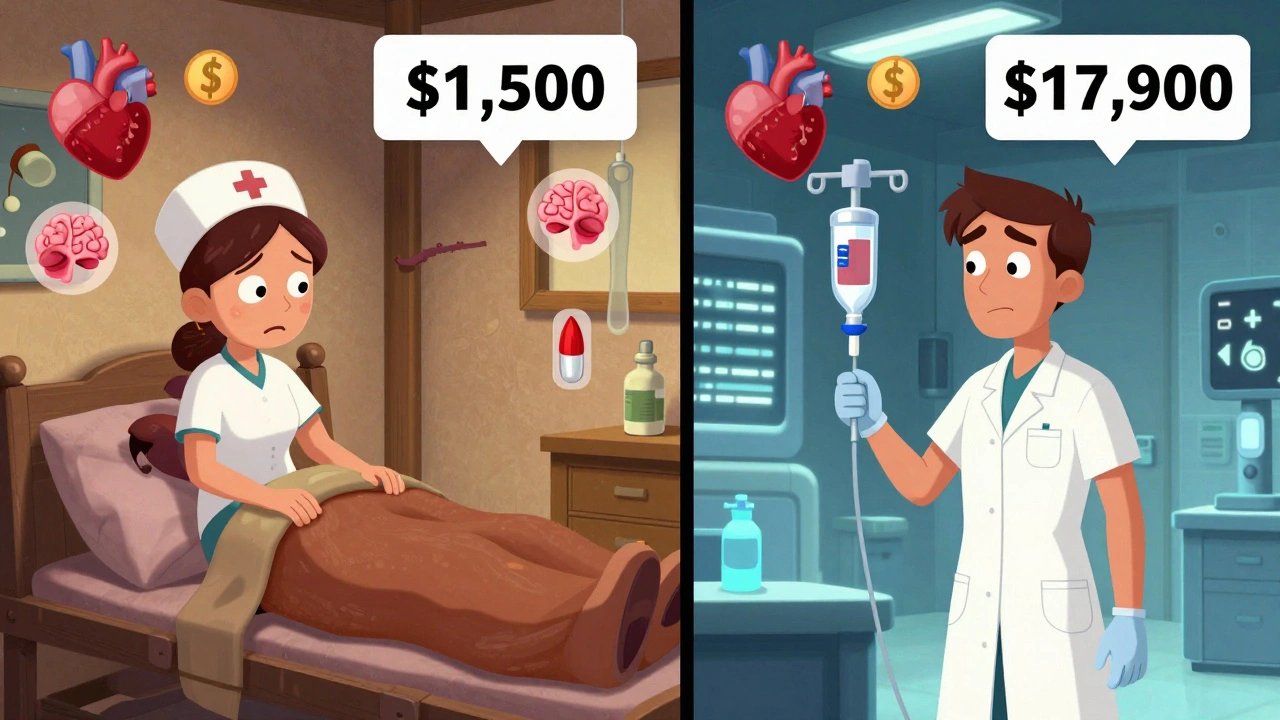
When Reversal Doesn’t Work - And Why
Reversal agents aren’t magic. They don’t fix the damage. They don’t replace surgery. And they don’t always work perfectly. One of the biggest surprises in clinical practice? Rebound anticoagulation. After idarucizumab neutralizes dabigatran, the drug can come back. About 23% of patients see their anticoagulant levels rise again within 24 hours. Why? Because dabigatran is stored in tissues and slowly leaks back into the blood. That’s why patients need to be monitored for at least 24 hours after reversal - and sometimes given a second dose. Andexanet alfa’s clotting risk is another problem. Even though it stops bleeding fast, it also increases the chance of new clots forming. That’s why guidelines now say it should only be used for life-threatening bleeding - not for patients needing routine surgery. For those cases, 4F-PCC or even temporary discontinuation might be safer. Then there’s timing. The faster you act, the better the outcome. Studies show that if reversal starts within two hours of bleeding, survival rates jump. Delays of more than four hours? Mortality doubles. That’s why hospitals with stroke centers and trauma units now keep reversal agents on standby - not tucked away in the pharmacy.What’s Coming Next: The Universal Reversal Agent
The holy grail isn’t just better reversal agents - it’s one that works for everything. Enter ciraparantag (PER977). This experimental drug, currently in Phase III trials, has shown promise in reversing not just dabigatran and Xarelto, but also heparin and low-molecular-weight heparins. In early studies, it reversed anticoagulation in under 10 minutes. If it works as expected, it could change everything. One drug. One protocol. No more guessing what the patient took. No more scrambling for the right vial. Just a single injection - fast, safe, and affordable. The trials are expected to finish by late 2024. If approved, ciraparantag could be on shelves by 2026. That’s not science fiction. That’s the next chapter in anticoagulant care.
What You Should Do Now
If you or a loved one is on a blood thinner, here’s what you need to know:- Know which drug you’re taking. Is it dabigatran? Rivaroxaban? Warfarin? Write it down. Keep the prescription bottle handy.
- Have a plan for emergencies. Ask your doctor: What’s the reversal protocol if I bleed? Do I need to carry a medical alert card?
- Know the signs of major bleeding. Unexplained bruising, blood in urine or stool, severe headaches, vomiting blood, sudden weakness - these aren’t normal. Call 911 immediately.
- Ask about reversal availability. If you live far from a major hospital, ask whether your local ER has reversal agents. If they don’t, ask if they have a transfer agreement with one that does.
There’s no shame in asking questions. These drugs save lives - but only if you understand how to respond when things go wrong.
Final Thoughts
Reversal agents have transformed anticoagulant therapy from a gamble into a controlled process. We went from hoping a patient would survive a bleed to knowing we can stop it - fast, reliably, and with evidence behind us. But access is uneven. Cost is a barrier. And mistakes still happen. The goal isn’t just to reverse the drug. It’s to reverse the outcome. To turn a tragedy into a recovery. And with ciraparantag on the horizon, we’re getting closer than ever.Can you reverse blood thinners at home?
No. Reversal agents are intravenous medications that must be given in a hospital or emergency setting under close monitoring. They require specialized equipment, trained staff, and immediate access to lab tests. Never attempt to reverse a blood thinner at home.
How long does it take for blood thinners to wear off naturally?
It depends on the drug. Warfarin can take 3-5 days. Dabigatran clears in about 12-24 hours in healthy people, but longer in those with kidney problems. Rivaroxaban and apixaban take 12-24 hours to wear off. In emergencies, waiting isn’t safe - that’s why reversal agents exist.
Do reversal agents cause blood clots?
Yes, some do. Andexanet alfa has a 14% risk of causing new clots like heart attacks or strokes. Idarucizumab has a much lower risk - around 5%. 4F-PCC falls in between. The risk is why these drugs are only used when bleeding is life-threatening.
Is there a universal reversal agent available yet?
Not yet. But ciraparantag (PER977) is in late-stage clinical trials and shows promise in reversing multiple types of blood thinners, including dabigatran, rivaroxaban, and heparin. If approved, it could be available by 2026.
What should I do if I’m on a blood thinner and need surgery?
Talk to your doctor at least 1-2 weeks before surgery. They’ll decide whether to stop the drug, bridge with heparin, or proceed with reversal agents on standby. Never stop your medication without medical advice - stopping suddenly can cause a clot.



ok but like… i read this whole thing and now i’m scared to take anything that isn’t aspirin?? like why does my blood even WORK if a single pill can make me a walking time bomb?? also typo in ‘dabigatran’ - it’s ‘dabigatran’ not ‘dabigatran’ lol
This is one of the clearest, most vital summaries of anticoagulant reversal I’ve seen outside of medical journals. The breakdown of each agent’s efficacy, cost, and risk profile is essential for patients and caregivers. The point about rebound anticoagulation after idarucizumab is especially critical - many don’t realize the danger doesn’t end with the first dose. Hospitals need to standardize protocols, and patients need to carry a printed summary of their drug and reversal plan.
broooooo i just got prescribed Xarelto last week 😭 and now i’m scared to sneeze. like… if i stub my toe do i need to call 911?? 🤯 also why is this so expensive?? i can’t even afford my co-pay 😭
So we’ve created a medical system where your survival depends on whether your hospital can afford a $17,900 vial… and we call this progress? The real reversal agent here is capitalism. It reverses your life expectancy based on your zip code. Also, ‘ciraparantag’ sounds like a rejected Star Wars droid name. 🤖
Thank you for this comprehensive overview. The distinction between reversal agents and their clinical applications is vital. Access disparities must be addressed. Patients deserve equitable care regardless of location or income. The data on mortality reduction is compelling and should drive policy change.
man i had no idea any of this even existed. i thought blood thinners just… wore off? like coffee? 😅 so if i’m on Eliquis and i fall, they just shoot me with this AndexXa thing? that’s wild. thanks for breaking it down so easy
so let me get this straight… you take a drug that could kill you if you sneeze wrong and then you pay 20 grand to undo it? and the hospital might not even have it?? this is why america sucks. also ‘4F-PCC’? what is this a Star Trek transporter code??
OMG this is the most important thing I’ve read all year. I’ve been on Pradaxa for 3 years and never knew about Praxbind. My mom had a bleed last year and they used PCC and she almost didn’t make it. I’m printing this out and taping it to my fridge. Also typo: ‘dabigatran’ not ‘dabigatran’ 😅
So let me get this straight - you’re telling me the only reason people survive these bleeds is because they’re rich enough to afford the ‘magic bullet’? And if you’re poor? You just… bleed out? This isn’t medicine. It’s a lottery. And you call this progress? How many people died because their hospital couldn’t afford $17,900? Just curious.
This gave me chills. I’m a caregiver for my dad on Xarelto and I never realized how much hinges on timing and access. Thank you for making this so human. I’m sharing this with every family member. We’re getting him a medical alert bracelet and a printed copy of this. We’ve got a plan now. That’s everything.
Why are we letting a foreign company control life-saving drugs? This is why we need American-made reversal agents. No more $17,900 vials from overseas. We’re paying for their R&D and then they charge us more than our rent. This is national security.
Ugh. Another post that makes me feel guilty for surviving. I’m on Eliquis. I didn’t ask for this. I didn’t choose this. And now I’m supposed to memorize drug names and hospital protocols? What if I’m alone when it happens? What if I’m in a car? What if I’m sleeping? You make it sound like I’m holding a live grenade. And now you’re telling me I need to ask my ER if they have the antidote? Like… what am I supposed to do? Beg? 😔
As someone from India where access to these drugs is nearly impossible, this post hit hard. We use warfarin because it’s cheap. But we have no reversal agents. No 4F-PCC. No nothing. People bleed out waiting for a plane to take them to Delhi. This isn’t just a US problem. Global equity in medicine isn’t a slogan - it’s a life or death issue. Thank you for writing this. We need more voices like yours.