


Ever wondered why your doctor asks for an EKG when you're feeling fine, but then suggests a "stress test" if you're having chest pains? It seems counterintuitive to put a potentially struggling heart under more stress, but that's exactly how these tests work. While a resting test shows the heart's "baseline," a stress test reveals how your heart handles a workload, often uncovering problems that stay hidden during a normal check-up. Understanding these ECG and Stress Tests helps you know what to expect and why they are critical for catching heart issues before they become emergencies.
Quick Summary
- ECG (EKG): A quick, non-invasive snap-shot of your heart's electrical activity.
- Stress Test: An ECG performed while your heart is working hard (via exercise or medicine).
- Core Goal: To find Coronary Artery Disease (CAD) and blood flow issues.
- Accuracy: Different types (Nuclear, Echo, Exercise) offer varying levels of sensitivity and specificity.
- Preparation: Usually requires avoiding caffeine and wearing gym clothes.
What exactly is an ECG?
An Electrocardiogram (commonly called an ECG or EKG) is a non-invasive test that records the electrical signals in your heart to check for irregular rhythms or signs of a previous heart attack. It's a bit like a voltage meter for your chest. Developed way back in 1903 by Willem Einthoven, this technology remains the gold standard for a first-look at cardiac health. When you get an ECG, a technician places sticky electrodes on your chest, arms, and legs. The actual recording only takes about 3 to 5 minutes. The test looks for specific patterns: if the electrical wave is too tall, too short, or delayed, it tells the doctor if the heart muscle is thickened or if the electricity is taking a "detour" due to damaged tissue.
Why a resting ECG isn't always enough
Here is the catch: some heart problems are "silent." You might have a blockage in an artery that allows enough blood through while you're sitting still, but not enough when you're jogging or climbing stairs. This is where Stress Testing is a diagnostic procedure that monitors the heart's electrical activity and blood flow during physical exertion or chemical stimulation. Think of it like testing a car's engine. You can look at the engine while it's idling (the resting ECG), and it might look perfect. But you don't really know if the engine is failing until you take it up to 100 km/h on the highway. By forcing the heart to work harder, doctors can see if the heart muscle begins to starve for oxygen-a condition known as ischemia.
The most common ways to "stress" the heart
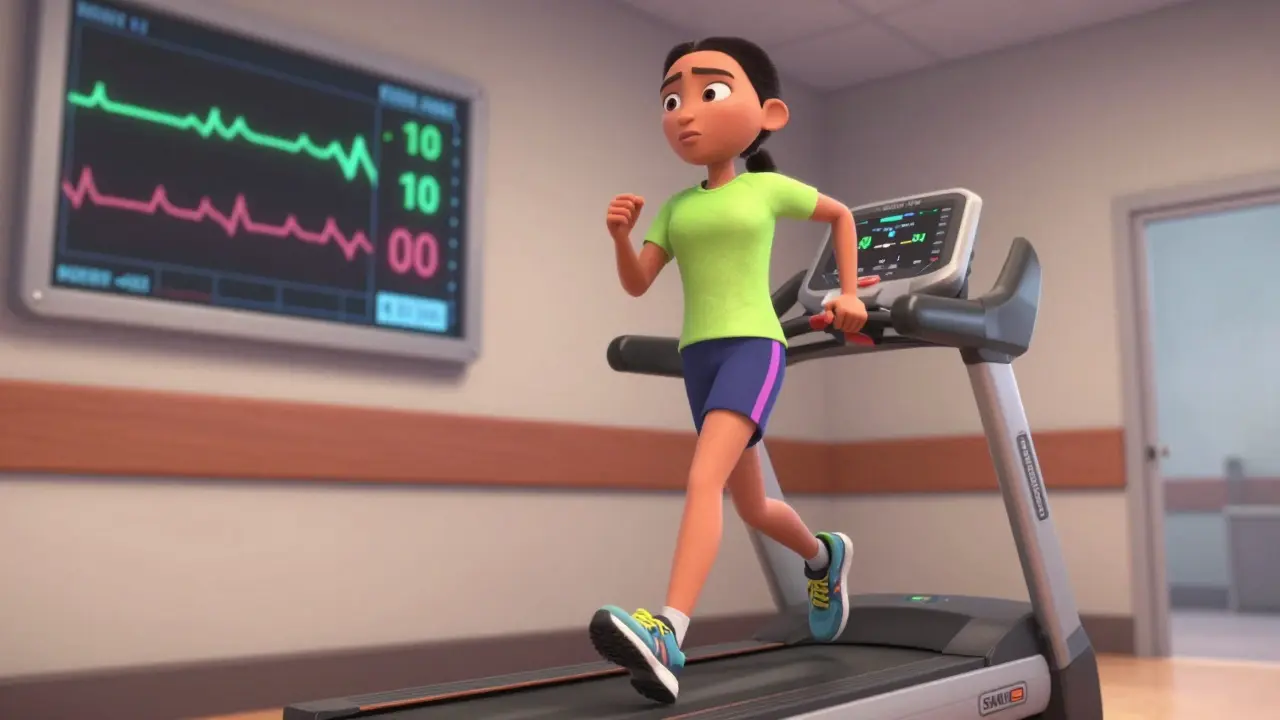
Not everyone can run on a treadmill, so doctors use different methods depending on your physical health. The most common approach is the exercise stress test, often using the Bruce Protocol, which is a standardized treadmill test that increases speed and incline every three minutes to progressively challenge the heart. If you have severe arthritis or asthma and can't walk on a treadmill, you'll likely get a chemical stress test. Doctors use pharmacological agents like adenosine or dobutamine to mimic the effects of exercise by widening blood vessels or making the heart beat faster. While effective, these can feel a bit intense-some patients report shortness of breath or a feeling of pressure during the process.
| Test Type | How it's done | Sensitivity (Detection Rate) | Main Trade-off |
|---|---|---|---|
| Standard Exercise ECG | Treadmill + ECG | ~68% | Lowest cost, lower accuracy |
| Stress Echocardiography | Exercise + Ultrasound | ~82% | No radiation, high specificity |
| Nuclear Stress Test | Radioactive tracer + Imaging | ~85-89% | High accuracy, involves radiation |
Which test is right for you?
Choosing a test usually depends on your risk level and your medical history. If you are a middle-aged man with a few risk factors, a standard treadmill test might be the first stop. However, doctors are increasingly moving toward Stress Echocardiography, which combines a stress test with ultrasound imaging. This is particularly helpful for women, as standard ECG stress tests can sometimes produce false negatives in premenopausal women due to differences in heart physiology.
For those who need the highest level of detail, a nuclear stress test is used. This involves injecting a radioactive tracer (like thallium-201) into the bloodstream. A special camera then tracks how the tracer moves through the heart. If a part of the heart isn't getting enough blood, the tracer won't reach it, creating a "cold spot" on the image. It's highly accurate but does expose you to a small amount of radiation-roughly equivalent to a few years of natural background radiation.
What to expect and how to prepare
The process is generally straightforward, but a little prep goes a long way. First, steer clear of caffeine for at least 24 hours. Caffeine can interfere with the chemical agents used in pharmacological tests and can artificially spike your heart rate, potentially skewing the results. Wear comfortable clothes and sneakers-you don't want to be doing the Bruce protocol in dress shoes.
During the test, the team will monitor four main things: your heart rate (beats per minute), your blood pressure (mmHg), the ECG waveforms, and your oxygen saturation. If you're on a treadmill, the incline and speed will increase every few minutes. You'll know you've reached the goal when you hit 85% of your age-predicted maximum heart rate (a rough formula is 220 minus your age).
Understanding the results
When the doctor looks at your results, they aren't just looking for a "pass" or "fail." They look at prognostic markers. One of the most important is ST-segment depression-a specific dip in the ECG wave that suggests the heart muscle isn't getting enough oxygen. They also look at your "functional capacity." Interestingly, data suggests that for every extra minute you can last on the treadmill, your risk of a major cardiac event drops by about 12%. If the test shows regional wall-motion abnormalities (meaning a part of the heart isn't pumping as strongly as the rest), there's a very high chance-about 92% accuracy-that there is a blockage in that specific coronary artery.
When are these tests not recommended?
Despite their usefulness, stress tests aren't for everyone. It's dangerous to put an unstable heart under pressure. For instance, if you've had a heart attack in the last 48 hours, or if you have unstable arrhythmias or acute heart failure, a stress test is strictly off-limits. In these cases, doctors will use safer alternatives, like a coronary CT angiography, to see the arteries without forcing the heart to work harder.
What is the difference between an ECG and a Stress Test?
An ECG is a resting test that records your heart's electrical activity at a single moment in time. A stress test is essentially an ECG that is monitored while your heart is under stress-either from physical exercise (like a treadmill) or from medication that mimics exercise. The stress test is designed to find problems that only appear when the heart is working hard.
Will a stress test be painful?
It is not "painful" in the sense of a needle or surgery, but it is physically demanding. If you are doing an exercise test, you'll feel the typical strain of a workout-shortness of breath and a fast heartbeat. If you are doing a chemical stress test, you might experience transient side effects like dizziness, flushing, or a feeling of chest pressure, but these usually pass within a few minutes.
How accurate are these tests?
Accuracy varies by method. A standard exercise ECG has about 68% sensitivity for detecting coronary artery disease. Stress echocardiography is more specific (around 88%), and nuclear stress tests are the most sensitive (up to 89%). Because no single test is 100% perfect, doctors often combine these results with your symptoms and medical history to make a diagnosis.
How should I prepare for my appointment?
Avoid caffeine for 24 hours before the test, as it can interfere with the medication used in some stress tests and can affect your heart rate. Wear comfortable athletic clothing and a pair of supportive sneakers. Make sure to tell your doctor about any medications you're taking, as some (like beta-blockers) can keep your heart rate too low during the test, potentially hiding the results.
Can a stress test find a heart attack?
A resting ECG can often show signs of a *past* heart attack by identifying permanent damage to the heart muscle. A stress test is better at finding "silent ischemia," which is when the heart isn't getting enough oxygen during activity, warning you that a future heart attack is possible if the blockage isn't treated.
Next Steps and Troubleshooting
If your test results come back as "inconclusive," don't panic. This happens in about 25% of intermediate-risk cases. It usually means the data wasn't clear enough to make a definitive call. Your doctor might suggest a more detailed imaging test, like a Cardiac CT or a coronary angiography, to get a direct look at the arteries.
If you experience severe chest pain or dizziness during a treadmill test, the technician will stop the test immediately. This is a safety feature, not a failure. Be sure to discuss any "warning signs" you felt during the test with your cardiologist, as the symptoms you experience are just as important as the lines on the ECG graph.





Write a comment