

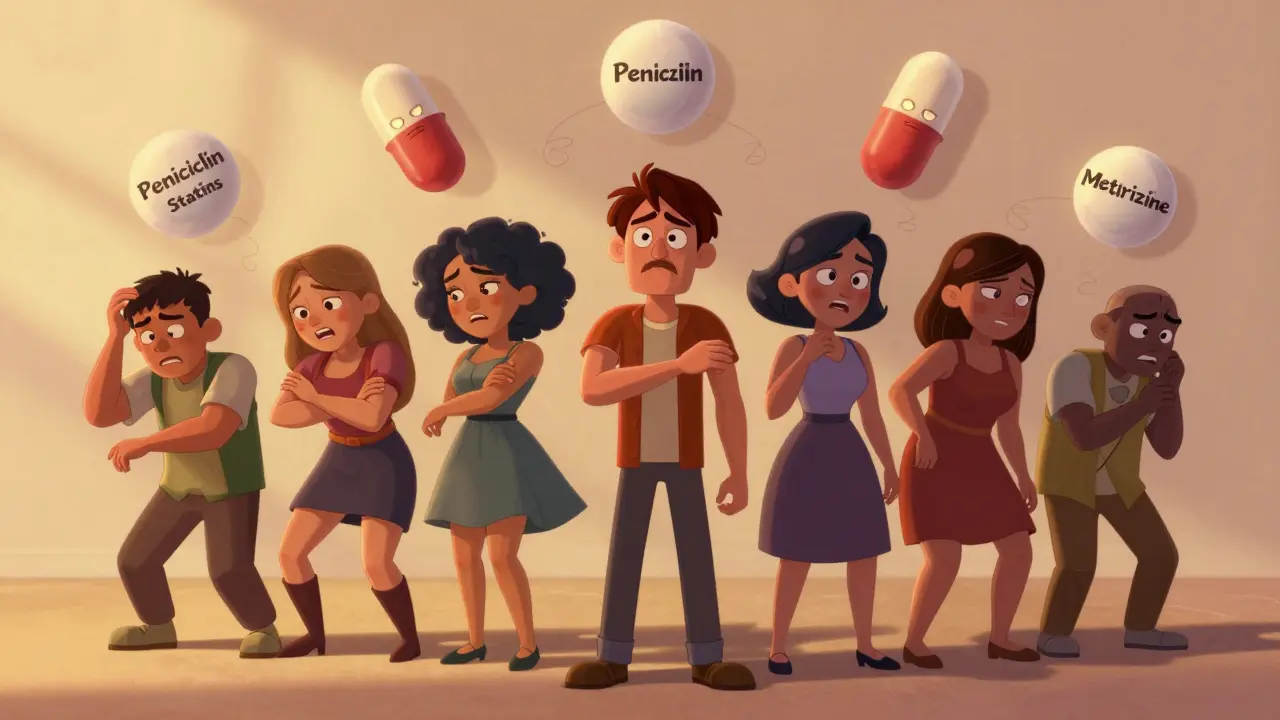
Itching from medications isn’t just a minor annoyance-it can be unbearable, disrupt sleep, and make you want to quit your treatment altogether. If you’ve started a new pill and suddenly can’t stop scratching, you’re not alone. Drug-induced pruritus, or itching caused by medications, affects 1-2% of people on certain drugs, and it’s often missed because doctors don’t always connect the dots between a new itch and a new prescription.
What Medications Cause Itching?
Itching isn’t tied to one type of drug. It shows up with antibiotics like penicillin and tetracycline, heart medications like beta-blockers and amiodarone, cholesterol drugs like statins, and even common pain relievers like aspirin and NSAIDs. But some offenders are more notorious than others.Heparin, used to prevent blood clots, causes itching in about 1 in 90 people. Trimethoprim-sulfamethoxazole, an antibiotic, hits 1 in 94. Calcium channel blockers, often prescribed for high blood pressure, lead to itching in nearly 1 in 110 patients. These aren’t rare outliers-they’re common enough that your doctor should consider them when you report unexplained itching.
Opioids like morphine are another big one. Up to 90% of people who get morphine via spinal injection develop intense itching within 6 to 12 hours. Even more surprising: antihistamines like cetirizine and levocetirizine-medications meant to stop itching-can cause severe itching when you stop taking them after long-term use. The FDA issued a warning in 2023 after tracking 209 cases where people developed debilitating itching after discontinuing these drugs, with some needing hospitalization or reporting suicidal thoughts.
Why Does This Happen?
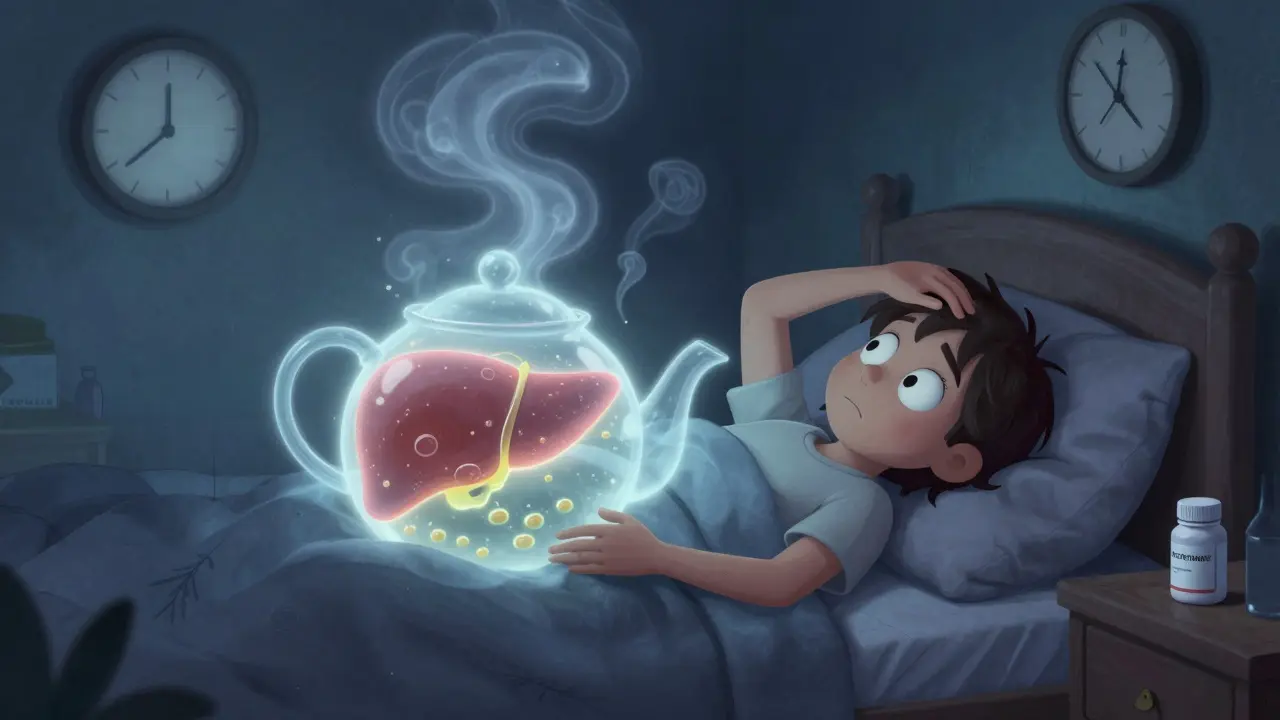
Not all itching works the same way. Some drugs trigger histamine release, which is why antihistamines help in cases like hives. But many drug-induced itches have nothing to do with histamine. That’s why taking Benadryl might do nothing at all.Cholestasis is one hidden cause. Some medications, like certain antibiotics or birth control pills, slow down bile flow in the liver. Bile acids build up in the skin and trigger itch receptors. This kind of itching often gets worse at night and doesn’t come with a rash.
Opioids activate a different pathway in the nervous system, directly stimulating itch nerves without involving histamine. That’s why drugs like naltrexone or butorphanol can help with opioid-induced itching-because they block those specific nerve signals, not histamine.
And then there’s the immune system. Some people develop delayed allergic reactions that show up as itching days or weeks after starting a drug. This isn’t a rash or swelling-it’s just relentless itch. In Black patients, chloroquine (used for malaria) causes itching in up to 90% of users. Hydroxyethyl starch, used in IV fluids during surgery, can cause itching that lasts for over a year.
Who’s Most at Risk?
Itching from medications doesn’t affect everyone equally. Studies show women are more likely to experience it-70% of reported cases were female. Black patients are also at higher risk, making up 40% of those affected, compared to just 23% in the general population. This isn’t random. Genetics, skin biology, and how the body processes certain drugs all play a role.Duration matters too. Most people who develop itching after stopping antihistamines had been taking them for at least three months. The median time was over two and a half years. The longer you’re on a drug, the higher your chance of developing this side effect. That’s why it’s often mistaken for aging skin or dryness-until you realize the itching started right after you began a new medication.
How Is It Diagnosed?
There’s no blood test for drug-induced pruritus. Diagnosis comes down to timing and elimination. If the itching started after you began a new medication, and it improves after stopping it, that’s strong evidence. But stopping a drug isn’t always safe-especially if it’s for high blood pressure, epilepsy, or depression.Doctors often use a process called dechallenge-rechallenge. Stop the suspected drug. If the itching fades, that’s a clue. Then, under medical supervision, restart it. If the itching comes back, it’s confirmed. The FDA found that 90% of people who restarted cetirizine after withdrawal saw their itching disappear. But only 38% of those who tried tapering off after restarting had lasting relief.
Keep a detailed list of everything you’re taking-prescription, over-the-counter, supplements, even herbal teas. Many cases are missed because patients forget to mention that they started taking melatonin, ibuprofen, or fish oil.
What Can You Do About It?
If your itching is mild and you’re not on a life-saving drug, stopping the medication may be the best solution. But if you can’t stop it-say, you need your blood pressure pill-there are other options.Topical treatments: Moisturizers help if dry skin is making it worse. Capsaicin cream (the stuff in chili peppers) can desensitize itch nerves over time. Low-dose steroid creams can calm inflammation if there’s any skin damage from scratching.
Oral options: Antihistamines like cetirizine or hydroxyzine work for histamine-related itch, but not for everything. For non-histamine itch, antidepressants like doxepin or amitriptyline can help by calming overactive nerve signals. Some studies show they’re as effective as antihistamines for chronic itch.
For opioid-induced itching, drugs like ondansetron (usually for nausea) or naltrexone can block the itch pathway without affecting pain relief. These aren’t first-line, but they’re lifesavers when standard treatments fail.
For cholestasis-related itching, medications like cholestyramine (a bile acid binder) can help. It’s not a cure, but it can reduce the intensity enough to make life bearable.

What to Avoid
Don’t just keep taking antihistamines hoping they’ll work. If they don’t help after a week, the itch isn’t histamine-driven. Keep using them anyway won’t help-and might cause drowsiness or dry mouth.Avoid hot showers. Heat makes itching worse. Use lukewarm water and pat your skin dry instead of rubbing. Skip scented soaps, alcohol-based lotions, and wool clothing. These irritate already sensitive skin.
And never stop a critical medication without talking to your doctor. If you’re on blood thinners, seizure meds, or antidepressants, quitting cold turkey can be dangerous. Work with your provider to find a safer alternative.
When to Seek Help
See a doctor if:- The itching lasts more than two weeks without a clear cause
- You have no rash but still can’t stop scratching
- It’s keeping you awake at night
- You’ve tried stopping a medication and the itch didn’t go away
- You feel hopeless, anxious, or have thoughts of self-harm because of the itch
The FDA documented cases where severe itching led to hospitalization and suicidal ideation. This isn’t just skin deep-it can break your mental health too. If you’re struggling, tell your doctor. There are treatments.
What’s Changing Now?
The FDA’s 2023 warning about antihistamine withdrawal was a turning point. For the first time, manufacturers had to update labels to warn people about this rare but serious side effect. That means more doctors will know to ask about it.Researchers are now focusing on non-histamine pathways. If we understand how opioids, bile acids, and other chemicals trigger itch without histamine, we can develop better drugs. Clinical trials are already testing new blockers that target specific nerve receptors involved in chronic itch.
Electronic health records are helping too. Studies using data from over a million patients have found patterns we never saw before. We now know which drugs are riskiest, who’s most vulnerable, and how long it takes for itching to appear.
For now, the best thing you can do is pay attention. If you start itching after a new medication, write it down. Note the date, how bad it is, and what you’re taking. Bring that list to your doctor. You might be the one who helps uncover the next big clue in drug-induced pruritus.



Okay but like… I started taking lisinopril last month and my skin felt like it was crawling for three weeks. I thought I was going crazy. My dermatologist laughed until I told her I’d been on it for six weeks. Then she went quiet. Turned out it was the med. I switched to losartan and my skin finally stopped screaming. Don’t ignore it. It’s not ‘just dry skin.’
Also, if you’re on statins and itching? Try CoQ10. Not a cure, but it helped me sleep again.
Of course the FDA finally ‘warns’ about antihistamine withdrawal after 209 cases. Because nothing says ‘public health’ like waiting until people are suicidal before you update a label. Meanwhile, my 80-year-old neighbor took Zyrtec for 12 years and stopped cold turkey-now she’s in therapy for ‘anxiety.’ Guess what? It was the itching. Not her brain. Just the drug. And now she’s terrified of every pill.
Someone should sue the pharmaceutical industry for emotional damages. Not just the physical ones.
Wait wait wait-so you’re telling me that the thing I’ve been using to stop my allergies is the thing that made me itch for 14 months after I quit??
I took cetirizine for 3 years. Stopped because I thought I was ‘immune.’ Then I started scratching like I had a thousand fire ants in my socks. No rash. Just… itch. All night. Every night. I cried. I scratched until I bled. I thought I was losing my mind.
I didn’t know this was a thing. No doctor ever told me. I thought I was just ‘sensitive.’
Thank you for writing this. I feel less alone.
Listen. If you’re on opioids and itching? Don’t just take Benadryl and hope. It won’t work. I had spinal morphine after surgery. Felt like my skin was being peeled off with a cheese grater. My nurse gave me naltrexone. Within 20 minutes, the itch vanished. Not reduced. Gone.
Doctors still treat this like it’s a joke. It’s not. It’s torture. And it’s treatable. Ask for naltrexone. Or ondansetron. Don’t let them dismiss you. You’re not being dramatic. You’re being smart.
So… you’re telling me the thing I’ve been taking for my allergies is the reason I can’t sleep? And the doctor just says ‘use lotion’? LOL. Classic. I’ve been on levocetirizine for 5 years. Stopped it last year. Started itching like I was possessed. My mom said I looked like a zombie. I looked in the mirror and didn’t recognize myself. I didn’t even know this was a thing until I Googled ‘itching after stopping antihistamine’ at 3am. Turns out, I’m not crazy. Just medicated.
OH MY GOD. I thought I was going insane. I was on amiodarone for AFib. Started itching like I’d been dipped in poison ivy. No rash. Just… pure, unrelenting, soul-crushing itch. I scratched my arms raw. I wore gloves to bed. I cried in the shower. My cardiologist said, ‘It’s probably just dry skin.’
Turns out, it was the drug. I switched to dofetilide. The itch? Gone in 72 hours. I feel like I’ve been reborn.
Why isn’t this common knowledge? Why do we have to suffer like this before someone takes us seriously? I’m not exaggerating. This is a medical emergency disguised as a nuisance.
Let me just say this, with all the love and care in the world: if you’re experiencing unexplained, persistent itching after starting a new medication-especially if it’s been more than two weeks-don’t wait for your doctor to connect the dots. Write it down. Track it. Bring a list. Include everything-even that ‘harmless’ herbal tea you started drinking because ‘it’s natural.’
And if your doctor says, ‘It’s probably just stress’ or ‘You’re overreacting’-find a new doctor. You deserve better. Your body is speaking. Listen. And don’t let anyone gaslight you into thinking it’s ‘all in your head.’ It’s not. It’s real. And it’s treatable. I’ve seen it. I’ve lived it. You’re not alone.
I’ve been on hydrochlorothiazide for 10 years. No problems. Then last year, I started itching like crazy. No rash. Just… everywhere. I thought I was getting older. Skin changes. Dryness. Blah.
Then I read this article. I stopped the med for a week (with my doctor’s okay). The itch? Vanished. Restarted it? Came back in 48 hours.
My doctor was shocked. Said he’d never seen it with diuretics. Turns out, he’s not alone. I’ve been telling everyone I know who’s on meds: ‘If you itch, don’t ignore it.’
It’s not just ‘annoying.’ It’s your body screaming.
so… like… i think this is why i’ve been feeling so… empty? i was on cetirizine for 4 years. stopped it because i wanted to be ‘clean.’ then i started itching so bad i couldn’t think. i cried every night. i felt like i was dissolving. i thought i was broken. but maybe… maybe it wasn’t me? maybe it was the drug? maybe i wasn’t weak? maybe i was just… poisoned? by medicine? i don’t know anymore.
someone please tell me i’m not crazy.
Yo. I just got back from India. My cousin there takes chloroquine for malaria prophylaxis. He said 90% of black people get itchy as hell on it. I was like, ‘Wait, what?’ He said, ‘Yeah, we call it ‘chloroquine dance.’ You scratch, you scream, you cry, you go to the hospital.’
Then I read this and realized… we’ve known this for decades. But in the US? We act like it’s new. 🤦♂️
Global health inequality is real. And it starts with itching.
Let’s be brutally honest here: the entire medical establishment has been systematically ignoring drug-induced pruritus because it doesn’t fit into a neat diagnostic box. No biomarker. No imaging. No quick fix. Just a person scratching until they bleed, and a doctor saying ‘use moisturizer.’
This isn’t an ‘edge case.’ It’s a systemic failure. The FDA’s 2023 warning was a PR move, not a policy shift. Pharmaceutical companies don’t want you to know that their $200/month drug causes debilitating side effects that last for months after discontinuation. They want you to keep taking it. Or switch to their newer, more expensive version.
And don’t get me started on the fact that Black patients are disproportionately affected, yet studies still underrepresent them. This isn’t just about itching. It’s about who gets heard. Who gets believed. Who gets treated. And right now? Too many of us are being left to suffer in silence because the system doesn’t care enough to look deeper.
Look, I get it. But this isn’t some ‘medical mystery.’ It’s just people being lazy. If you start itching after a new pill? Stop it. That’s it. End of story. No need for rechallenge. No need for ‘clinical trials.’ Just quit the damn thing and see what happens. If it stops? You found your culprit. If it doesn’t? Then it’s something else.
Why do we need a 10-page article to tell us this? We’ve had ‘if it hurts, stop doing it’ since kindergarten. Why is medicine so complicated now? Maybe we need to stop overcomplicating everything and just listen to our bodies. America’s over-medicated. We need less pills, not more labels.
Wait-so you’re telling me the itching stopped when you switched meds? Same thing happened to me with statins. I switched from atorvastatin to rosuvastatin and the itch vanished. My doctor said, ‘They’re basically the same.’ But they’re not. Not for my body.
Also, I tried capsaicin cream. It burned like hell at first. But after 3 days? The itch started fading. Now I use it every night. It’s weird. But it works.
Thanks for reminding me I’m not the only one who’s been through this.