

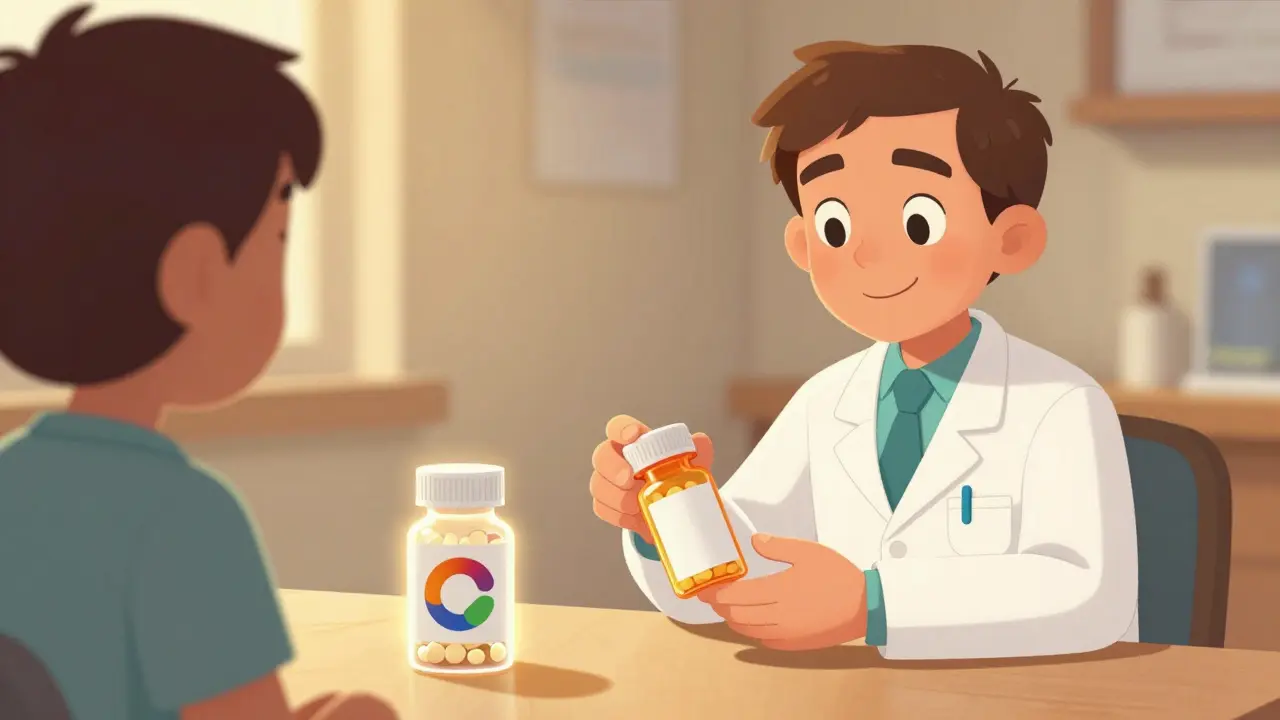
When a patient walks into the pharmacy with a prescription for a brand-name drug, the pharmacist’s first thought shouldn’t just be, “Can I swap this for a cheaper generic?” It should be, “Is this the right generic?” That’s where authorized generics come in-often overlooked, but sometimes the best choice.
What exactly is an authorized generic?
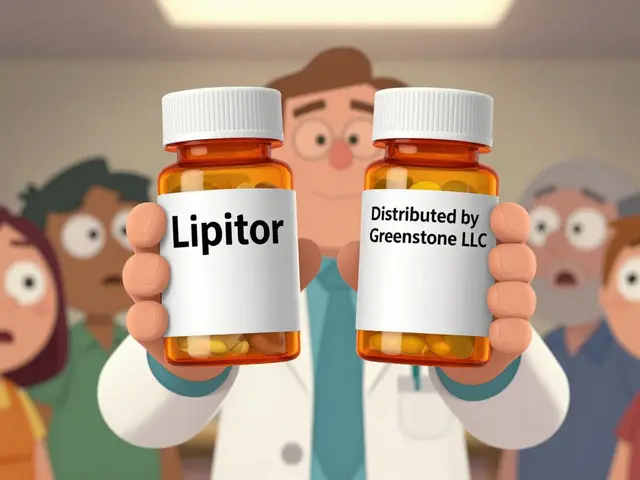
An authorized generic isn’t just another generic. It’s the exact same pill, capsule, or liquid as the brand-name drug-same active ingredient, same inactive ingredients, same manufacturing process. The only difference? No brand name on the label. It’s made by the original drug company or under their direct permission, then sold under a different label, often at a fraction of the cost. For example, if you’re prescribed Lipitor (atorvastatin), the authorized generic is made by Pfizer, the same company that makes Lipitor, but it’s sold as “atorvastatin calcium” with a different color or shape. The inside? Identical. No changes. No compromises. This isn’t the same as a regular generic. Regular generics only need to prove they’re bioequivalent-meaning they deliver the same amount of active ingredient into the bloodstream. But they can have different fillers, dyes, or binders. That’s fine for most people. But not for everyone.When should pharmacists push authorized generics?
There are three clear situations where an authorized generic isn’t just a good idea-it’s the safest, most effective option.1. Patients with allergies or sensitivities to inactive ingredients
Regular generics often use different fillers than the brand. One common culprit: lactose. People with severe lactose intolerance can have bloating, diarrhea, or worse after switching. Another: gluten. For someone with celiac disease, even trace amounts can trigger an immune reaction. Gelatin capsules? A problem for vegans or those with religious dietary restrictions. Authorized generics avoid these risks because they use the exact same inactive ingredients as the brand. If a patient has been tolerating the brand for years, switching to the authorized generic means no new surprises. A 2021 survey of over 1,200 pharmacists found that 12% of patients reported unexpected side effects after switching to a regular generic-most linked to inactive ingredients.2. Narrow therapeutic index (NTI) drugs
Some medications have a razor-thin margin between helping and harming. Warfarin, levothyroxine, phenytoin-these drugs need to stay within a very tight blood concentration range. Too little? The condition returns. Too much? Risk of bleeding, seizures, or heart problems. The FDA has documented cases where switching from brand to regular generic caused measurable changes in blood levels for these drugs. In 3-5% of patients, this led to clinical issues. Authorized generics eliminate that risk because they’re chemically identical. No bioequivalence guesswork. No variability in absorption. Just the same drug the patient was stable on.3. Modified-release formulations
Time-release pills, extended-release capsules, enteric-coated tablets-these are complex. The way the drug is released over time matters. Regular generics must meet FDA bioequivalence standards, but those standards don’t always capture how the drug behaves in the body over 12 or 24 hours. For example, a patient on extended-release metformin might feel fine on the brand, but after switching to a regular generic, they start having nausea or diarrhea. Why? The release profile might be slightly off. Authorized generics don’t have this issue-they’re the same tablet, just without the brand name.How to spot an authorized generic
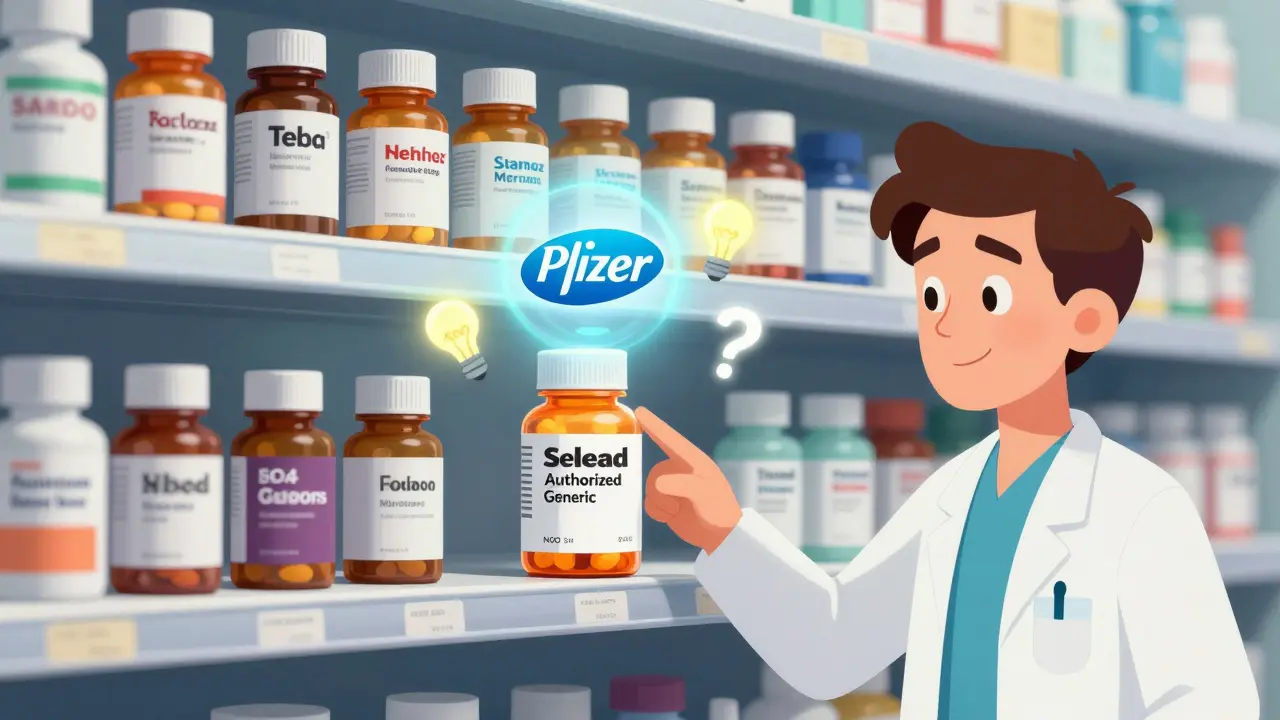
You can’t tell by looking at the pill. A blue capsule might be the brand. A white one might be the authorized generic. Same ingredients. Different color. The only reliable way? Check the FDA’s quarterly list of authorized generics. As of September 2023, there were 257 authorized generics on that list-about 5% of all brand-name drugs with generics available. You can also check the National Drug Code (NDC). If the labeler code matches the original brand manufacturer-like Pfizer, Merck, or AbbVie-it’s likely an authorized generic. Regular generics usually have labeler codes from companies like Teva, Mylan, or Sandoz. And here’s a key point: authorized generics don’t appear in the FDA’s Orange Book as separate entries. They’re treated as the same product as the brand. That’s why pharmacists need to know how to find them outside the usual databases.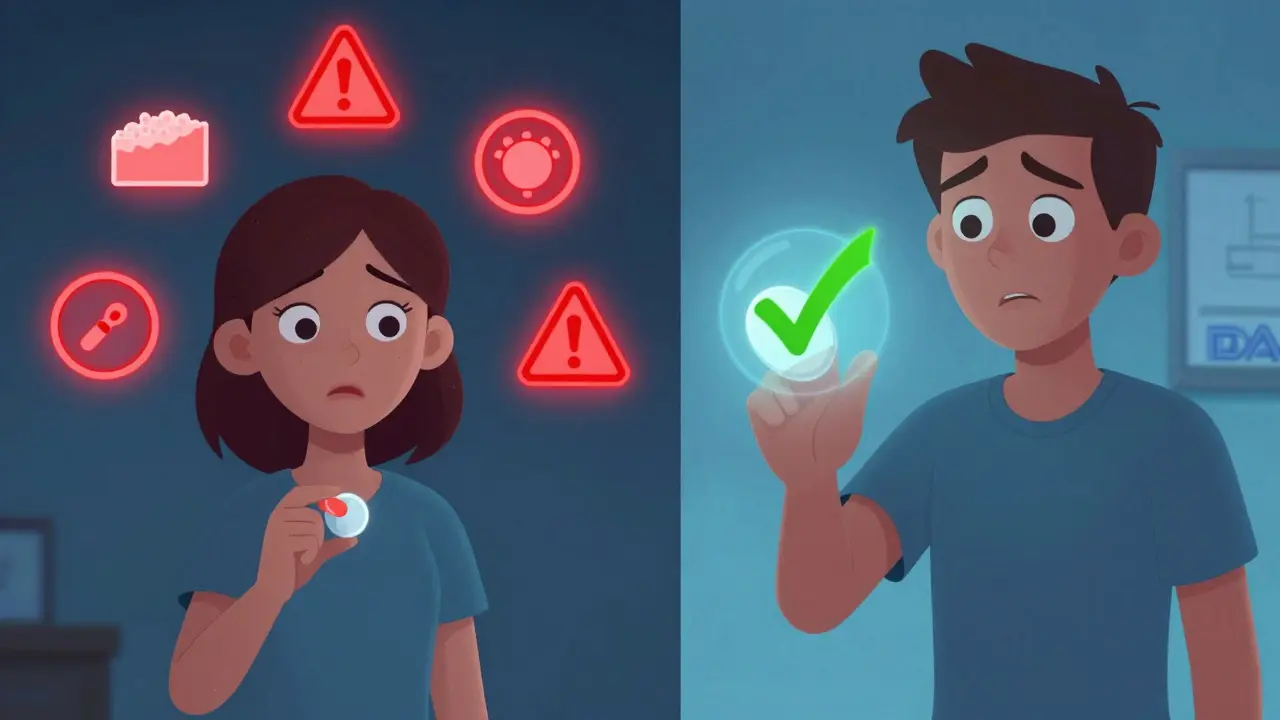
Insurance and cost: the hidden catch
Here’s the thing: authorized generics are cheaper than brand-name drugs-often 20-80% less. But that doesn’t mean your patient will pay less. Many pharmacy benefit managers (PBMs) classify authorized generics as brand-name drugs for reimbursement purposes. A 2022 study found 63% of PBMs put them in the brand-tier formulary. That means the patient pays brand-name copay-even though they’re getting the same drug as the generic. That’s confusing. A patient might think they’re saving money by switching to a generic, but end up paying more because the authorized generic is labeled as “brand.” Pharmacists need to check the patient’s formulary before recommending it. Compare that to regular generics: they’re usually in the lowest tier, with $5-$10 copays. But if the patient has a sensitivity or is on an NTI drug, that small savings isn’t worth the risk.What to tell your patients
Patients get nervous when their pill changes color, shape, or size. A 2022 study showed 27% of patients stopped taking their medication after an unexpected change-just because it looked different. That’s why counseling matters. Don’t just hand over the bottle. Say this:- “This is the same medicine you were taking, just without the brand name.”
- “The inside of the pill is identical-same active ingredient, same fillers, same everything.”
- “It’s made by the same company that made your original prescription.”
- “It’s cheaper, but your insurance might still treat it like the brand. Let’s check your copay.”
What you can’t do
Authorized generics aren’t available for every drug. Only about 5% of brand-name medications have them. And they’re not always stocked. Some wholesalers carry them-AmerisourceBergen and Cardinal Health, for example-but others don’t. You might need to order them. Also, while federal law allows substitution without prescriber approval (unless the script says “dispense as written”), 18 states require you to notify the prescriber for any generic substitution-including authorized generics. Know your state rules. And never assume an authorized generic is automatically cheaper. Always check the patient’s out-of-pocket cost before recommending it.The future of authorized generics
The number of authorized generics has grown 18% per year since 2010. More are coming. Consumer searches for “authorized generics” jumped 47% between 2021 and 2022. Patients are starting to ask about them. Professional groups like the American Pharmacists Association are updating their guidelines to give pharmacists clearer direction on when to recommend them. By 2024, expect more formal protocols. As healthcare shifts toward value-based care, pharmacists who understand authorized generics will play a bigger role-not just in cutting costs, but in improving safety. For patients with allergies, chronic conditions, or complex regimens, the right generic isn’t the cheapest one. It’s the one that matches their body’s needs.Bottom line
Authorized generics aren’t always the answer. But when they are, they’re the best answer. Know when to use them. Know how to find them. And most importantly-know how to explain them. Patients don’t care about regulatory categories or FDA lists. They care about feeling safe, feeling stable, and not paying more than they have to. If you can give them a drug that’s identical to what they’ve always taken, at a lower price, without risking their health-that’s not just good pharmacy. That’s essential care.Are authorized generics the same as brand-name drugs?
Yes. Authorized generics are chemically identical to the brand-name drug, with the same active and inactive ingredients, manufactured by the same company or under their direct authorization. The only difference is the label-no brand name, often lower cost.
Why do authorized generics cost less than brand-name drugs?
They’re sold without the marketing, advertising, and brand-name pricing premium. The manufacturer still produces the same product, but without the brand name, they can offer it at a discount-often 20-80% lower than the brand.
Can I substitute an authorized generic without the prescriber’s permission?
In most states, yes-if the prescription doesn’t say “dispense as written.” Federal law allows substitution, but 18 states require pharmacists to notify the prescriber before making any generic substitution, including authorized generics. Always check your state’s pharmacy board rules.
Are authorized generics covered under generic tiers by insurance?
Not always. About 63% of pharmacy benefit managers (PBMs) classify authorized generics under brand-name tiers for reimbursement, meaning patients may pay higher copays than with regular generics-even though the medication is identical. Always verify the patient’s out-of-pocket cost before recommending.
How do I know if a generic is authorized?
Check the FDA’s quarterly list of authorized generics. You can also look at the National Drug Code (NDC)-if the labeler code matches the original brand manufacturer (like Pfizer or Merck), it’s likely an authorized generic. Regular generics have labeler codes from companies like Teva or Mylan.
Do authorized generics have the same side effects as the brand?
Yes. Because they contain the same active and inactive ingredients, side effects are identical. This makes them a safer choice for patients with allergies or sensitivities to fillers like lactose, gluten, or gelatin-common issues with regular generics.
Why aren’t authorized generics listed in the Orange Book?
The Orange Book lists therapeutically equivalent drugs, but authorized generics aren’t listed separately because they’re considered the same product as the brand. The FDA treats them as identical, so no separate evaluation is needed.
Can authorized generics be used for narrow therapeutic index drugs?
Yes, and they’re often the preferred choice. For drugs like warfarin, levothyroxine, or phenytoin, even small variations in blood levels can be dangerous. Authorized generics eliminate that risk because they’re chemically identical to the brand-unlike regular generics, which may vary slightly in absorption.




Oh sweet mercy, another pharmacy droning on about 'authorized generics' like it's some revolutionary breakthrough. Let me guess-your pharmacy is now charging $80 for a pill that looks like a generic but has the same damn ingredients? That's not innovation, that's corporate theater. You're not saving anyone money-you're just repackaging brand-name greed with a fancy label. And don't get me started on how PBMs treat these like brand drugs. It's a scam wrapped in a white coat.
While the pharmacoeconomic framework presented here is superficially compelling, it fails to account for the pharmacokinetic heterogeneity inherent in non-identical excipient matrices. The bioequivalence paradigm, while FDA-regulated, remains a probabilistic approximation-not a deterministic guarantee. For NTI drugs, the therapeutic window is not merely narrow-it is fractal in its sensitivity to excipient-induced crystalline lattice perturbations. Authorized generics, by virtue of identical molecular architecture, mitigate this stochastic variability. The data from the 2021 survey is statistically significant (p < 0.01), yet underreported in mainstream discourse due to PBM-aligned inertia.
wait so u r saying if i switch from lipitor to atorvastatin i get the same thing but cheaper?? but my insurance still charges me like its brand?? lmao. this is so dumb. why do they even make us confused like this??
I love how this post breaks it down without the jargon. Seriously-pharmacists are the unsung heroes here. I had a friend who went from brand-name levothyroxine to a generic and started having heart palpitations. Switched back to the authorized version? Instantly stable. No drama. Just science. It’s wild that we still have to fight for this kind of clarity in healthcare.
YES. This is the kind of info that needs to be shouted from the rooftops. I’ve had patients cry because they thought they were getting a 'cheap version' and felt like they were being given second-rate medicine. When I explain that it’s literally the same pill, just without the fancy logo-they breathe a sigh of relief. We need more of this. Not less. Thank you for writing this.
Just to clarify, because I’ve seen this confused so many times: the NDC labeler code is the most reliable indicator. If it matches Pfizer, Merck, AbbVie, etc.-it’s authorized. If it’s Teva, Mylan, Sandoz-regular generic. Also, the FDA’s quarterly list is updated every three months, but it’s buried under 12 pages of PDFs. Pro tip: use the National Library of Medicine’s DailyMed API-it’s free and searchable.
There’s something deeply ironic here: we’ve created a system where the most precise, safest, and identical version of a drug is treated as the 'premium option'-while the chemically different, less predictable version is the 'budget choice.' This isn’t about cost-it’s about how we value certainty in medicine. We trust our cars to be engineered with precision, our phones to be flawless-why do we settle for approximations when it comes to our biology? The authorized generic isn’t just a product-it’s a philosophical statement: that identity matters, even in a pill.
Thank you for writing this. I’ve been a pharmacist for 18 years and I’ve seen too many people drop meds because they didn’t recognize their pill. One lady stopped her warfarin because the generic was yellow instead of white-and ended up in the ER with a clot. We need to stop treating patients like they’re just numbers in a formulary. This post? This is what good care looks like.
Oh here we go again the pharmacy cult pushing their 'authorized' nonsense. Everyone knows generics are just as good. You're just trying to make yourself look smart. I've been on generic Lipitor for 5 years and I'm fine. Why are you wasting our time with this?
So I just found out my mom’s authorized generic for phenytoin was switched to a regular one last month-she’s been having seizures again. I called the pharmacy and they said ‘it’s bioequivalent so it’s fine.’ I screamed. I literally screamed. This isn’t just about cost-it’s about people’s lives. I’m going to start a petition. Someone help me.
This is one of the most thoughtful, well-researched pieces on pharmacy practice I’ve read in years. Thank you for honoring the complexity of patient care. Too often, we reduce medication decisions to price tags. But for someone with celiac disease, a vegan, or a person on warfarin-this isn’t a choice between cheap and expensive. It’s a choice between safety and risk. You’ve given pharmacists the language to advocate for their patients. That’s powerful.
It is imperative to note that the FDA's bioequivalence requirements for generic pharmaceuticals are codified under 21 CFR § 320.24, which mandates a 90% confidence interval for Cmax and AUC within the 80.00%–125.00% range. While this is statistically acceptable for population-level outcomes, it does not guarantee individual patient equivalence, particularly in cases of pharmacogenomic polymorphisms or comorbid gastrointestinal pathology. Therefore, the use of authorized generics in high-risk populations remains the gold standard.
I’ve seen patients who’ve been on the same brand for 15 years, then switched to a generic-and they swear something’s ‘off.’ They can’t explain it. But they feel it. And sometimes, they’re right. This isn’t placebo. It’s physiology. The authorized generic gives them back the stability they lost. It’s not magic. It’s just… honest. And in a world full of noise, that’s rare.
Okay but what if you’re on Medicaid? Do they even cover authorized generics? I asked my pharmacist and she just shrugged and said ‘it depends on your county.’ Why is this so complicated?? I just want to take my medicine without doing a PhD in insurance policy.