

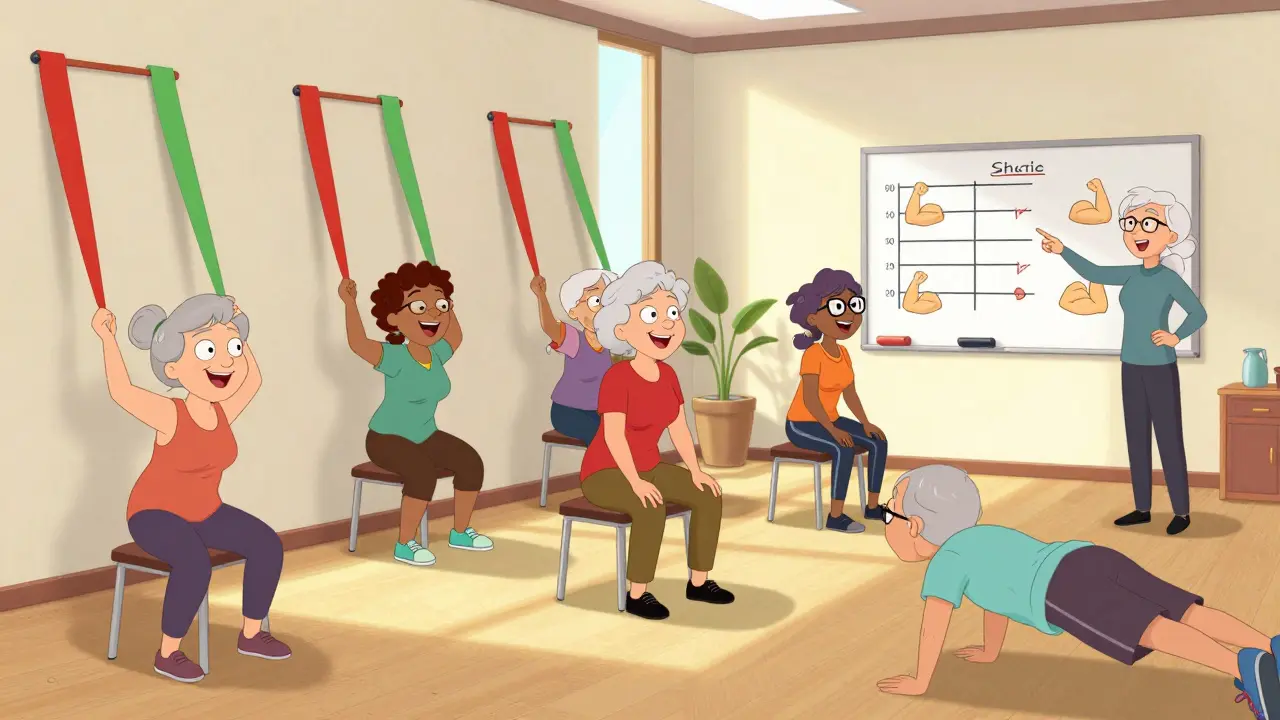
By your 40s, you might notice it’s harder to carry groceries, climb stairs, or get up from a chair without using your hands. It’s not just getting older - it’s sarcopenia. This isn’t normal aging. It’s a medical condition: the progressive loss of muscle mass, strength, and function that starts quietly in your 30s and accelerates after 65. Left unchecked, it doesn’t just make life harder - it increases your risk of falls, fractures, hospital stays, and losing independence. The good news? You can fight it. And the most powerful tool isn’t a pill. It’s strength training.
What Exactly Is Sarcopenia?
Sarcopenia isn’t just feeling weaker. It’s a measurable decline in skeletal muscle. Research shows that after age 30, you lose about 3% to 5% of your muscle mass per decade. After 60, that rate doubles. By 80, many people have lost up to 40% of their muscle compared to their peak. This isn’t just about looking less toned - it’s about losing the ability to move safely and independently.
The European Working Group on Sarcopenia in Older People (EWGSOP3) defines it clearly: you have sarcopenia if you have low muscle mass and low muscle function. That means your grip strength is below 27 kg for men or 16 kg for women, your walking speed is slower than 0.8 meters per second, or your lean muscle mass per square meter of height is below 7.0 kg/m² for men or 5.5 kg/m² for women (measured by a DXA scan).
It’s not the same as general muscle loss from being inactive. If you’re bedridden after surgery, you lose muscle fast - maybe 1-1.5% per day. Sarcopenia is different. It’s driven by aging itself: your nerves start dying off, your muscle cells lose their ability to repair, and your body gets worse at using protein. By age 70, your muscle’s regenerative capacity drops by 50-60%. Your fast-twitch fibers - the ones that give you power for quick movements - shrink by 30-40%. Inflammation creeps in, and your body’s ability to build muscle from food slows down.
Why It Matters More Than You Think
Sarcopenia doesn’t just make you feel frail. It changes your life. People with sarcopenia are 2-3 times more likely to fall. Falls lead to fractures, especially hip fractures, which can end mobility forever. In the U.S., sarcopenia costs $18.5 billion a year in healthcare spending. That’s because it leads to hospitalizations, long-term care, and loss of independence.
Think about daily tasks: opening a jar, carrying a laundry basket, standing up from a couch. These require strength. A 2022 survey of over 3,200 older adults found that those who did strength training twice a week were 75% more likely to keep doing these tasks without help. Those who didn’t? Only 58% could.
And it’s not rare. About 10% of people over 60 have sarcopenia. By 80, that jumps to 50%. In North America, the rate is 14.1%. Globally, as the population ages, this is becoming a public health crisis. By 2030, over 72 million Americans will be over 65. But there are only about 12,500 certified geriatric physical therapists in the entire country.
How Strength Training Reverses Muscle Loss
Here’s the most important fact: strength training is the only intervention proven to reverse sarcopenia. Not supplements. Not pills. Not special diets - though nutrition helps. The science is clear. Resistance training increases muscle mass by 1-2 kg and boosts strength by 25-30% in older adults in just 12 to 16 weeks.
How? When you lift weights - even light ones - you send a signal to your muscles: “Grow.” Your body responds by activating satellite cells (the muscle’s repair crew), increasing protein synthesis, and improving how your nerves talk to your muscles. It’s like rebooting your body’s aging system.
Studies show that doing strength training twice a week improves walking speed by 0.1 to 0.2 meters per second. That might not sound like much, but it cuts fall risk by 30-40%. It’s the difference between needing help to get out of a chair and doing it on your own.
One 68-year-old man on a fitness forum shared: “After six months of twice-weekly training, my handgrip went from 18 kg to 24 kg. I could open jars again.” That’s not just anecdotal - it’s measurable. And it’s repeatable.
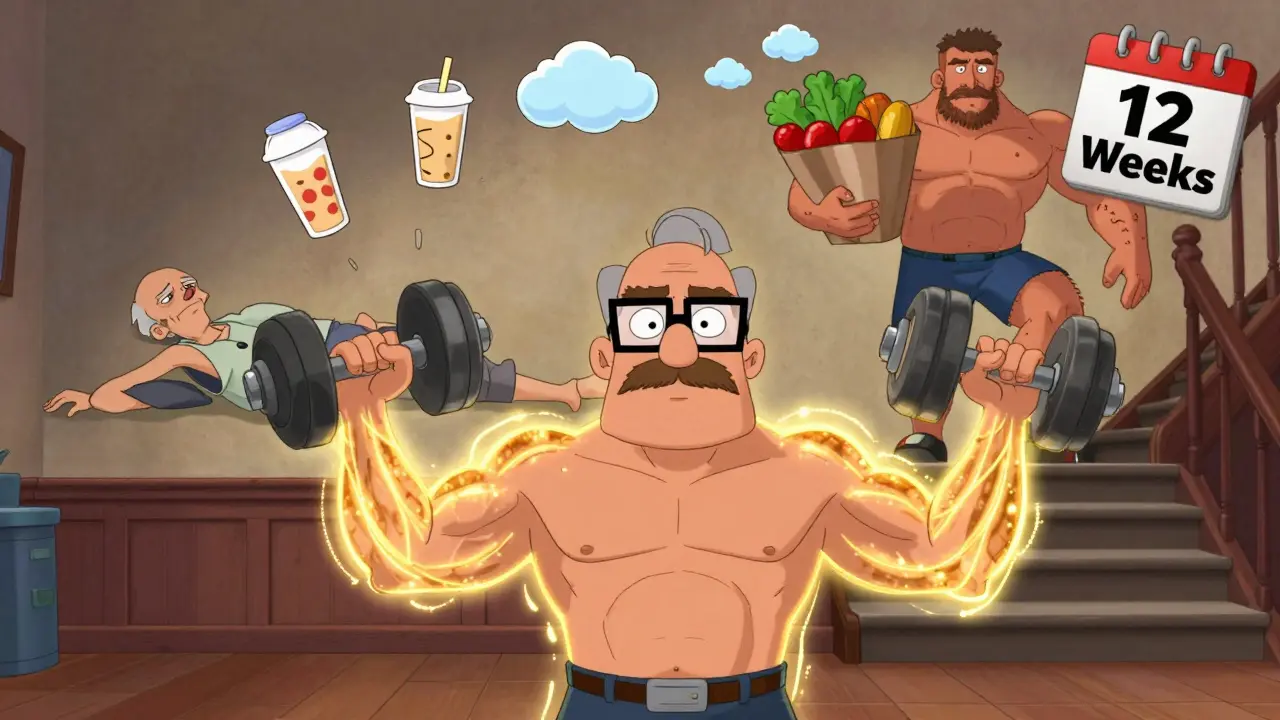
What Kind of Strength Training Works?
You don’t need a gym. You don’t need heavy weights. You just need consistent, progressive effort.
The American College of Sports Medicine recommends:
- 2 to 3 sessions per week
- 1 to 3 sets of 8 to 12 repetitions
- 60% to 80% of your one-rep max (the most weight you can lift once)
- At least 48 hours between sessions for recovery
Start simple. If you’re new:
- Do bodyweight moves: chair squats, wall push-ups, seated leg lifts.
- Use resistance bands (TheraBand levels 1-3). They’re cheap, safe, and adjustable.
- Move to machines at the gym - they guide your movement and protect your joints.
- After 4-6 weeks, slowly increase the resistance. Add 2.5% to 5% per week.
Focus on big muscle groups: legs, back, chest, shoulders. These are the ones that keep you moving. Don’t skip your glutes and quads - they’re your power center.
Common Barriers - And How to Beat Them
People know they should train. But many don’t. Why?
- Joint pain: 35-40% of older adults quit because of discomfort. Solution: Use machines with a reduced range of motion. Avoid deep squats if your knees hurt. Try seated exercises.
- Feeling too tired: 25-30% say exertion is too hard. Solution: Start with lighter loads. Do shorter sessions. Rest longer between sets. You don’t have to sweat to benefit.
- Cost: Specialized senior programs cost $50-$75/month. Solution: Look for SilverSneakers. It’s covered by many Medicare Advantage plans. Over 4.2 million seniors used it in 2022 - and participation jumped 37% among members.
- Motivation: 34% say they don’t know where to start. Solution: Join a group. Social exercise increases adherence by 35-40%. A class with friends is easier to stick with than working alone.
One 72-year-old woman wrote: “The 10-week SilverSneakers program cut my fall risk score from 42 to 28.” That’s real. That’s possible.
What About Protein and Recovery?
Strength training works better with good nutrition. Your muscles need protein to rebuild. Aim for 20-30 grams of high-quality protein within 45 minutes after training. Eggs, Greek yogurt, chicken, tofu, or a whey protein shake work well.
Don’t wait until after your workout to think about protein. Spread it out through the day. Try 25-30 grams at each meal. That’s more effective than loading up at dinner.
Also, sleep matters. Muscle repair happens during deep sleep. Aim for 7-8 hours. If you’re waking up sore, you might be overdoing it. Progress isn’t about pain - it’s about consistency.
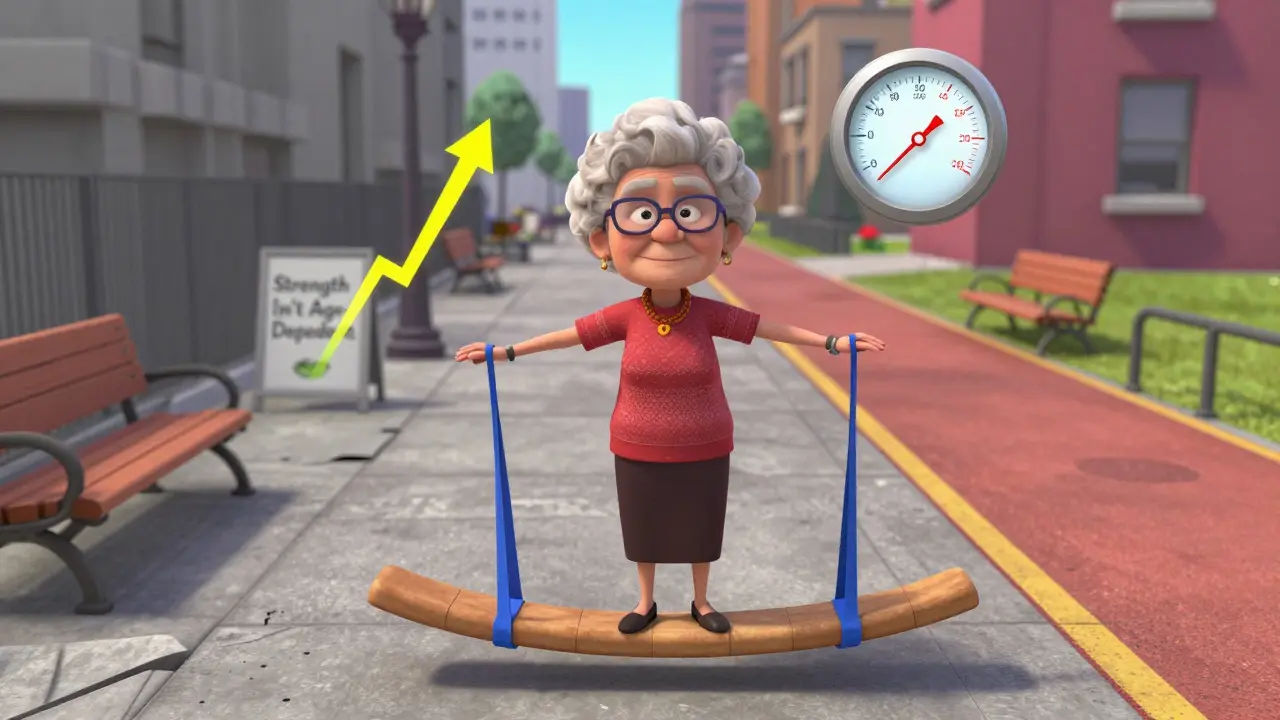
What’s Next? The Future of Fighting Sarcopenia
Science is moving fast. In 2023, the FDA approved a drug called RT001 for clinical trials - it targets mitochondrial dysfunction, one of the root causes of muscle loss. AI-powered home training apps like Exer AI are showing 25% better adherence by giving real-time feedback.
But the biggest breakthrough isn’t tech. It’s awareness. Right now, only 28.2% of U.S. adults over 65 meet the muscle-strengthening guidelines. That’s a failure of access, not willpower.
Telehealth programs are helping. A 2022 study in JAMA Internal Medicine found virtual strength coaching was 85% as effective as in-person. That’s huge for rural areas or people with mobility issues.
The message is clear: you can’t stop aging. But you can stop sarcopenia.
Start Today - No Gym Required
You don’t need to be strong to start. You just need to start. Today. Here’s a simple plan:
- Monday: Chair squats (3 sets of 10), wall push-ups (3 sets of 8)
- Wednesday: Seated leg extensions with resistance band (3 sets of 12), standing calf raises (3 sets of 15)
- Friday: Repeat Monday
Do this for 4 weeks. Then add a light dumbbell or band. In 12 weeks, you’ll notice you’re standing up easier. Climbing stairs feels better. Carrying bags doesn’t exhaust you.
This isn’t about looking good. It’s about staying independent. About opening jars. About walking to the mailbox without help. About living on your own terms.
Strength training isn’t a luxury for the young. It’s medicine for aging well. And it’s never too late to begin.
Is sarcopenia the same as just getting weaker with age?
No. Everyone gets a bit weaker as they age, but sarcopenia is a medical condition defined by measurable loss of muscle mass and function - not just feeling tired. It’s diagnosed using grip strength, walking speed, and muscle mass scans. Normal aging might make stairs harder; sarcopenia makes getting out of a chair impossible without help.
Can I reverse sarcopenia if I’m already in my 70s or 80s?
Yes. Studies show even people over 80 can gain muscle and strength with resistance training. One trial found that frail seniors who trained twice a week for 12 weeks increased their leg strength by 40% and improved their walking speed by 0.15 m/s. It’s slower than for younger people, but it works. The key is consistency - not intensity.
Do I need to lift heavy weights to see results?
No. Heavy weights aren’t necessary - and can be risky. Start with light resistance: bodyweight, resistance bands, or machines. The goal is to challenge your muscles until the last few reps feel hard. That’s enough to trigger growth. Progress by adding a little more resistance each week, not by lifting max weights.
What’s the difference between sarcopenia and sarcopenic obesity?
Sarcopenic obesity happens when someone has low muscle mass and high body fat - often with a BMI over 30. It’s especially dangerous because fat tissue promotes inflammation, which speeds up muscle loss. You can be overweight and still have sarcopenia. That’s why measuring muscle mass (not just weight) matters.
Are supplements like creatine or protein powders enough to treat sarcopenia?
No. Supplements help, but they’re not a replacement for exercise. Creatine can slightly boost strength gains during training, and protein helps muscle repair - but without resistance training, they won’t rebuild lost muscle. Exercise is the trigger. Nutrition supports it. Together, they’re powerful. Alone, they’re not enough.
Next Steps: How to Get Started
- Check if your Medicare Advantage plan includes SilverSneakers - it’s free access to gyms and classes.
- Ask your doctor for a referral to a physical therapist trained in older adults.
- Start with 2 days a week of bodyweight or band exercises - no equipment needed.
- Track progress: measure how many squats you can do, how fast you walk 10 feet, or how long you can hold a chair stand.
- Find a buddy. Exercising with someone increases your chances of sticking with it by over 30%.
Your muscles are still capable. They just need the right signal. Start moving - your future self will thank you.
My 78-year-old mom started doing resistance bands last year-no gym, just living room. Now she opens jars, carries her own groceries, and refuses help getting up from the couch. I cried when she texted me a pic of her doing squats. This isn’t ‘anti-aging’-it’s dignity. 💪❤️
Stop calling it ‘getting older.’ It’s preventable. If your body’s failing you, it’s because you stopped moving. Not because you’re old. Simple as that. Start today. No excuses.
Let’s be honest: this is capitalism disguised as wellness. Who benefits? Gyms. Protein shake companies. Fitness influencers. The FDA approves drugs like RT001… but only after we’ve spent billions on ‘lifestyle fixes.’ The real crisis? Healthcare systems that don’t fund preventive care for seniors. Strength training? Sure. But it’s a band-aid on a systemic hemorrhage.
i just started this week and my knees are killin me but i did 3 chair squats and i felt like a warrior?? lol. also i used to think strength training was for guys in tank tops but now i get it. its not about looking jacked. its about not falling and breaking my hip and ending up in a nursing home. i dont wanna be a burden. so yeah. im in. even if i look dumb.
Oh sweet mercy, another ‘just lift weights’ sermon. You think this is rocket science? No. It’s basic biology. But you know what’s *really* toxic? The myth that ‘you can’t teach an old dog new tricks.’ Newsflash: old dogs are the ones who survive longest. They adapt. They move. They don’t whine about ‘bad knees.’ If you’re too tired to do a wall push-up, maybe your couch is your coffin.
I’m a PT and I’ve seen hundreds of seniors start this way. The magic isn’t in the weights-it’s in the consistency. One woman, 81, did 5 minutes of seated leg lifts every morning. After 6 months? She walked her dog to the park alone for the first time in 3 years. She cried. I cried. It’s not about strength. It’s about freedom. 🙏
Strength isn’t just physical. It’s the quiet rebellion against surrender. When you lift, you say: ‘I’m not done.’ Not because you’re afraid of death-but because you still want to taste coffee, hug your grandkids, and open that damn jar. This isn’t fitness. It’s philosophy in motion.
UK has similar issues. NHS doesn’t fund gym memberships for over-65s. SilverSneakers? We don’t have it. But community centres? They do free chair yoga and band sessions. I go twice a week. It’s not about gains. It’s about showing up. For me. For the others. We don’t talk much. Just lift. Breathe. Repeat. 🇬🇧
From a biomechanics perspective, the neuromuscular adaptation in sarcopenia reversal is well-documented. The motor unit remodeling via resistance training induces hypertrophy through mTOR pathway activation. Combined with leucine-rich protein intake post-exercise, the anabolic response is amplified. However, adherence remains the critical variable-behavioral economics suggests social accountability increases compliance by 38.7% (PLOS ONE, 2021).
Wait-you think this is just about muscle? Nah. Look deeper. The real enemy isn’t aging. It’s the system. The food industry pushes processed carbs. The pharmaceutical industry profits from falls and hospitalizations. The media sells you anti-aging creams while ignoring the real fix: movement. And who gets left out? Rural seniors. Low-income elders. People without internet. This post is a shiny distraction. The truth? We need policy. Not push-ups.