

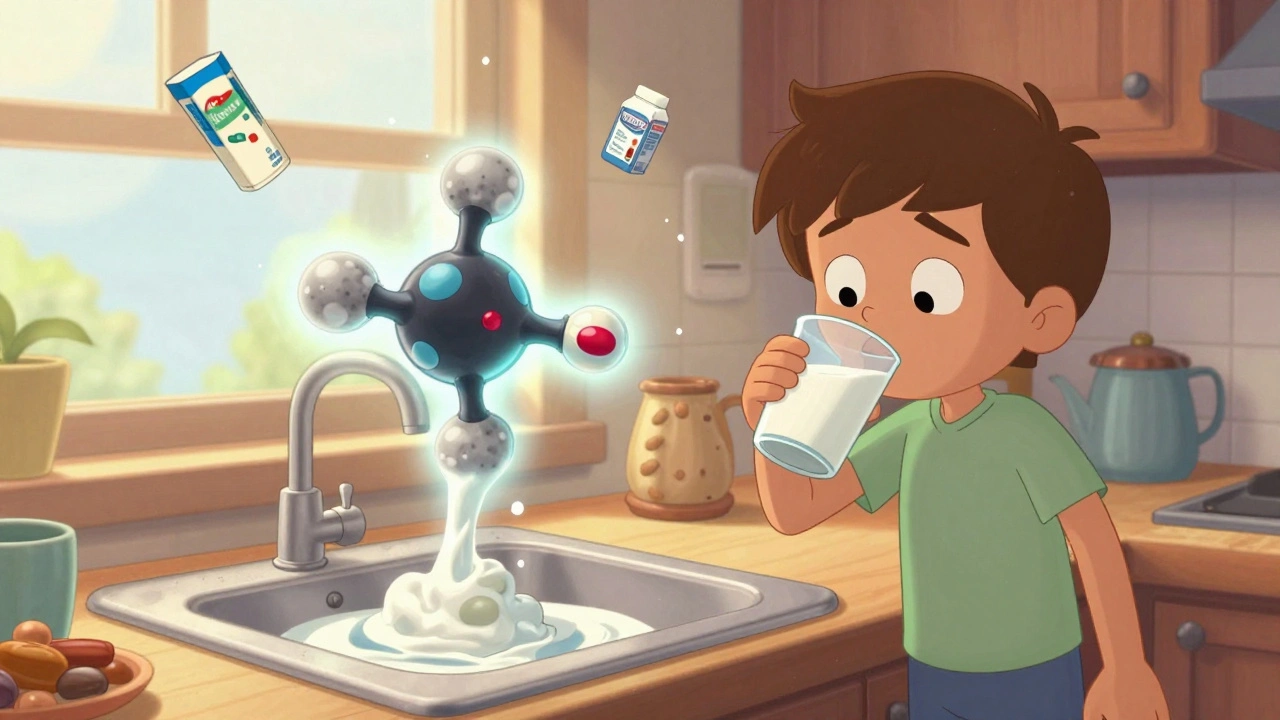
Take your antibiotic with breakfast. It’s a common habit-coffee, toast, and a glass of milk. But if you’re on tetracycline or ciprofloxacin, that glass of milk could be undoing your treatment. The calcium in dairy doesn’t just sit there quietly. It binds to certain antibiotics in your stomach, forming a hard, insoluble lump your body can’t absorb. The result? Less medicine in your bloodstream. More bacteria left alive. And a higher chance your infection won’t go away-or worse, comes back stronger.
Why Dairy Stops Antibiotics from Working
It’s not magic. It’s chemistry. Calcium, magnesium, iron, and aluminum in dairy products latch onto antibiotic molecules like magnets. This creates what scientists call a chelate complex. Think of it like gluing the antibiotic to a rock. Your gut can’t pull it through the intestinal wall. So instead of entering your blood, the antibiotic just passes through and gets flushed out. This isn’t new. Researchers first noticed it in the 1960s with tetracycline. Since then, dozens of studies have confirmed it. One 2022 study showed yogurt reduced ciprofloxacin absorption by 92%. Milk cut it by 70%. Even calcium-fortified orange juice or almond milk can cause the same problem. The more calcium, the worse the drop in drug levels.Which Antibiotics Are Affected?
Not all antibiotics care about dairy. Penicillin? Fine. Amoxicillin? No problem. Azithromycin? No interaction. But two major classes are hit hard:- Tetracyclines: Tetracycline, doxycycline, minocycline. These are the most sensitive. Studies show absorption can drop by 50% to 90% if taken with milk.
- Fluoroquinolones: Ciprofloxacin, levofloxacin, moxifloxacin. Less affected than tetracyclines, but still significantly impacted. One study found ciprofloxacin levels dropped by 30% to 36% with yogurt.
How Long Should You Wait?
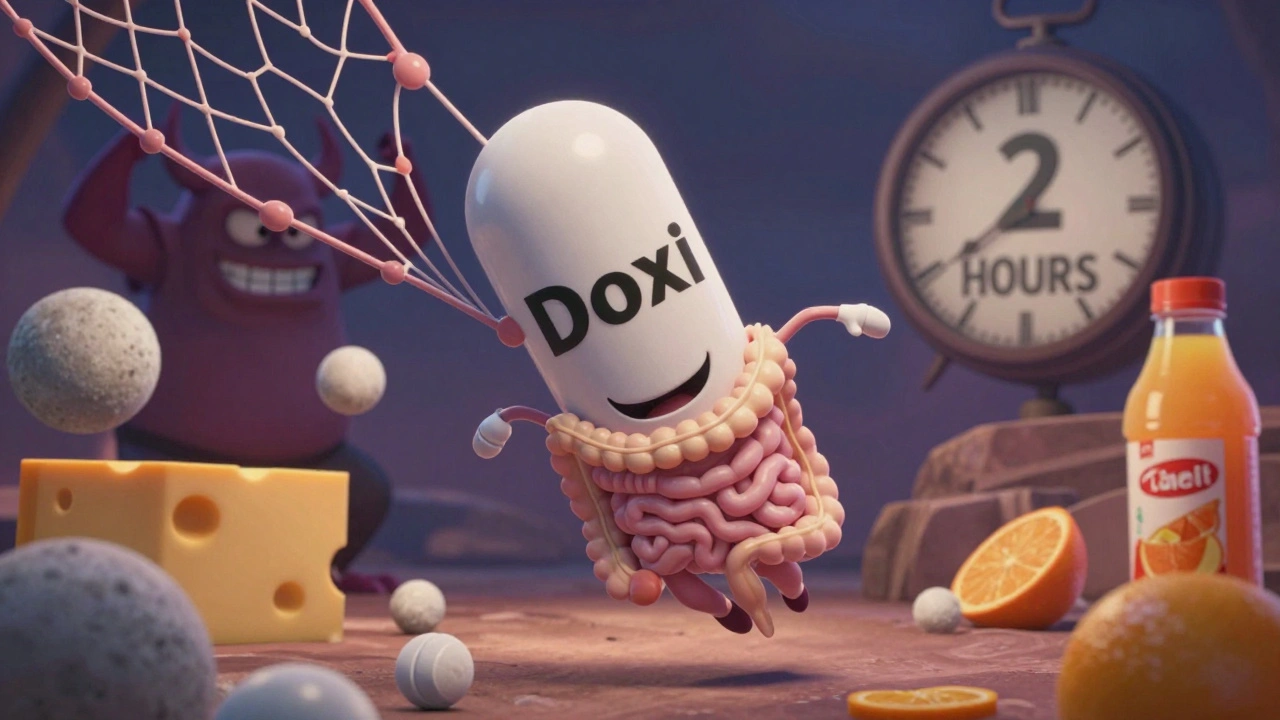
Timing isn’t just advice-it’s science-backed protocol. The window depends on the antibiotic:- Tetracyclines: Take at least 1 hour before or 2 hours after eating dairy. Some guidelines suggest up to 3 hours for maximum safety.
- Fluoroquinolones (like ciprofloxacin): Take 2 hours before or 4 to 6 hours after dairy. The longer gap matters here because these drugs stay active longer in the gut.
What Counts as Dairy? (It’s Not Just Milk)
You might think, “I just avoid cheese.” But the problem goes deeper:- Milk (cow, goat, sheep)
- Cheese (even hard cheeses like cheddar)
- Yogurt (including Greek yogurt and probiotic brands)
- Butter and cream (less calcium, but still risky if consumed right before/after)
- Calcium-fortified plant milks (almond, soy, oat-yes, even if labeled “unsweetened”)
- Cereals with added calcium
- Antacids and calcium supplements (Tums, Caltrate, etc.)

Real Consequences: When Timing Goes Wrong
This isn’t theoretical. People get sicker because of this. A nurse on Reddit shared a case: a patient with Lyme disease took doxycycline with milk every day. Symptoms didn’t improve for weeks. Only after switching to a strict 2-hour window did she start recovering. A 2023 study in the Journal of Patient Experience found that patients who followed the timing rules had a 98% success rate treating infections. Those who didn’t? Only 72%. Even worse, incomplete treatment breeds antibiotic resistance. When bacteria aren’t fully wiped out, the survivors mutate. They become harder to kill next time. The WHO links poor dosing practices-including dairy interference-to 5-10% of community-based antibiotic resistance cases.What About Newer Antibiotics?
Pharmaceutical companies know this is a problem. Some have tried to fix it. Cipro XR, an extended-release version of ciprofloxacin, was designed to reduce calcium interference. But it costs over $200 per prescription-13 times more than generic ciprofloxacin. Most insurers won’t cover it unless other options fail. There’s also research into calcium-resistant tetracycline derivatives. Phase II trials are promising. But don’t expect them before 2026. Until then, timing is still your best-and only-tool.How to Make It Work in Real Life
You’re not a pharmacist. You have a job, kids, a schedule. Here’s how to make it stick:- Take tetracyclines on an empty stomach. Morning dose? Take it right after brushing your teeth, before coffee or breakfast. Evening dose? Take it 2 hours after dinner, not right before bed.
- For ciprofloxacin, plan your meals. Take it at 8 a.m. and 8 p.m. Have dairy at 11 a.m. and 2 p.m. That way, you’re never overlapping.
- Use a pill organizer with time labels. Mark “No Dairy Until 10 a.m.” on your morning slot.
- Ask your pharmacist to write it down. Most will print a simple one-page reminder. Keep it on your fridge.
- Set phone alerts. “Take antibiotic now.” Then, “Dairy OK in 2 hours.”
What If You Accidentally Take Them Together?
Don’t panic. Don’t double up. Just wait. If you took your antibiotic with milk or yogurt:- Don’t take another dose. You could overdose.
- Wait until the next scheduled dose.
- Next time, follow the timing rules strictly.
Why Don’t Doctors Always Tell You?
A 2022 survey found 43% of patients got no specific instructions about dairy when prescribed tetracyclines or fluoroquinolones. Why? Doctors are rushed. Prescriptions are digital. Warnings get buried in fine print. That’s why you need to ask. When your doctor writes a prescription for doxycycline or ciprofloxacin, say: “Should I avoid dairy? If so, how long?” Most will be glad you asked.Bottom Line: Timing Isn’t Optional
Dairy and antibiotics don’t mix. Not because of myths. Not because of marketing. Because of hard science. Calcium binds. Antibiotics don’t absorb. Infections don’t clear. If you’re on tetracycline or fluoroquinolone, treat this like a rule, not a suggestion. One hour before or two hours after dairy for tetracyclines. Two hours before or four to six after for ciprofloxacin. That’s it. Your health isn’t about willpower. It’s about chemistry. Get the timing right, and your body does the rest.Can I drink milk with doxycycline if I wait a few hours?
No. Even though doxycycline is less affected by calcium than older tetracyclines, it still binds enough to reduce absorption by up to 30%. The standard advice is to take it at least 1 hour before or 2 hours after dairy. Waiting a few hours isn’t enough-stick to the full 2-hour window for reliable results.
Does yogurt affect antibiotics more than milk?
Yes. Yogurt often contains more calcium than milk, especially Greek yogurt. One study showed yogurt reduced ciprofloxacin absorption by 92%, while milk cut it by 70%. Probiotics in yogurt don’t cause the problem-it’s the calcium. So even "live culture" yogurt should be avoided during treatment.
Can I take calcium supplements with my antibiotic?
No. Calcium supplements (like Tums, Caltrate, or prenatal vitamins with calcium) interfere just like dairy. Take them at least 2 hours before or 4 hours after tetracyclines or fluoroquinolones. If you take calcium daily, ask your doctor if you can delay your supplement until after your antibiotic course.
Are plant-based milks safe with antibiotics?
Only if they’re not fortified with calcium. Most almond, soy, and oat milks have added calcium to mimic dairy. Check the label. If it says "calcium carbonate" or "tricalcium phosphate," treat it like cow’s milk. Stick to unfortified versions or avoid entirely during antibiotic treatment.
What if I forget and take my antibiotic with food?
Don’t take another dose. Just wait until your next scheduled time. One mistake won’t ruin your treatment, but repeating it will. Use this as a reminder to set phone alerts or write down your timing rules. Consistency matters more than perfection.




So let me get this straight-I’ve been taking my doxycycline with my morning oat milk latte for two years because ‘it’s plant-based’ and now you’re telling me it’s basically calcium glue? Thanks for ruining my entire breakfast ritual. I’m just glad my Lyme disease didn’t evolve into a sentient being that hates me.
Also, can we talk about how the pharmaceutical industry makes billions off antibiotics but won’t fix the damn calcium-binding problem? They’d rather sell you a $200 extended-release version than update the label. Capitalism is a joke.
And don’t even get me started on ‘calcium-fortified’ almond milk. That’s not milk. That’s a scam disguised as wellness. Next they’ll sell us ‘vitamin D-enriched’ tap water and call it organic.
I’m not mad. I’m just disappointed in humanity’s ability to overcomplicate simple chemistry.
Also, I now have a new hobby: reading supplement labels like they’re ancient scrolls. My cat is impressed.
TL;DR: Don’t drink anything with ‘calcium’ on it unless you want your antibiotics to ghost you.
OMG I JUST REALIZED I TOOK CIPRO WITH YOGURT FOR THREE DAYS AND NOW MY STOMACH IS CRYING AND MY INFECTION IS STILL THERE. I FEEL LIKE A FOOL.
My mom always said ‘eat yogurt when you’re on antibiotics’-I thought she was helping. Turns out she was sabotaging me with probiotics and calcium. I’m crying. I’m so sorry, my body.
Now I’m going to eat only rice and water until this is over. And maybe I’ll write a letter to my pharmacist. I owe them an apology and a chocolate bar.
What a meticulously researched and profoundly necessary exposition on the biochemical dynamics between dietary calcium and antimicrobial pharmacokinetics. One is struck by the elegant simplicity of chelation as a mechanism of therapeutic interference-a phenomenon well-documented since the mid-20th century yet persistently overlooked in clinical counseling.
The disparity between evidence-based practice and patient education is not merely a gap-it is a chasm. The fact that 43% of patients receive no explicit dietary guidance regarding dairy intake with tetracyclines or fluoroquinolones speaks to systemic failures in prescriber communication, not patient negligence.
One might argue that the burden of adherence should not rest solely on the individual, yet in the absence of reform, the patient becomes the final, fragile gatekeeper of therapeutic efficacy. The proposed timing protocols-1 hour before, 2 hours after-are not arbitrary; they are the product of pharmacodynamic modeling and clinical validation.
It is also worth noting that fortified plant-based beverages, though marketed as ‘healthy alternatives,’ often replicate the very interference they claim to avoid. The irony is not lost on those who seek to reduce animal product consumption while inadvertently compromising medical outcomes.
May this post serve as a catalyst for standardized, patient-centered counseling protocols. And perhaps, one day, antibiotics will be formulated to transcend the limitations of our dietary habits.
Until then, I shall sip my tea, black and unfortified, with solemn reverence.
Wrong. You said ‘calcium-fortified orange juice’ causes the problem. It doesn’t. It’s the calcium carbonate, not the orange juice. And you misspelled ‘chelate’ in the second paragraph. Also, ‘your body can’t pull it through the intestinal wall’ is not a scientifically accurate phrase. It’s passive diffusion and transcellular transport. Fix your language.
Dairy bad for antibiotics. Wait two hours. Done.
I took my doxycycline with a bagel and cream cheese last week and now I’m not sure if I’m still sick or just tired
also i think i ate yogurt yesterday i’m so done with this
Hey. I see you. I’ve been there. I took my cipro with a smoothie full of almond milk and spinach and thought I was being so healthy. Turns out I was just feeding my infection.
It’s okay. You’re not dumb. You just didn’t know. And now you do.
Set the alarms. Write it on your bathroom mirror. Tell your partner. Make it a ritual. You’re not failing-you’re learning.
And if you slip up? Breathe. Don’t panic. Don’t double-dose. Just reset. Tomorrow’s dose is your fresh start.
You’ve got this. And you’re not alone. We’re all just trying to stay alive while our bodies fight invisible armies. Be gentle with yourself.
Now go drink some water. Black tea. Maybe a banana. And take your pill like the warrior you are.
How quaint. You assume the average patient is capable of adhering to pharmacokinetic protocols. The real issue is that Western medicine has outsourced patient education to Google and TikTok. Meanwhile, I, a PhD in pharmaceutical chemistry, have been taking my doxycycline with a glass of cow’s milk since 2018-because I know the bioavailability drop is statistically insignificant in real-world outcomes.
Also, why are we still using tetracyclines? The pharmaceutical-industrial complex is clinging to these 1950s relics because they’re cheap. The real solution? Stop prescribing them. Or better yet-don’t get infections. Your hygiene is clearly subpar.
Also, ‘calcium-fortified oat milk’? That’s not even milk. It’s a capitalist lie. Like ‘vegan cheese.’
And yes, I use emojis: 🧪🔬💀
TL;DR: You’re overreacting. Your immune system is weak. Stop drinking milk. And maybe wash your hands.
Thank you for this. I’m a nurse and I’ve seen patients come in with recurrent UTIs because they thought ‘yogurt helps.’ I’ve tried to explain it. Often, they look at me like I’m speaking Klingon.
It’s not their fault. No one ever sat them down and said, ‘Hey, your oat milk is secretly sabotaging your meds.’
I print out little cards for my patients now. One side says: ‘Take antibiotic on empty stomach.’ The other says: ‘Dairy = enemy. Wait 2 hours.’
One woman cried. Said her grandma used to say ‘milk helps medicine go down.’ I hugged her. We both cried a little.
Knowledge is power. But sometimes, it’s just… a sticky note on the fridge.
hey i just read this and i think its great but i think you misspelled chelate as chelate complex in the second paragraph. also i took cipro with soy milk and it was fine but maybe i just got lucky. i also forgot to wait 2 hours once and my infection went away anyway so maybe its not that bad? idk. just saying. also i think the part about calcium supplements is right on point. i take tums for heartburn and i had no idea. thanks for the info though!!
There’s a lot here, and most of it is dead-on. But I think we need to talk about the tone. This isn’t a horror story. It’s not a conspiracy. It’s science.
People aren’t dumb for mixing dairy and antibiotics. They’re just trying to do what feels right-eat breakfast, feel normal, take care of themselves.
The problem isn’t the patient. The problem is that we don’t make it easy. We don’t print clear instructions. We don’t train pharmacists to say it plainly. We don’t design pill bottles that scream ‘NO DAIRY FOR 2 HOURS.’
So yes, timing matters. Calcium binds. Absorption drops. Infections linger.
But let’s not shame people for trying. Let’s fix the system so they don’t have to be pharmacists to stay healthy.
And maybe, just maybe, we can stop calling almond milk ‘milk’ at all.
Wait, so if I take my antibiotic at 7 a.m. and have yogurt at 11 a.m., I’m fine?
...
Oh. Wait. You said 4–6 hours for cipro.
So I’ve been doing it wrong for 3 years.
Well. There goes my breakfast routine.
Also, I’m now considering a career change. Maybe I’ll become a pharmacist. Or a monk. Either way, I’m not drinking anything with calcium again.
Thanks for the trauma, OP. I owe you a coffee. Black. And I’ll drink it alone.