

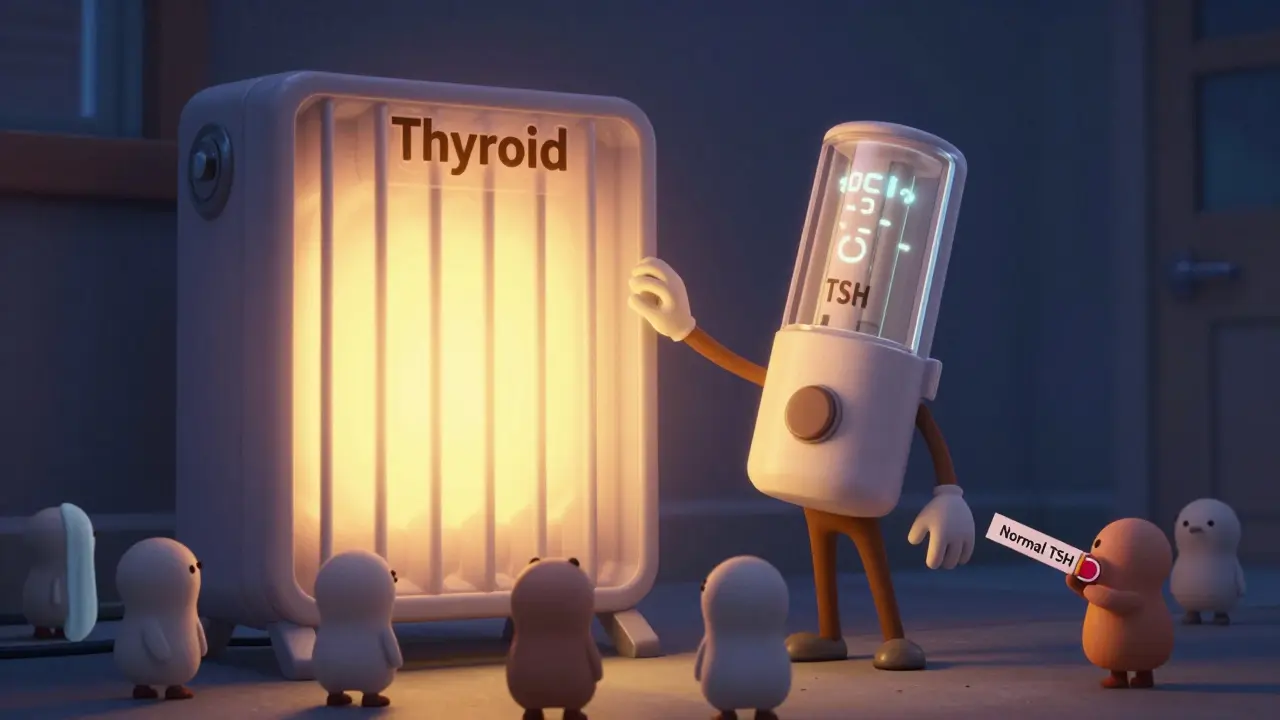
Most people think a simple blood test for TSH is enough to know if their thyroid is working right. But that’s not always true. I’ve seen too many cases where someone feels exhausted, gains weight, or can’t shake cold sensitivity - and their doctor says, ‘Your TSH is normal.’ Yet their free T4 is low. And they’re left confused, frustrated, and still sick. The truth is, TSH and T4 work together like a thermostat and a heater. One tells you if the system is off. The other tells you why.
What TSH and T4 Actually Measure
TSH stands for thyroid-stimulating hormone. It’s made by your pituitary gland, the control center in your brain. When your thyroid isn’t making enough hormone, the pituitary says, ‘Hey, work harder!’ and pumps out more TSH. That’s why high TSH usually means your thyroid is underperforming - hypothyroidism.
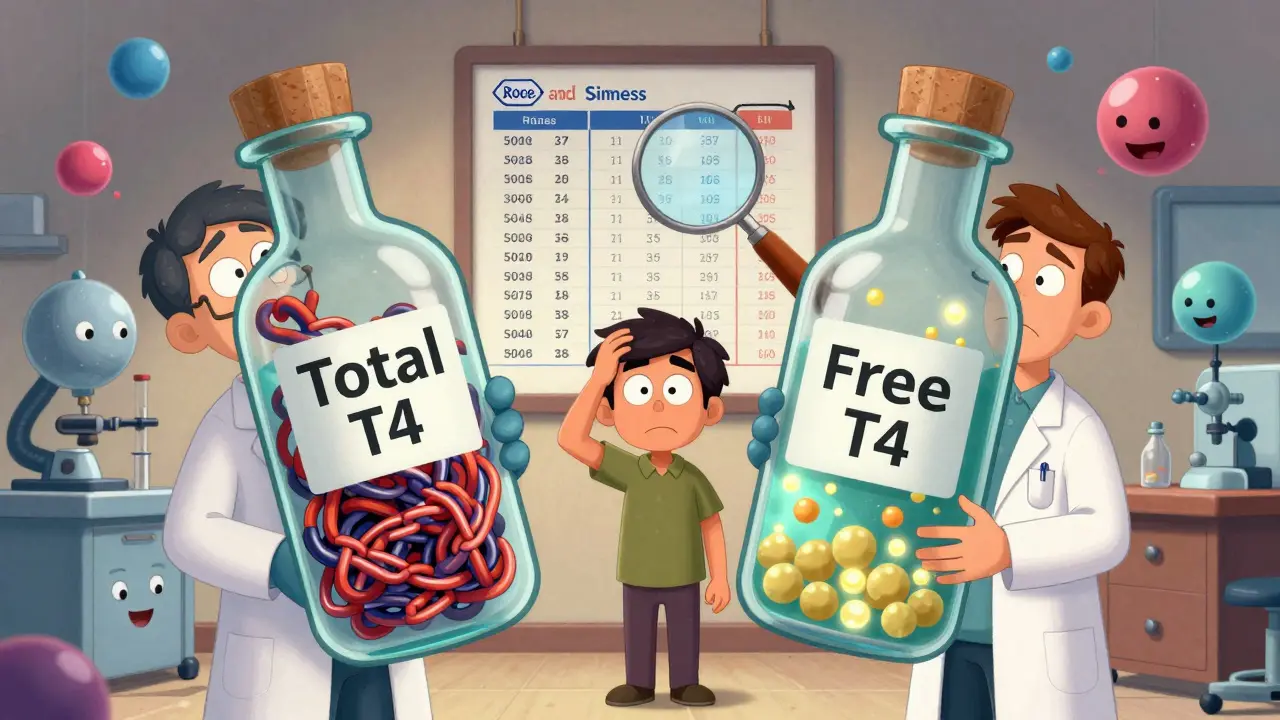
T4, or thyroxine, is the main hormone your thyroid produces. But only a tiny fraction of it is free and active - that’s called free T4 (FT4). The rest is bound to proteins and useless until it’s released. That’s why doctors don’t just measure total T4 anymore. They look at FT4, which tells you how much actual hormone is floating around in your blood, ready to be used by your cells.
Normal TSH ranges are usually 0.5 to 5.0 mIU/L. But that’s a broad average. For pregnant women, the ideal TSH in the first trimester is 0.1 to 2.5 mIU/L. For people over 80, it can safely go up to 6.5 mIU/L without meaning something’s wrong. The same goes for FT4: normal is 0.7 to 1.9 ng/dL, but lab methods vary. Roche’s test might show a value 12% higher than Siemens’ for the same blood sample. That’s why comparing results across labs can lead to unnecessary dose changes.
Why TSH Alone Isn’t Enough
TSH is the most sensitive test for thyroid problems - and that’s why it’s usually the first one ordered. But it’s not perfect. About 5 to 7% of thyroid disorders are missed if you only check TSH. Why? Because sometimes the problem isn’t the thyroid at all. It’s the pituitary. Or the brain. That’s central hypothyroidism. In these rare cases, TSH is low or normal, but T4 is also low. If you don’t check FT4, you’ll miss it entirely.
Another problem is illness. If you’re hospitalized with pneumonia, heart failure, or even severe flu, your body shuts down thyroid hormone production as a survival move. TSH drops, T4 drops - but it’s not a thyroid disease. It’s called non-thyroidal illness syndrome. In the ICU, 30 to 60% of patients show this pattern. Testing only TSH here leads to wrong diagnoses and unnecessary treatment.
Then there’s the ‘normal TSH but symptomatic’ group. A 2023 survey of over 12,000 patients found that 68% waited over a year for a correct diagnosis because their doctor relied only on TSH. On Reddit’s r/Hypothyroidism forum, hundreds of people share stories where their TSH was 3.5-4.5 mIU/L - technically ‘normal’ - but their FT4 was below 0.8 ng/dL. They had hypothyroid symptoms. Their TSH was in the ‘normal’ range, but not in their normal range.
How Doctors Use TSH and T4 Together
Here’s how it works in real practice. First, TSH is checked. If it’s outside 0.5-5.0 mIU/L, then FT4 is automatically tested. That’s the standard two-step protocol used in 95% of cases. If TSH is high and FT4 is low - you have overt hypothyroidism. Treatment starts with levothyroxine, usually at 1.6 mcg per kg of body weight. For a 70kg person, that’s about 112 mcg per day.
If TSH is high but FT4 is normal - that’s subclinical hypothyroidism. It doesn’t always need treatment. But if you’re pregnant, have heart disease, or have symptoms like fatigue and brain fog, most doctors will start medication anyway. For hyperthyroidism, TSH is low (under 0.1 mIU/L) and FT4 is high (over 1.8 ng/dL). That’s Graves’ disease or a toxic nodule. Treatment is different - antithyroid drugs, radioactive iodine, or surgery.
For pregnancy, the rules change. TSH should be kept under 2.5 mIU/L in the first trimester. If it’s not, levothyroxine doses often need to be increased by 25-30% right away. That’s because the baby depends on mom’s thyroid hormone until 12 weeks. Low T4 in early pregnancy is linked to lower IQ scores in children, according to multiple studies.
Dosing Thyroid Medication Right
Levothyroxine isn’t a one-size-fits-all pill. Kids need 10-15 mcg/kg/day. Elderly patients over 70 often start at 0.5-0.7 mcg/kg/day because their hearts can’t handle sudden increases. People with heart disease get even lower starting doses. Dosing is adjusted every 6 weeks based on TSH levels. You don’t rush it. Too much too fast can cause atrial fibrillation or bone loss.
Once stable, TSH is checked once a year. But if you change brands, gain or lose weight, start or stop estrogen, or become pregnant - you need a repeat test. Even switching from one generic to another can cause TSH to shift by 10-15% because of differences in fillers and absorption.
And here’s a big one: most people take levothyroxine on an empty stomach, 30-60 minutes before breakfast. Coffee, calcium, iron, and soy can block absorption. I’ve seen patients take their pill with coffee, then wonder why their TSH keeps creeping up.

What’s New in 2025
The biggest shift coming is the use of FT3 testing. For years, doctors ignored it. But a 2023 trial with 1,200 patients showed that 15-20% of those still feeling tired on levothyroxine had low FT3 - even when TSH and FT4 were normal. This doesn’t mean everyone needs FT3 tested. But if you’ve been on medication for months and still feel off, asking for FT3 might help.
Also, labs are finally getting better at standardizing results. In 2024, the FDA approved a new reference material, NIST SRM 2921. It’s cutting lab-to-lab variation from 15% down to 5%. That means your TSH result from one hospital will match your result from another. No more being told your dose is too high just because the lab changed.
And AI is starting to help. Mayo Clinic’s pilot program used machine learning to combine TSH, FT4, age, BMI, and symptoms. It reduced misdiagnoses by 22%. That’s not replacing doctors - it’s giving them better tools.
What to Ask Your Doctor
If you’re being tested for thyroid issues, ask these questions:
- Are you checking both TSH and free T4?
- What lab are you using, and what’s their normal range?
- If my TSH is normal but I still feel bad, should we check FT4 or FT3?
- Are you adjusting my dose based on symptoms, or just the number?
- Is this result comparable to my last test - same lab, same method?
Don’t let a single number define your health. TSH and T4 are tools. They’re powerful - but only when used right.
Can TSH be normal but still have hypothyroidism?
Yes. This is called subclinical hypothyroidism. TSH is mildly elevated (4.5-10 mIU/L), but free T4 is still in the normal range. Some people have symptoms like fatigue, weight gain, or dry skin. If you’re symptomatic, pregnant, or have heart disease, treatment with levothyroxine is often recommended even if T4 is normal.
Why is free T4 more important than total T4?
Total T4 includes both bound and free hormone. But only free T4 can enter your cells and work. Binding proteins can change due to pregnancy, birth control, liver disease, or kidney problems - making total T4 misleading. Free T4 measures only the active hormone, so it’s a much more accurate indicator of thyroid function.
Can medications affect TSH and T4 test results?
Yes. Estrogen (in birth control or HRT) raises binding proteins, increasing total T4 but not free T4. Lithium, amiodarone, and some antidepressants can lower thyroid hormone production. Iron, calcium, and antacids can block levothyroxine absorption if taken too close to the pill. Always tell your doctor what you’re taking before testing or adjusting doses.
How often should I get my TSH and T4 checked?
When starting or adjusting levothyroxine, check every 6 weeks until stable. Once stable, once a year is enough - unless you’re pregnant, gain/lose weight, start new meds, or feel symptoms returning. Pregnant women need testing every 4-6 weeks in the first half of pregnancy and at least once in the third trimester.
Is it true that some labs give different TSH results?
Yes. Different manufacturers (Roche, Siemens, Abbott) use different methods, and their reference ranges can vary by up to 15%. That’s why switching labs can make your TSH look higher or lower - even if your dose hasn’t changed. Always try to use the same lab for consistency. New FDA standards are reducing this variation, but it’s still a problem.





TSH is just the government's way of keeping us docile 🤡
They don't want you knowing your FT4 is low because then you'd start asking questions about Big Pharma and synthetic thyroid pills. I've been on natural desiccated thyroid for 3 years and my TSH? Always 'normal'. My energy? Skyrocketed. Coincidence? I think not.
If you're still relying on TSH alone you're practicing medicine in the 1980s
Anyone who doesn't test FT4 is either lazy or incompetent
Stop letting labs dictate your health
OMG YES. I was told my TSH was fine for 2 years while I was basically a zombie. Then I begged for FT4 and it was 0.6. My doctor acted like I was asking for alien tech. Now I'm on meds and I can finally remember my kids' names again 🙏
I appreciate the detailed breakdown, though I'd caution against overstating the role of lab variation. While differences exist, most reputable labs adhere to CLIA standards. Still, your point about symptom correlation over absolute numbers is spot on.
Let me tell you something I've seen in my 15 years as a nurse in Mumbai: women with TSH at 4.8 and FT4 at 0.75 are told 'it's just stress' or 'you're getting older'. But their hands shake, their hair falls out, they cry for no reason. One lady came in with a 3-month-old baby and couldn't hold her because she was so weak. We checked FT4. She was in subclinical hypothyroidism. Started on levothyroxine. Within 6 weeks, she was laughing again. TSH alone is like checking your car's dashboard light without looking under the hood. You'll never know why the engine's dying. And don't even get me started on how many patients switch labs and get confused because their 'numbers changed'. It's heartbreaking. We need to educate doctors everywhere, not just in the US. Thyroid health is universal. Your body doesn't care what lab printed your results. It just wants to function.
I used to be that guy who thought 'normal TSH = fine'. Then I started getting panic attacks at 3am and my knees felt like jelly. I dug into the research myself. Found out my FT4 was half of what it should be. Went to my endo, showed him the data. He rolled his eyes but ordered the test anyway. Turns out I was right. Now I take my pill at 5am with a glass of water and nothing else. Coffee? No. Calcium? No. Soy? Hell no. I'm not some lab rat. I'm a human being with a thyroid that deserves respect.
TSH is the whisper. FT4 is the scream.
Most doctors only listen to the whisper.
But the body? It screams until you finally hear it.
And then you wonder why you were so tired all along 😌
The thyroid is the soul's thermostat
When it fails you don't just feel cold
You feel forgotten by the universe
And the system doesn't care unless the numbers scream loud enough
I’m from Indonesia and I’ve seen this everywhere. My aunt in Jakarta was told her TSH was normal - but she couldn’t climb stairs without stopping. Her daughter brought her to a private clinic that tested FT4. It was 0.5. They started her on meds. Within a month, she was dancing at her granddaughter’s birthday party. This isn’t just Western medicine - it’s human medicine. Stop letting labs and guidelines silence your body’s truth.
I wish more people knew this. I had a doctor tell me my TSH was 'in range' so I should just 'get more sleep'. I was sleeping 10 hours a night and still exhausted. I went to a functional medicine doc, got FT4 tested - it was 0.65. Started on levothyroxine. Within 3 weeks I could think again. I swear to god, I forgot what it felt like to not have brain fog. Don't let anyone dismiss your symptoms because a number looks okay on paper.
Ah yes, the classic 'TSH is normal so you're fine' mantra. The medical equivalent of telling someone with a broken leg, 'Your X-ray looks fine, just walk it off.'
Meanwhile, your body is screaming in binary: 01000110 01010100 01000101 01001100 01001100 01010101 01001101 01001111 01000101 01010011 01010011 01000101 01001100 01000100 01001111 01001110 01000101 01010100 01001000 01000101 01010010 01000001 01010000 01011001
I used to be one of those people who thought I was just 'lazy'. Then I read your post. I went back to my old lab results. My FT4 was 0.68. My TSH was 4.2. I didn't even know what FT4 was. I didn't ask. I just accepted 'normal'. Now I'm on meds. I'm not cured. But I'm alive again. I'm not mad at my doctor. I'm mad at the system that taught him to ignore the signs.
This is the kind of info I wish I had 5 years ago. I had my TSH checked every year, but never FT4. I just thought I was getting older. Turns out I was just hypothyroid. Thanks for putting this out there.
Let’s be real - the medical establishment treats thyroid function like a spreadsheet. TSH is the KPI. FT4 is the footnote. Patients are the variables they optimize for cost, not for quality of life. AI is helping? Cool. But why did it take 2025 to realize that humans aren’t widgets? And why are we still using reference ranges based on populations that include people with undiagnosed hypothyroidism? That’s not normal. That’s systemic negligence dressed up as science.
I just found out my FT4 was low last month. I’d been ignoring my fatigue for years. I didn’t want to believe it was thyroid-related. I didn’t want to be 'that patient'. But reading this… I feel seen. Thank you.