


When you pick up a generic pill at the pharmacy, you expect it to work just like the brand-name version. But how do regulators know it actually does? The answer lies in a quiet but powerful standard called the 80-125% rule. It’s not about how much active drug is in the pill. It’s not about taste, color, or price. It’s about what happens inside your body after you swallow it.
What the 80-125% Rule Actually Means
The 80-125% rule is a statistical gatekeepers for generic drugs. If a generic version of a drug is to be approved, its performance in the body must fall within this range compared to the original brand-name drug. This isn’t a guess. It’s based on real data from clinical studies in healthy volunteers.
Here’s the key: the rule applies to two measurements - AUC (Area Under the Curve) and Cmax (maximum concentration). AUC tells you how much of the drug your body absorbs over time. Cmax tells you how fast it gets into your bloodstream. Both matter. A drug could be absorbed fully but too slowly - or too fast - and cause problems.
Regulators don’t look at the raw numbers. They take the logarithm of the ratio between the generic and brand-name drug. Why? Because drug levels in the blood don’t follow a normal bell curve - they follow a log-normal curve. After this transformation, the acceptable range becomes symmetric: from -0.2231 to +0.2231 on the log scale. That translates to 80% to 125% on the original scale.
But here’s the part most people get wrong: this isn’t saying the generic contains 80% to 125% of the active ingredient. That’s a myth. Most generics contain 95% to 105% of the labeled amount - same as brand drugs. The 80-125% rule measures how your body handles the drug, not how much is in the tablet.
Why a 90% Confidence Interval?
You might wonder why regulators use a 90% confidence interval instead of the more familiar 95%. It’s not arbitrary. A 90% CI means there’s a 5% chance the true value is below 80% and a 5% chance it’s above 125%. Together, that’s a 10% total risk of being outside the acceptable range. That’s considered acceptable for drug safety.
Traditional hypothesis testing - where you try to prove two things are the same - doesn’t work well here. With large enough studies, even tiny differences become statistically significant. That’s why regulators flipped the script. Instead of proving equivalence, they set a boundary. If the entire 90% confidence interval fits inside 80-125%, the drugs are considered bioequivalent. No need to prove they’re identical - just that any difference is too small to matter clinically.
How Bioequivalence Studies Are Done
These aren’t long, expensive trials with patients. They’re tightly controlled studies in healthy volunteers - usually 24 to 36 people. Each person takes both the brand and generic versions, in random order, with a washout period in between. Blood samples are taken every 15 to 30 minutes for 24 to 72 hours, depending on the drug.
The data is analyzed using specialized software. The geometric mean ratio of AUC and Cmax is calculated, then the 90% confidence interval is built. Both values must fall entirely within 80-125%. If one slips out, the study fails. No exceptions.
Some drugs are tricky. High-variability drugs - like warfarin or certain seizure meds - show wide differences between people even when taking the same brand. For these, regulators allow scaled bioequivalence. Instead of a fixed 80-125%, the range expands based on how much the drug varies in the body. For example, if a drug’s within-subject variability is over 30%, the acceptable range can stretch to 69.84-143.19% for Cmax. This keeps safe generics from being blocked just because the drug itself is unpredictable.
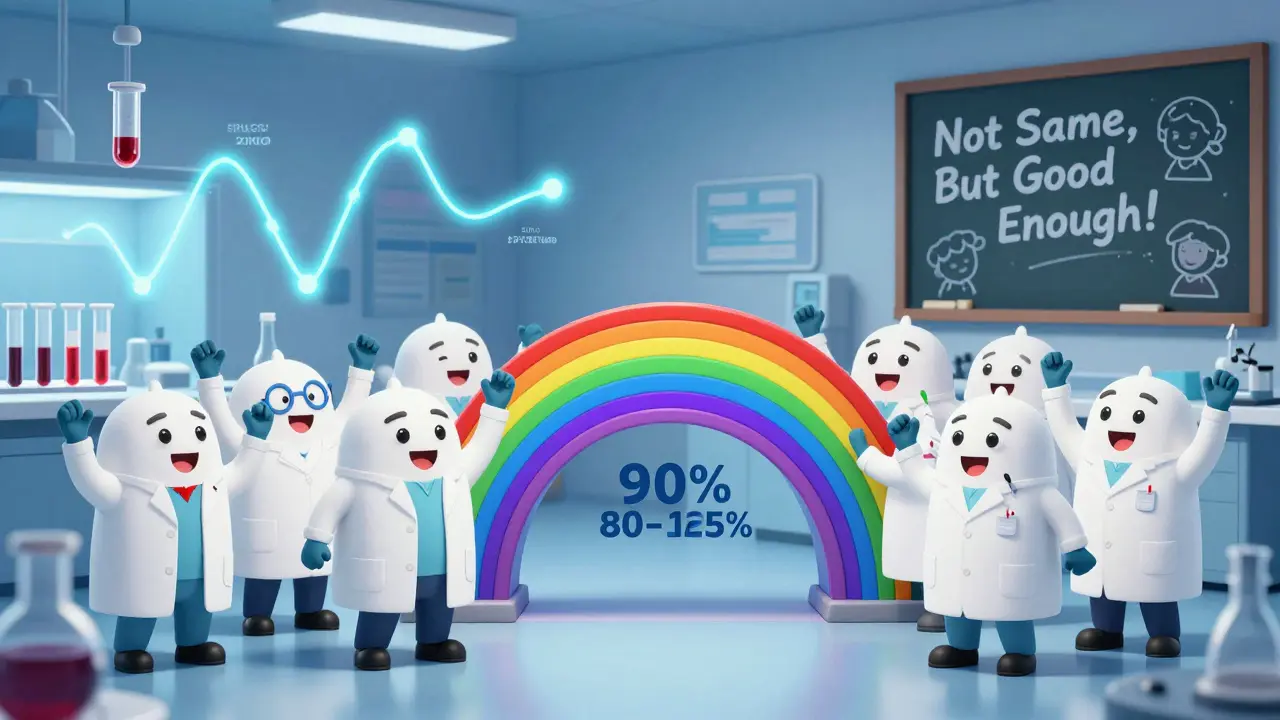
Global Standards - Same Rule, Everywhere
The 80-125% rule isn’t just an American thing. It’s used by the FDA, the European Medicines Agency, the World Health Organization, Health Canada, and China’s NMPA. This global alignment means a generic drug approved in the U.S. can often be submitted for approval in Europe with minimal changes. It saves time, money, and speeds up access to affordable medicines.
Before this standard, countries used different rules. Some required 75% of patients to have ratios within 75-133%. Others used additive ±20% differences. The shift to the multiplicative 80-125% rule in the 1980s was a major upgrade. It better reflected how drugs behave in the body and gave regulators a clearer, more reliable tool.
When the Rule Isn’t Enough
Not all drugs fit neatly into this box. Drugs with a narrow therapeutic index - where small changes in blood levels can cause serious harm - need tighter limits. For drugs like levothyroxine, warfarin, and digoxin, regulators now require a 90-111% range. That’s a 10% window instead of 45%. It’s a much stricter standard because the margin for error is razor-thin.
Complex formulations are another challenge. Inhalers, topical creams, and extended-release tablets don’t behave like simple pills. The 80-125% rule was built for oral immediate-release drugs. For these complex products, regulators are developing new methods - like in vitro testing, pharmacokinetic modeling, and advanced dissolution profiles. The FDA’s Complex Generics Initiative has invested $35 million annually since 2018 to tackle this.
Even with all these safeguards, some doctors remain cautious. A 2022 survey of neurologists found that 28% reported occasional problems with generic anti-seizure drugs. But only 4% believed those issues were caused by bioequivalence failure. Most problems came from differences in fillers, coatings, or how the pill breaks down - not the active ingredient’s absorption.
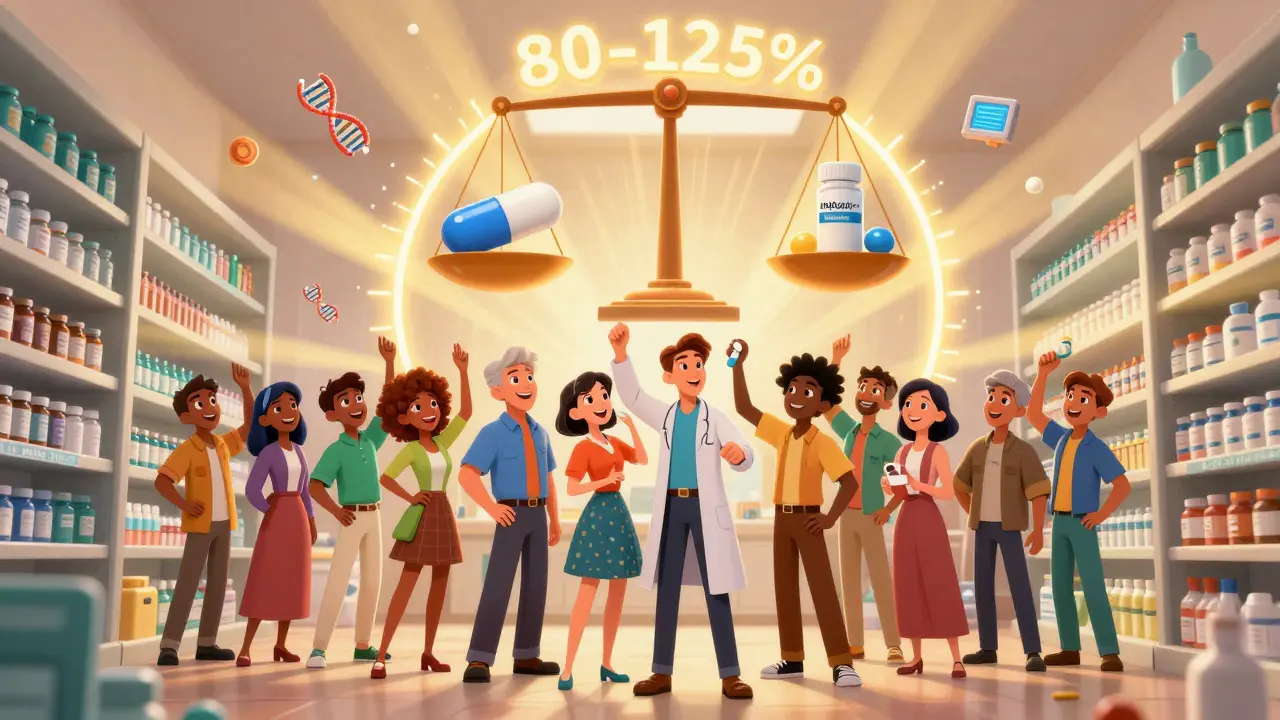
Myths vs. Reality
There’s a lot of misinformation out there. A 2022 survey found 63% of community pharmacists thought the 80-125% rule meant generics could contain 80% to 125% of the active ingredient. That’s wrong. The rule measures absorption, not composition.
Patients often worry too. Online forums are full of people afraid their generic seizure or thyroid meds are “only 80% as strong.” But real-world data tells a different story. The FDA analyzed over 2,000 generic drugs approved between 2003 and 2016. Only 0.34% needed label changes due to bioequivalence issues after hitting the market.
Post-marketing surveillance - tracking drugs after approval - shows the system works. If a generic caused consistent problems, regulators would see it. They’d pull it. They’d tighten the rules. But that rarely happens.
What’s Next for Bioequivalence?
The 80-125% rule has held up for nearly 40 years. But science is moving. Researchers are exploring whether genetic differences in drug metabolism - like variations in CYP450 enzymes - should be part of future bioequivalence standards. Could we one day tailor approval criteria based on a patient’s DNA? It’s possible.
The FDA’s 2023-2027 plan includes $15 million for “model-informed bioequivalence.” That means using computer simulations to predict how a drug behaves in different people, reducing the need for large human trials. For some drugs, this could mean skipping in vivo studies entirely - if dissolution tests and modeling prove the drug behaves the same.
For now, the 80-125% rule remains the gold standard. It’s not perfect. It’s not magic. But it’s been proven. Over 14,000 generic drugs in the U.S. alone have passed this test. They’ve been taken by hundreds of millions of people. And the vast majority work just as well as the brand.
Why This Matters
Without the 80-125% rule, generic drugs wouldn’t exist at scale. Every time you save $20 on a prescription because you chose a generic, this rule made it possible. It’s the reason a month’s supply of lisinopril costs $4 instead of $120. It’s why millions of people with diabetes, high blood pressure, or depression can afford their meds.
It’s not about cutting corners. It’s about proving equivalence without repeating expensive clinical trials. It’s about using smart science to make healthcare more affordable - without sacrificing safety.
The rule isn’t about guesswork. It’s about data. It’s about statistics. And most of all, it’s about trust - that the system works, even when you’re not looking.
Is the 80-125% rule about how much active ingredient is in a generic drug?
No. The 80-125% rule does not refer to the amount of active drug in the tablet. Generics must contain 95-105% of the labeled amount, just like brand drugs. The rule measures how much of the drug your body absorbs and how fast - using pharmacokinetic data from clinical studies. It’s about bioavailability, not composition.
Why is a 90% confidence interval used instead of a 95% one?
A 90% confidence interval allows for a 5% risk of being below 80% and a 5% risk of being above 125%, totaling a 10% overall risk. This is considered acceptable for bioequivalence because the goal isn’t to prove exact equivalence - it’s to ensure any difference is too small to affect patient outcomes. A 95% CI would be too strict and could block safe generics that are clinically equivalent.
Do all generic drugs need to pass the 80-125% rule?
Yes - for most oral immediate-release drugs. But exceptions exist. Drugs with a narrow therapeutic index (like warfarin or levothyroxine) must meet tighter limits (90-111%). Highly variable drugs may use scaled bioequivalence, which adjusts the range based on how much the drug varies between people. Complex products like inhalers or extended-release tablets require different testing methods altogether.
Can a generic drug be approved even if its bioequivalence study fails?
No. If the 90% confidence interval for AUC or Cmax falls outside the 80-125% range, the application is rejected. Regulators don’t approve drugs that don’t meet the standard. However, companies can redesign the formulation, run a new study, or request a waiver if the drug qualifies for an alternative approach - like dissolution testing for simple formulations.
Are there any documented cases where generics failed because of the 80-125% rule?
Yes - but they’re rare. In the U.S., dozens of generic applications are rejected each year because they don’t meet bioequivalence criteria. These are usually due to formulation issues - like wrong excipients, poor dissolution, or inconsistent release profiles. The rule doesn’t fail; the product does. When a generic fails, it’s because the manufacturer didn’t match the reference drug’s performance in the body - not because the rule is flawed.






So let me get this straight - a generic pill can be 20% weaker or 25% stronger and it’s considered ‘the same’? I’m just saying, if my blood pressure meds are acting up, I’m not gonna trust a math equation over my own body.
It’s sad how people don’t understand that this rule is just corporate greed dressed up as science. The pharmaceutical companies don’t care if you live or die - they just want to make sure their generics pass the numbers so they can keep charging $4 instead of $120. The real question is: why are we letting them decide what ‘safe’ means?
Look, I get why people are nervous - I used to be too. But this isn’t some shady loophole. This is rigorous, peer-reviewed, globally accepted science. The fact that you can buy a month’s supply of lisinopril for $4 and not have a heart attack? That’s this rule working. Stop fearing the math and start trusting the data.
As someone who grew up in India, I’ve seen generics used everywhere - and they work. This rule? It’s the reason millions can afford meds. No hype. Just science.
Okay but what if the FDA’s database is hacked? What if the ‘bioequivalence’ studies are all faked by Big Pharma? I heard a guy on Reddit whose cousin’s neighbor’s dog got sick after taking a generic - and now he’s on a feeding tube. Coincidence? I think not. Someone’s lying. And it ain’t the brand-name guys.
Don’t overthink it. If your doctor says it’s fine, and the FDA says it’s fine, and your bloodwork looks good - trust the process. Your body doesn’t care if it’s blue or white. It cares if it works.
The elegance of the 80-125% rule lies in its practicality. Rather than demanding perfect equivalence - an impossible standard - it focuses on clinically insignificant variation. This is not just regulatory policy; it’s a triumph of applied pharmacokinetics.
I used to be scared of generics too, especially after my anxiety med switched. But after six months of no issues, I realized - my body didn’t care. The pill just worked. Maybe the fear’s more about branding than biology.
Let me be clear: if your generic thyroid med doesn’t feel exactly the same as the brand, you’re not imagining it. This rule is a joke. They’re cutting corners, and your health is the cost. Wake up, people - this isn’t science, it’s capitalism.
Man, this whole thing is wild. It’s like the body’s a magic box and the drug’s a key. The 80-125% rule doesn’t care what the key looks like - it just checks if it turns the lock the same way. And somehow, after decades of billions of doses, it’s still holding up. That’s not luck. That’s smart engineering. Respect.