

Generic Drug Cost Calculator
Compare Brand vs Generic Costs
Your Savings
Based on FDA-approved generic drug equivalents
Important: This drug may have a narrow therapeutic index. Consult your doctor before switching.
Note: Savings typically range from 80-85% for most generic drugs. Learn more about FDA-approved generics
When you pick up a prescription, you might see two very different-looking pills on the counter. One has a familiar logo, bright colors, and a name you’ve seen on TV. The other is a small, plain tablet with no brand name-just a chemical one you can’t pronounce. You might wonder: Is this cheaper pill just as good? Does the label change mean something’s different? The answer is simpler than most people think: generic drugs are not inferior. They’re the same medicine, just sold under a different name and price tag.
What Makes a Generic Drug a Generic Drug?
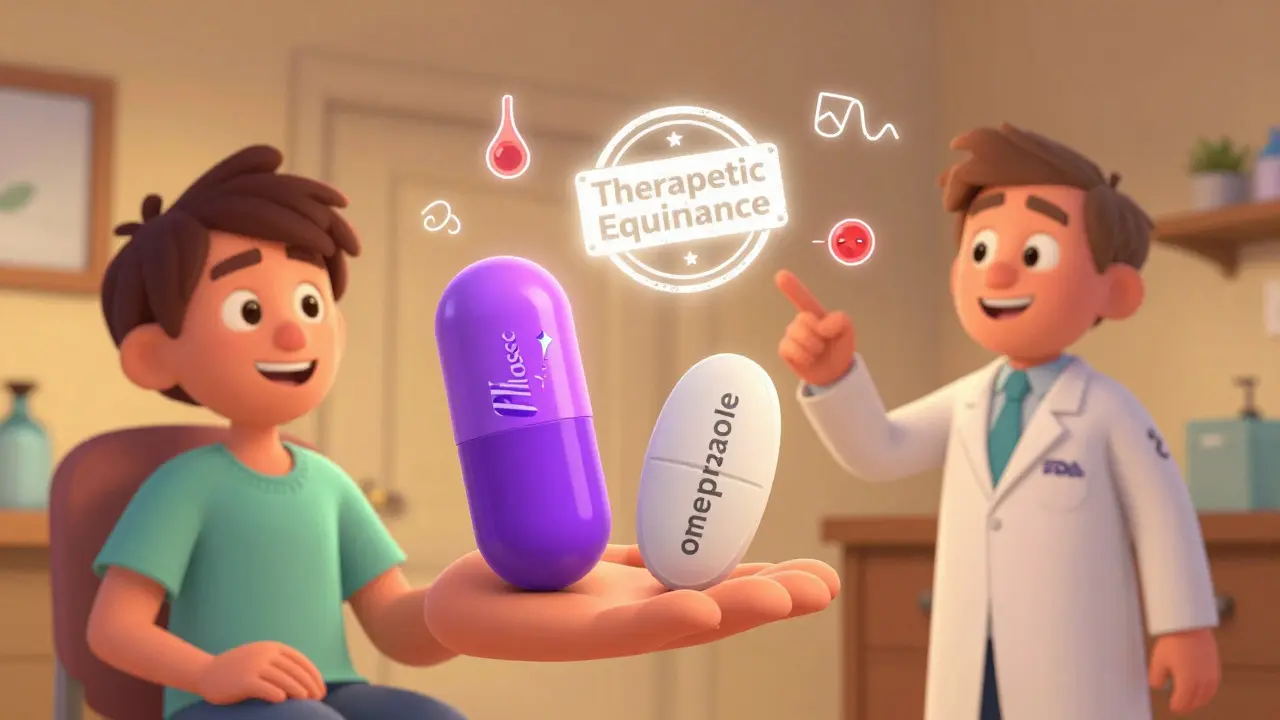
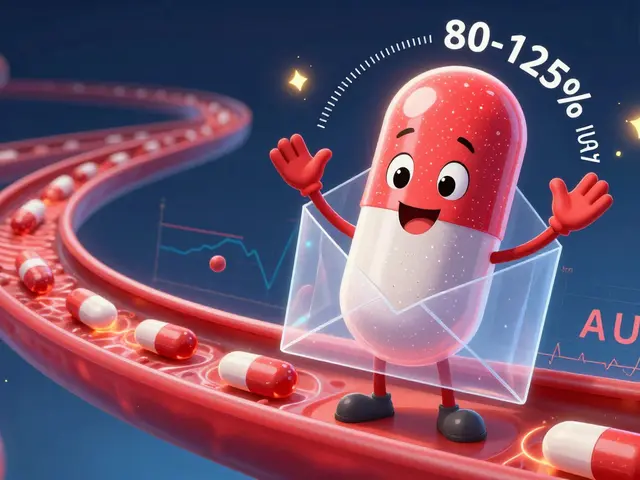
The FDA doesn’t approve a generic drug unless it matches the brand-name version in every way that matters-except how it looks or how much it costs. That means the same active ingredient, the same strength, the same way it’s taken (pill, injection, etc.), and the same effect on your body. The FDA calls this therapeutic equivalence. To prove it, manufacturers must run tests showing their drug gets absorbed into your bloodstream at the same rate and to the same extent as the brand-name version. The standard? The amount of drug in your blood must fall between 80% and 125% of the brand’s levels. That’s not a wide gap-it’s tighter than the natural variation you’d see between two different batches of the same brand-name drug.
Here’s the catch: the inactive ingredients can be different. That’s the fillers, dyes, and binders that hold the pill together or give it color. These don’t affect how the medicine works, but they’re why a generic version of omeprazole might be white and oval, while Prilosec is purple and capsule-shaped. Trademark law forces this difference so you can’t confuse one brand for another. But if you’re switching from brand to generic, and suddenly your pill looks like a different color or shape, it’s not because the medicine changed. It’s because the label and packaging had to change.
Label Differences: What’s on the Box Actually Matters
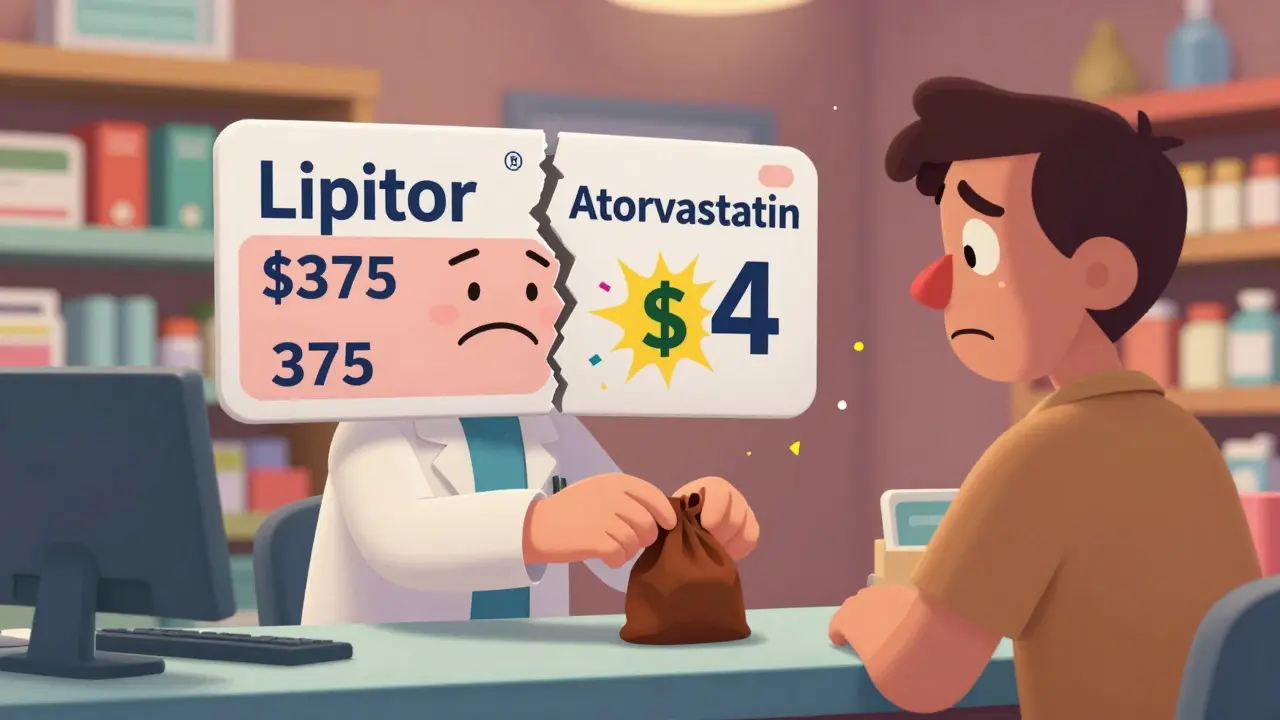
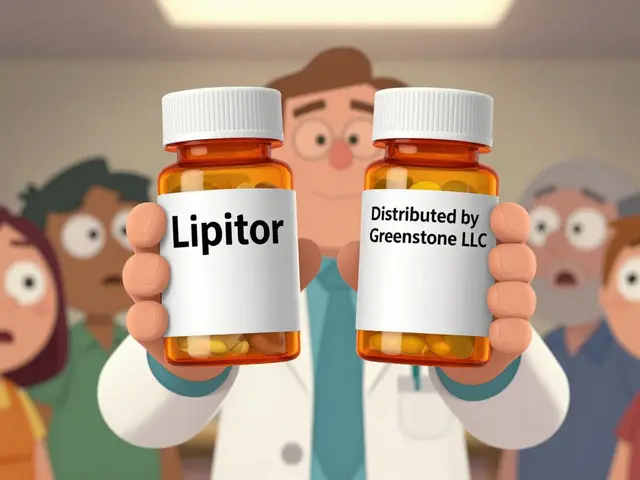
The label on a brand-name drug says something like "Lipitor 20 mg". The generic? It says "Atorvastatin 20 mg". That’s not a trick. It’s the law. The FDA requires generic labels to mirror the brand’s in every clinical detail-dosage, warnings, side effects, contraindications. The only difference is the name. You won’t find extra warnings on the generic, or missing ones. The instructions for taking it, what to avoid, and what side effects to watch for? Identical.
Even the patient information leaflet inside the box must contain the same data. The FDA’s 2021 guidance on labeling makes this clear: generic drugs must follow the same format and content rules as brand-name drugs. This isn’t a loophole-it’s a strict requirement. If a brand-name drug has a black box warning for liver damage, the generic has to carry the exact same warning. No exceptions.
Why Are Generics So Much Cheaper?
Brand-name drugs cost a fortune because the company had to pay for years of research, clinical trials, marketing, and patent protection. That’s why Lipitor once cost $375 a month. Once the patent expires, other companies can make the same drug without repeating all that expensive work. They don’t need to prove the drug works again-they just need to prove their version behaves the same way in your body. That cuts costs dramatically.
As of 2023, generics cost 80% to 85% less than their brand-name equivalents. At Walmart, a 30-day supply of generic atorvastatin (the active ingredient in Lipitor) costs $4.00. The same dose of Lipitor? Still over $300. That’s not a typo. That’s the power of competition after patent expiration. According to the Congressional Budget Office, generic drugs saved the U.S. healthcare system $313 billion in 2023 alone. From 2007 to 2016, that number hit $1.67 trillion.
And it’s not just big drugs. The FDA reports that 90% of generic prescriptions cost less than $10 a month. For people managing chronic conditions like high blood pressure, diabetes, or depression, that difference means they can actually afford to take their medicine every day. A Kaiser Permanente survey found 78% of patients said generic cost savings helped them stick to their treatment plan.
Are There Times When Generics Aren’t the Best Choice?
For most drugs-over 90% of them-generics are just as safe and effective. But there are exceptions. These are drugs with a narrow therapeutic index (NTI). That means the difference between a dose that works and one that’s dangerous is very small. Even tiny changes in how much of the drug gets into your blood can cause problems.
The FDA specifically flags a few: warfarin (blood thinner), levothyroxine (thyroid hormone), and phenytoin (seizure medicine). For these, doctors often recommend sticking with one manufacturer-brand or generic-because switching between different generic versions might cause slight fluctuations in blood levels. It’s not because generics are unsafe. It’s because even small changes in these drugs can matter. That’s why pharmacists monitor TSH levels closely when switching patients on levothyroxine. It’s precaution, not proof of failure.
Another gray area? Complex drugs. Things like inhalers, injectables, or topical creams where the delivery system matters as much as the drug itself. EpiPen (epinephrine auto-injector) has limited generic options because the device must work perfectly every time. The FDA is working on this-79 complex generics were approved in 2022, up 22% from the year before. But for now, some patients still need the brand.
What Do Real Patients Say?
On Drugs.com, generic atorvastatin has a 6.6 out of 10 rating from over 1,800 reviews. Lipitor? 6.3 from under 900. That’s not a big gap. Most users say they saved money and noticed no difference in how they felt. On Reddit’s r/pharmacy thread, a pharmacist with years of experience wrote: "I’ve switched thousands of patients from brand to generic with zero therapeutic issues, except for a few cases with levothyroxine where we monitored TSH levels closely."
Some complaints? Appearance. Twelve percent of patients in a University of Michigan study said they hesitated or worried when their pill looked different. One woman told her pharmacist, "I thought I got the wrong medicine because it wasn’t blue anymore." That’s not about effectiveness-it’s about familiarity. Once people learn the label says the same active ingredient, those fears fade.
How to Know If Your Generic Is Approved
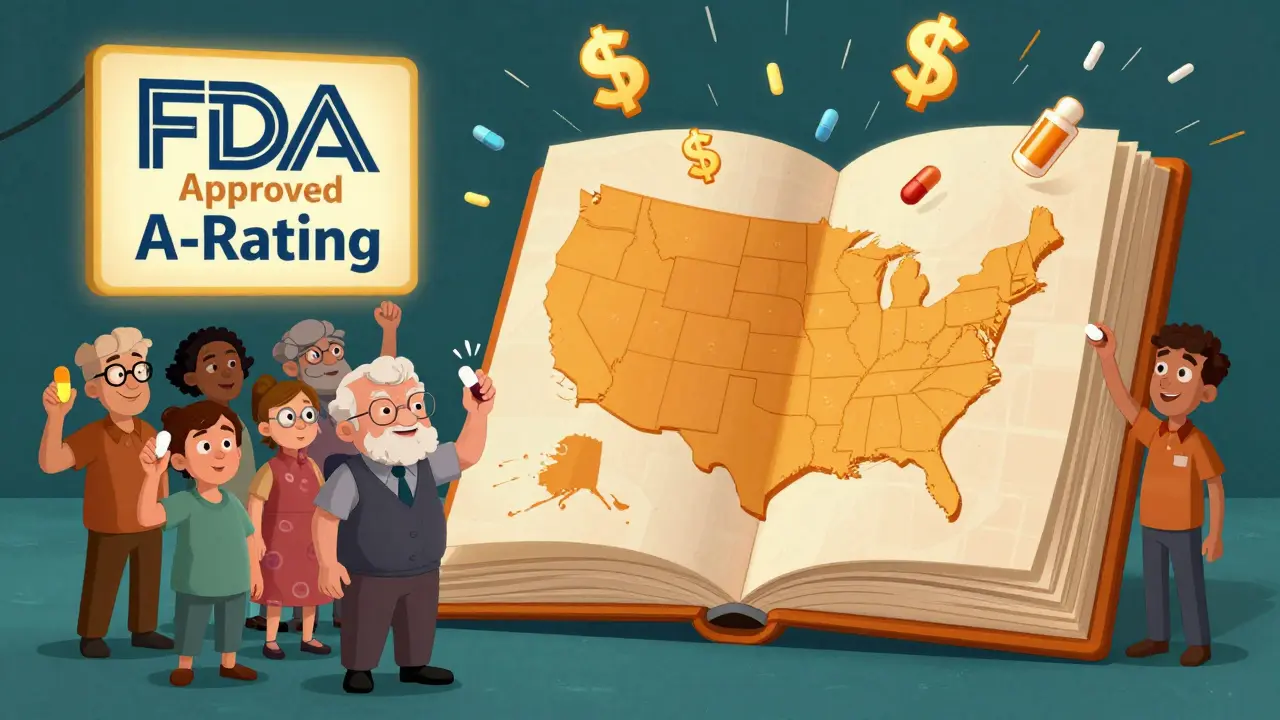
The FDA’s Orange Book is the official list of all approved generic drugs and their therapeutic equivalence ratings. Look for an "A" rating. That means the drug is therapeutically equivalent to the brand. If it’s an "B" rating? That’s a red flag-it means the FDA hasn’t confirmed equivalence. But those are rare. Most generics you’ll see on the shelf have an "A" rating.
Also, check if your pharmacist can substitute. In 49 states, they can switch you to a generic unless your doctor writes "Dispense as Written" on the prescription. That’s not a restriction-it’s a system designed to save you money. Most doctors (94%, according to the American Medical Association) are comfortable prescribing generics. They know the data.
What’s Changing in 2026?
The FDA launched its Generic Drug Program Dashboard in 2023 so you can track application status in real time. In September 2023, the first generic version of semaglutide (the active ingredient in Ozempic) got approved. That’s huge-it means a drug that cost over $1,000 a month could soon be under $50. The Bipartisan Prescription Drug Pricing Reform Act of 2023 is pushing even harder for generic competition on high-cost drugs. And by 2026, the FDA aims to cut review times for complex generics by 20%.
With over $268 billion in brand-name drug sales set to face generic competition between 2023 and 2028, the future is clear: more generics, faster approvals, and lower prices. The science, the data, and the real-world outcomes all point to the same thing: generics are not second-rate. They’re the same medicine, priced right.
Are generic drugs as effective as brand-name drugs?
Yes. The FDA requires generic drugs to have the same active ingredient, strength, dosage form, and route of administration as the brand-name version. They must also prove they work the same way in the body through bioequivalence testing. Studies involving millions of patients, including a 2021 JAMA Internal Medicine review of cardiovascular drugs, found no meaningful difference in effectiveness between generics and brand-name drugs.
Why do generic drugs look different from brand-name drugs?
U.S. trademark laws require generic drugs to look different in color, shape, size, or markings to avoid confusion with the brand-name product. These differences are only cosmetic and have no effect on how the drug works. The active ingredient and its performance in your body remain identical.
Can I switch from a brand-name drug to a generic safely?
For most drugs, yes. The FDA approves generic substitution unless your doctor specifically writes "Dispense as Written." For drugs with a narrow therapeutic index-like warfarin, levothyroxine, or phenytoin-your doctor may recommend sticking with one version to avoid small fluctuations in blood levels. Even then, switching is safe with proper monitoring.
Do generic drugs have the same side effects as brand-name drugs?
Yes. The FDA requires generic drug labels to include the same warnings, side effects, and contraindications as the brand-name version. While inactive ingredients (like dyes or fillers) may differ, they rarely cause side effects. If you experience a new reaction after switching, it’s worth discussing with your doctor-but it’s not because the active drug changed.
Why are some generic drugs more expensive than others?
Price differences between generic versions happen because of market competition. The first generic manufacturer to enter the market after a patent expires often charges a bit more. As more companies start making the drug, prices drop. You might pay $5 for one generic version of metformin and $2 for another. Both are equally effective-just different manufacturers. Always compare prices at your pharmacy.
Is it true that generic drugs are made in less safe facilities?
No. The FDA inspects all manufacturing facilities-whether for brand-name or generic drugs-using the same strict standards. Over 50% of generic drug production happens in the U.S., and the rest are held to the same quality controls. The FDA has found no higher rate of contamination or safety issues in generic manufacturing plants compared to brand-name ones.
What Should You Do Next?
If you’re taking a brand-name drug and paying a lot for it, ask your doctor or pharmacist: "Is there a generic available?" If yes, and your condition isn’t one of the rare NTI cases, switching is a smart move. Check the FDA’s Orange Book to confirm the generic has an "A" rating. Compare prices at different pharmacies-sometimes the same generic costs $2 at one store and $12 at another. And if you’re nervous about the new pill’s appearance? Look up the active ingredient online. You’ll find it’s the same medicine, just cheaper.




OMG YES THIS! 🙌 I switched my blood pressure med from brand to generic and saved $200/month. No difference in how I feel, just way less stress about the bill. Pharma companies are laughing all the way to the bank while we’re stuck paying for their marketing budgets. 💸
Wait… so you’re telling me… the FDA… is just… a puppet? 🤔 The same ‘active ingredients’… but different fillers… and you’re just supposed to trust that? What if the fillers are secretly altering the bioavailability? What if the ‘80-125%’ range is a loophole designed by Big Pharma to keep us docile? And who even approved these labs? Are they even inspected? Or is this all a lie to sell us cheaper pills while they profit from the original patents? I’ve read about ‘inactive ingredients’ causing immune reactions… what if this is a slow poisoning? 🕵️♂️
As someone from India where generics are the backbone of healthcare, I can say with confidence: this isn’t just theory-it’s life-saving reality. My mother takes levothyroxine, and we’ve switched between generics for years. Yes, we monitor TSH-but not because generics are risky, but because thyroid balance is delicate. The real villain isn’t the generic pill-it’s the system that lets brand names charge $500 for a drug that costs $2 to make. Kudos to the FDA for enforcing equivalence. 🙏
I’ve been thinking about this for a while-how we attach meaning to shape, color, and brand names. It’s not about chemistry, it’s about psychology. We’ve been conditioned to believe that if it doesn’t look like the ad on TV, it can’t be the same. But the science doesn’t care about aesthetics. The body doesn’t care if the pill is purple or white. It just cares if the molecule gets absorbed. And it does. Every. Single. Time. The fear isn’t rational-it’s manufactured. We’re afraid of the unknown, not the medicine. And yet, we’ll pay 20x more to keep the illusion alive. Isn’t that wild?
It is with profound gratitude and deep respect for public health infrastructure that I acknowledge the monumental contribution of the FDA in ensuring the safety, efficacy, and accessibility of generic pharmaceuticals. The data is unequivocal. The outcomes are measurable. The savings are staggering. To those who still harbor doubt-I urge you to consult the Orange Book, speak with your pharmacist, and consider the dignity of being able to afford your medication. This is not just policy-it is compassion in molecular form.
generic drugs are fine i guess but why do they always look so ugly like a lab experiment gone wrong i mean come on why cant they make em look nice like the brand ones at least make em shiny or something also why do i have to google the ingredient every time i get a new bottle its exhausting
Switched my antidepressant to generic. Same effect. Saved $180/month. Pharmacist confirmed the A-rating. No drama. Just good science.
My dad’s on warfarin. We stuck with the same brand for years… then switched to a generic with his doctor’s okay. TSH stayed stable. No issues. He said, ‘If it works, why pay more?’ Simple logic. Also-Walmart’s $4 generics? That’s not a deal. That’s justice.
lol i just take whatever they give me at the pharmacy
I used to freak out when my pills changed shape or color-thought I was getting ripped off or something was wrong. Then I started checking the active ingredient on Drugs.com. Turns out, I’ve been on the same medicine for years, just with different packaging. Now I laugh at how much I stressed over it. Honestly? The real change wasn’t the pill. It was me learning to trust the science instead of the marketing. And hey-if it saves me $100 a month? I’ll take the white oval any day. 🤷♀️